Arts
Hip-Hop: Summary and Study Notes
From a Bronx block party to a global culture
Study this topic in OriaThe essentials
In August 1973, in the Bronx, a young DJ from Jamaica stretched out the rhythmic passages of funk records to get his neighbors dancing. Out of that came hip-hop, with its four elements: DJing, rap, dance and graffiti. You'll follow its story, from the first records of 1979 to the golden age and the East Coast–West Coast rivalry, from its arrival in France with MC Solaar, IAM and NTM to its conquest of the world, until it became the most-listened-to music genre in the United States.
Key dates and facts
- 1973
- Kool Herc's party at 1520 Sedgwick Avenue, on August 11
- 1979
- The Sugarhill Gang's Rapper's Delight
- 1982
- The Message by Grandmaster Flash and the Furious Five
- 1986
- First platinum rap album, Raising Hell
- 1987
- Landmark albums by Public Enemy and Eric B. & Rakim
- 1990
- First diamond-certified hip-hop album
- 1996
- Death of Tupac Shakur, on September 7
- 1997
- Death of The Notorious B.I.G., on March 9
- 1982
- The New York City Rap Tour reaches France, in November
- 1984
- Sidney's H.I.P. H.O.P. airs on TF1
🏙️ The Bronx, 1973: a block party
In the early 1970s, the South Bronx, in New York, was a neighborhood in crisis. The construction of a major highway, the Cross Bronx Expressway, had cut it in two and pushed the better-off white families to leave. Those who stayed were African American, Latino and Caribbean residents on modest incomes. Arson ravaged apartment buildings, and violent street gangs controlled part of the area. This is the setting in which hip-hop was born, a reflection of the social realities of its creators.
🇯🇲 The Jamaican legacy
Some of its roots lie in Jamaica. From the 1950s on, DJs there set up huge open-air sound systems to get crowds dancing, and talked rhythmically into the microphone over the records: this was toasting. In the studio, producers stripped the vocals from tracks to create new versions: dub, considered hip-hop's most important artistic precedent. In the United States, the African American oral tradition, radio hosts who spoke in rhyme, and politically engaged poets such as The Last Poets and Gil Scott-Heron also paved the way.
🎂 August 11, 1973
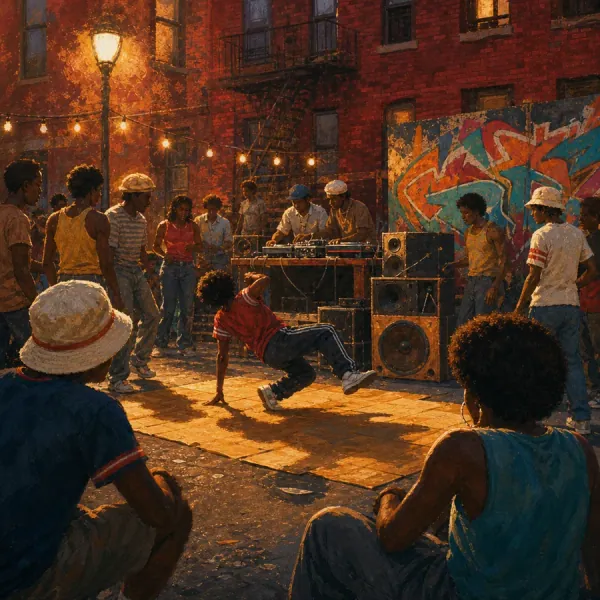
DJ Kool Herc, whose real name is Clive Campbell, was born in Kingston, Jamaica, in 1955. He arrived in the Bronx with his family at age 12, in November 1967, and settled at 1520 Sedgwick Avenue. On August 11, 1973, his sister Cindy Campbell threw a party in the building's recreation room to raise money for back-to-school shopping. Herc played funk and soul records. He had noticed that dancers went wild during the break, the short passage where the melody stops and only the drums and percussion remain. His idea: stretch out that moment by alternating between two copies of the same record.
An instrumental passage in a song, often funk, where only the rhythm remains. Repeated in a loop, it becomes a breakbeat, the rhythmic foundation of hip-hop.
This date has been widely celebrated as the “birth of hip-hop.” Herc's success soon outgrew the building's small rec room, and he joined the block parties, street parties where DJs plugged their equipment into the streetlights. For many young people, these parties offered an alternative to the streets and the gangs.
“Hip hop saved a lot of lives.”
Tony Tone, member of the Cold Crush Brothers
🎤 The four elements of hip-hop
Hip-hop isn't just music: it's a culture that brings together several forms of expression, born separately and united in the Bronx of the 1970s. A typical party featured a DJ, an MC and dancers, while graffiti artists decorated the stage and drew the flyers.
🎚️ The DJ
Herc's method was still rough. Other DJs, such as Grandmaster Flash, Grand Wizzard Theodore and Jazzy Jay, perfected it. Using headphones, they cued up the exact start of the break on one record while the other was playing, then switched from one to the other: the break could thus go on forever. Spinning a record backward by hand produced a distorted sound; the effect became a technique in its own right, scratching, credited to Grand Wizzard Theodore.
🗣️ The MC
At first, the DJ talked on the mic himself to hype up the crowd. When his job got more complicated, an MC, short for “master of ceremonies,” took over. Coke La Rock, at Herc's side, is often considered the very first. MCs relied on call-and-response chants, then invented more and more elaborate lyrics, delivered rhythmically over the breaks: this was rap. Like the dancers, they competed in creativity. Women were there from the start, like MC Sha-Rock of the Funky 4 + 1.
Each rapper's own way of laying their voice over the beat: speed, accents, breathing, and play on rhymes, assonance and alliteration.
🤸 Breaking
Dancers used the breaks to show off their best moves: they were called b-boys and b-girls, the “b” standing for break. Their dance, breaking, which the media would call breakdancing, strings together floor moves, spins and sudden freezes. Originality is the rule: everyone invents their own moves. According to one witness of the time, young people battled each other by dancing instead of fighting. The Rock Steady Crew, which included members of Puerto Rican descent, became one of the most famous crews.
🎨 Graffiti
With spray cans, graffiti writers signed walls and subway cars. A tag is a simple signature drawn in a single stroke; graffiti gives the letters volume, in two or three dimensions, then adds ornaments, characters and backgrounds. For those who make it, it's a way of reclaiming the city.
A fifth discipline is often added: beatboxing, which imitates rhythms with the mouth, throat and nose. The DJ Afrika Bambaataa founded the Zulu Nation, which brought together dancers, graffiti artists and rappers and championed values summed up in the motto “peace, love, unity and having fun.”
In 1977, a gigantic blackout plunged New York into darkness and led to looting. DJ equipment was among the most stolen items.
“The next day there were a thousand new D.J.'s.”
DJ Kool Herc, on the 1977 blackout
The rest of the course
This page publishes the first 2 parts. The full course has 8: here is what the next ones cover.
- 💿 From the first records to the new school
The move from parties to records: the first rap recordings in 1979, Rapper's Delight, The Message, electro and the TR-808 drum machine, then the new school of Run-DMC and the first big commercial hits.
- 👑 The golden age and the East–West rivalry
Hip-hop's golden age (mid-1980s to mid-1990s): sampling, Public Enemy, West Coast gangsta rap, the commercial explosion of 1990, then the East Coast–West Coast rivalry and the deaths of Tupac Shakur and The Notorious B.I.G.
- 🎧 Three records explained
Three landmark works explained: The Message (1982), IAM's L'École du micro d'argent (1997) and Kendrick Lamar's DAMN., the first album to win the Pulitzer Prize for Music (2018).
- 🇫🇷 French rap: Sidney, MC Solaar, IAM, NTM
The arrival of hip-hop in France in 1982, Sidney's TV show H.I.P. H.O.P. in 1984, Dee Nasty's free jams, then the explosion of the 1990s with MC Solaar, IAM and Suprême NTM.
- 🌍 A global culture
The spread of hip-hop around the world since the 1980s: dance in Japan and South Africa, scenes in Europe, Latin America and Africa, a peace declaration at the UN and breaking's debut at the Paris 2024 Olympics.
- 📱 Today: the number one music genre
Hip-hop since the late 1990s: the bling era, the rise of the South and trap, the streaming era, the most-consumed genre in the United States since 2017 and the dominant genre in France since the mid-2010s.
Study “Hip-Hop” with flashcards and quizzes
In Oria, you read the full course, then practice on it: flashcards, multiple-choice quizzes, open questions or the Feynman method. Cards and questions then come back in your daily review, paced by spaced repetition.
Study this topic in OriaSources
These notes draw on the sources below. If a point seems doubtful, refer back to them.