Arts
Impressionism: Summary and Study Notes
The painters who put light on canvas
Study this topic in OriaThe essentials
In the Paris of the 1860s, a handful of young painters rejected the rules of official art and went out to paint in the open air. In 1874, their exhibition at Nadar's studio earned them a mocking nickname, "Impressionists," which they would eventually claim as their own. You'll discover their technique, their major figures, from Monet to Berthe Morisot, their eight exhibitions, and how this long-despised movement ended up at the Musée d'Orsay.
Key dates and facts
- April 15, 1874
- Opening, at the same time as the Salon
- 35 Boulevard des Capucines
- Former studio of the photographer Nadar
- 30
- Artists exhibited
- c. 3,500
- Visitors
- 1900
- Gare d'Orsay, built by Victor Laloux
- Dec. 9, 1986
- Opening of the Musée d'Orsay
- 1848 – 1914
- Period covered by the collections
- 1,100+
- Impressionist and Post-Impressionist canvases
🏛️ Paris, the Salon and official art
Before it was a movement, Impressionism was a revolt against a system. In the mid-19th century, French painting was dominated by the Académie des Beaux-Arts. It prized grand subjects: history, religion, mythology, portraiture. Landscape and still life were considered lesser genres. For a young painter, the obligatory step was the Salon in Paris, a major exhibition whose works were chosen by a jury. Being accepted at the Salon meant becoming known, finding buyers and commissions. Being rejected meant staying invisible.
As early as the 1850s, the painter Gustave Courbet was already shaking up these rules by depicting the reality of his own time, without idealizing it. But the real shock came in 1863.
🚪 1863: the Salon des Refusés
That year, the Salon jury was especially harsh: it rejected more than 3,000 works out of roughly 5,000 submitted. The protests were so numerous that Emperor Napoleon III, after visiting the Palais de l'Industrie in April, decided that the rejected works could be shown to the public, who would judge for themselves.
"Numerous complaints have reached the Emperor concerning the works of art that were rejected by the jury…"
Official announcement, Le Moniteur universel (April 24, 1863) (translated)
The Salon des Refusés opened on May 15, 1863, in twelve rooms of the Palais de l'Industrie, on the Champs-Élysées. About 1,200 works by 871 artists were shown there, including canvases by Camille Pissarro, James Whistler, Henri Fantin-Latour and Johan Jongkind. It drew more visitors than the official Salon, but many came to mock it. The critic Maxime Du Camp called it "sad and grotesque."
🧺 Manet, the painter of scandal
The canvas that caused the most uproar was by Édouard Manet: Le Déjeuner sur l'herbe (Luncheon on the Grass), first titled Le Bain (The Bath). It shows a nude woman sitting in the grass beside two men dressed in the fashion of the day. A nude in painting was accepted if it depicted a goddess or a nymph; here it was a woman of the present, in a setting of the present. Critics found the painting "indecent" and read it as an allusion to prostitution. It became one of the most violent controversies in 19th-century art.
Two years later, Manet struck again. Olympia, painted in 1863, was shown at the 1865 Salon. The model, Victorine Meurent, lies nude and stares directly at the viewer, while a Black servant brings her a bouquet. Manet borrowed the composition of Titian's Venus of Urbino, but replaced the little dog with a black cat. This was no longer an ideal Venus but a recognizable, modern woman: the scandal was immense.
📷 A changing world
Two new developments also pushed young painters to seek something else. Photography could now reproduce reality faithfully: painting no longer needed to compete with it on that ground and could instead explore perception, the subjective impression. And Japanese prints, now arriving in Europe, showed bold framing, diagonals, views cropped like snapshots. This taste for Japan, Japonism, would leave its mark on Monet as much as on Degas.
For the future Impressionists, the lesson of 1863 was clear: the Salon would not want them. They asked for a new Salon des Refusés in 1867 and again in 1872; both times, the answer was no. One day, they would have to exhibit on their own.
🎨 The birth of the group
Impressionism was not born of a manifesto but of friendships. In the early 1860s, several young painters met in the places where one learned to paint in Paris. Degas, Manet, Fantin-Latour, and the Morisot sisters crossed paths at the Louvre, where artists came to copy the masters. In 1861, Pissarro, Guillaumin and Cézanne got to know each other at the Académie Suisse. From 1862 on, Claude Monet, Frédéric Bazille, Auguste Renoir and Alfred Sisley studied together in Charles Gleyre's studio. The four of them eventually left it to go paint landscapes outdoors.
☕ The Café Guerbois
From 1866 on, the small group took to meeting at the Café Guerbois, in the Batignolles district, in northwest Paris, not far from Manet's studio. Manet, older and already famous for his scandals, was the strongest personality at these gatherings. Around the tables one also found writers and critics such as Émile Zola, Zacharie Astruc and Edmond Duranty, the photographer Nadar, and the collector Ernest Hoschedé. They discussed painting, modernity, light. People soon spoke of the "Batignolles group."
🌳 Painting outdoors
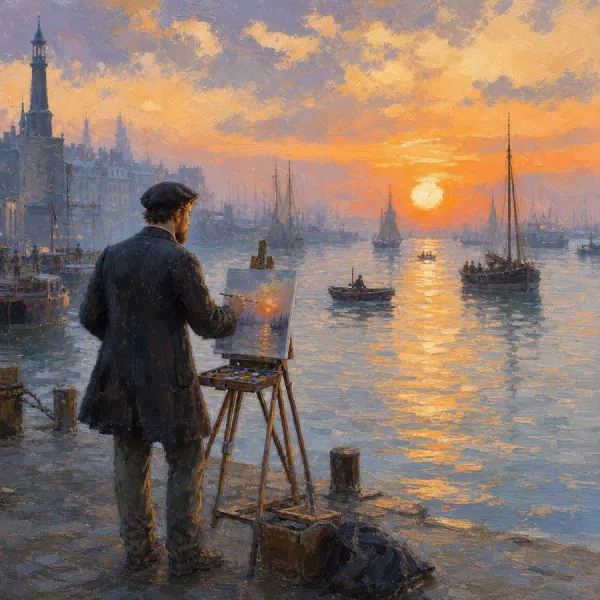
The great shared idea was to paint outdoors, en plein air. Before them, a landscape painter made quick sketches outside, then finished the real painting in the studio. The future Impressionists wanted to finish their canvases on the spot, facing what they saw. They drew inspiration from the Englishman John Constable, the painters of the Barbizon school, and above all from two older artists, Eugène Boudin and Johan Jongkind, who painted the skies and coasts of Normandy. Monet, who grew up in Le Havre, met Boudin around 1858 and would credit him with his calling as a painter.
🧪 A material revolution: the tube
Painting outdoors would not have been so easy without an invention: the flexible paint tube, developed in 1841 by the American painter John Goffe Rand. Before that, artists ground their pigments and mixed them with linseed oil, then stored the paste in pig bladders or glass syringes, awkward to carry around. With tubes, a painter could take their palette anywhere. New bright pigments also became available: cobalt blue, viridian, cadmium yellow, synthetic ultramarine, and later cerulean blue in the 1860s.
🌊 1869: La Grenouillère
In 1869, Monet and Renoir set up their easels side by side at La Grenouillère, a bathing and boating spot on the Île de Croissy, on the Seine. They painted the shimmering water, the reflections, the bathers. These canvases are often considered the first in the Impressionist style: objects are no longer drawn with outlines but defined by the light and the reflections it creates.
⚔️ The war of 1870
The Franco-Prussian War of 1870–1871 scattered the group. Bazille was killed in battle. Degas and Manet were called up in Paris, Renoir in the provinces. Monet and Pissarro went into exile in London. It was also in London that Monet met, through the painter Daubigny, a dealer who, like him, was a refugee: Paul Durand-Ruel. Between 1870 and 1874, Durand-Ruel showed works by the group in seven exhibitions at his London gallery. In 1872 he bought his first canvases from Monet, then from Degas, Pissarro, Sisley, Renoir and Manet. He would become the Impressionists' most loyal dealer.
The rest of the course
This page publishes the first 2 parts. The full course has 7: here is what the next ones cover.
- 🌅 1874: the exhibition at Nadar's
The group's first exhibition in 1874 at Nadar's former studio, the painting Impression, Sunrise, and the article by Louis Leroy that gave the movement its name.
- 🖌️ The technique: brushstroke, light, color
What defines Impressionist painting: visible brushstrokes, juxtaposed pure colors, colored shadows, wet-on-wet painting, modern subjects, Japanese-influenced framing, and Monet's series.
- 👩🎨 The painters of the group
Portraits of the main Impressionists: Monet, Renoir, Degas, Pissarro, Sisley, Berthe Morisot, Mary Cassatt and Gustave Caillebotte.
- 🗓️ The eight exhibitions and the end of the group
The eight Impressionist exhibitions from 1874 to 1886, internal tensions, defections, the American market, and the final 1886 exhibition that marked the end of the group.
- 🏆 Legacy: from Neo-Impressionism to the Musée d'Orsay
What became of Impressionism after 1886: Neo-Impressionism and Post-Impressionism, official recognition, the Caillebotte bequest, the Water Lilies at the Orangerie, and the Musée d'Orsay.
Study “Impressionism” with flashcards and quizzes
In Oria, you read the full course, then practice on it: flashcards, multiple-choice quizzes, open questions or the Feynman method. Cards and questions then come back in your daily review, paced by spaced repetition.
Study this topic in OriaSources
These notes draw on the sources below. If a point seems doubtful, refer back to them.