Arts
The History of Cinema: Summary and Study Notes
From the Lumière factory gates to the age of streaming
Study this topic in OriaThe essentials
On December 28, 1895, thirty-three people paid to watch moving pictures: cinema was born. You'll follow its adventure, from Méliès's camera tricks to the silent era, from the coming of sound in 1927 to Hollywood's golden age, from Italian neorealism to the French New Wave, and on to blockbusters, digital filmmaking and streaming. Along the way, you'll discover a handful of films that changed everything and the techniques that make a movie sweep us away.
Key dates and facts
- 1892
- Reynaud's luminous pantomimes at the Musée Grévin
- 1895
- The Lumières' first paid screening, on December 28
- 1896
- Alice Guy's The Cabbage Fairy
- 1902
- Méliès's A Trip to the Moon
- 1927
- Release of The Jazz Singer , on October 6
- 1929
- Hollywood switches almost entirely to sound
- 1934
- Strict enforcement of the Hays Code begins
- 1939
- The Wizard of Oz and Gone with the Wind
- 1995
- Toy Story , the first computer-animated feature film
- 2007
- Netflix launches its streaming service
🎞️ 1895: the birth of cinema
Cinema didn't come out of nowhere. Throughout the 19th century, people were already projecting images onto screens with magic lanterns, and optical toys created the illusion of movement. Starting on October 28, 1892, Émile Reynaud presented his “luminous pantomimes” at the Musée Grévin in Paris: hand-drawn characters projected onto a screen and accompanied by original music. Until 1900, about half a million spectators came to see them.
In the United States, the inventor Thomas Edison and his assistant William Kennedy Dickson developed the Kinetoscope, shown to the public in 1893: a box into which you peered, alone, through a peephole to watch a short loop of film lasting about half a minute. It was a genuine hit, but only one person could watch the film at a time.
🏭 The Lumière brothers
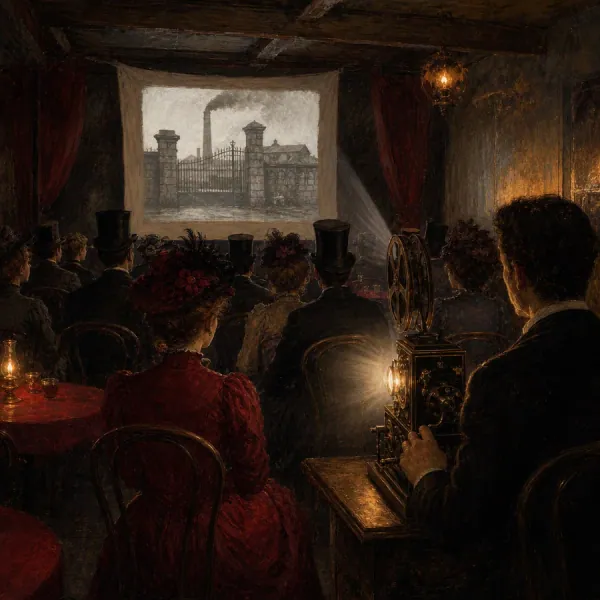
In Lyon, Louis and Auguste Lumière, sons of a photography industrialist, developed the Cinématographe, a device that could shoot film, print copies and project them onto a big screen. On March 22, 1895, Louis demonstrated it to scientists in Paris with a single film, Workers Leaving the Lumière Factory in Lyon. Then came the big day: on December 28, 1895, in the Salon Indien of the Grand Café on the Boulevard des Capucines, the first public, paid screening took place. The program was made up of ten short films, about twenty minutes in all, including L'Arroseur arrosé (The Sprinkler Sprinkled), a little farce performed by actors. On the first night there were only thirty-three spectators. A week later, thanks to word of mouth, the line stretched all the way to the next street.
A stubborn legend claims that the audience fled the room when they saw The Arrival of a Train at La Ciotat. In reality, that film wasn't on the December 28 program: it was first shown on January 25, 1896, in Lyon. Historians speak at most of spectators flinching, especially since the screen was modest. What is really striking is the diagonal framing chosen by Louis Lumière: the locomotive comes from the back of the image straight toward us.
The Lumières sent camera operators to film all over the world. In 1896, in Venice, one of them, Alexandre Promio, set his camera on a gondola and, without realizing it, invented the tracking shot. Yet the two brothers had little faith in the future of the spectacle, and they stopped producing films in the early 20th century.
“Making films, the way the fashion had then become, was no longer our business. I can't see myself in today's studios.”
Louis Lumière, as reported by the historian Georges Sadoul (translated)
🎩 Méliès, the magician
Georges Méliès, an illusionist and director of the Théâtre Robert-Houdin, attended one of the first screenings. He wanted to buy the device; the Lumières refused, so he got hold of a camera in England. Méliès discovered the stop trick: you stop filming, change something, start again, and a character seems to vanish. He founded Star Film, made more than five hundred films and built a studio fitted with trapdoors like a theater stage. In 1902, A Trip to the Moon, inspired by Jules Verne and H. G. Wells, showed scientists fired by a giant cannon right into the eye of the Moon. It is often considered the first great science fiction film.
👩🎬 Alice Guy, Pathé and Gaumont
A secretary for Léon Gaumont, Alice Guy made The Cabbage Fairy in 1896, often cited as one of the very first fiction films: she became the first woman film director in history. Meanwhile, Charles Pathé turned cinema into a true industry. At its peak, Pathé Frères was the largest film company in the world, and France dominated the global market until World War I.
🎹 The silent era: inventing a language
The first films lasted less than a minute and contained a single shot: the camera didn't move, as if you were watching a scene in a theater. The whole challenge of the 1900s and 1910s was to invent a language of cinema's own.
✂️ Breaking down and editing
It was English filmmakers, later grouped under the name of the Brighton School, who led the way. In 1900, in Grandma's Reading Glass, George Albert Smith alternated a wide shot of a boy and his grandmother with close-ups of what the boy examines through a magnifying glass: a watch, a bird, his grandmother's eye. The film is split into several shots linked by a single story: this was the birth of shot breakdown. English chase films, hugely popular, spread this way of filming.
In the United States, D. W. Griffith made The Adventures of Dollie in 1908, cutting from one place to another to show actions happening at the same time. This cross-cutting, which he compared to the technique of Dickens's novels, made it possible to tell long, complex stories. Films got longer, and the feature film took hold in the 1910s. In 1909, 35 mm film became the international standard.
🗣️ Cinema was never silent
“Silent” cinema never actually played in silence. A pianist, sometimes a small orchestra, accompanied the screenings, a sound-effects artist made the noises, and at fairgrounds a barker narrated the story. From 1908, intertitles, those cards of text, let audiences read the dialogue; around 1912, they began to be inserted in the middle of scenes. About 80% of films from the 1890s to the 1920s were even in color, tinted in dye baths or hand-colored: blue for night, red for a fire.
🎩 The great movements of the 1920s
- American slapstick: Charlie Chaplin and Buster Keaton slowed down the frantic pace of the early comedies so audiences could appreciate the precision of their movements. From 1917, Chaplin blended laughter with emotion.
- German Expressionism: in Berlin, films such as The Cabinet of Dr. Caligari (1920), Nosferatu (1922) and Metropolis (1927) used sets with impossible angles and painted shadows to speak of madness and anxiety in the aftermath of World War I.
- Soviet montage: in 1921 or 1922, the director Lev Kuleshov showed his students that the same face seems to express different emotions depending on the image that follows it. Sergei Eisenstein turned editing into a weapon in Battleship Potemkin (1925).
An editing effect in which viewers give meaning to a shot based on the shot paired with it. According to the filmmaker Vsevolod Pudovkin's account, the deliberately neutral face of the actor Ivan Mosjoukine, edited alongside a bowl of soup, a coffin or a child, seemed to express hunger, sadness or tenderness in turn.
During World War I, European film production collapsed. The United States seized the opportunity and took the lead in world cinema, a position it has never given up.
The rest of the course
This page publishes the first 2 parts. The full course has 8: here is what the next ones cover.
- ⭐ Hollywood and the coming of sound
The birth of Hollywood, the studio and star systems, the switch to sound with The Jazz Singer in 1927, Technicolor, the Hays Code and the golden age of the 1930s and 1940s.
- 🌍 After the war: neorealism, the New Wave and world cinemas
The great postwar movements: Italian neorealism, the golden age of Asian cinemas, the French New Wave and New Hollywood.
- 🏆 Five films that changed cinema
Five works explained: Battleship Potemkin (1925), Citizen Kane (1941), Bicycle Thieves (1948), Breathless (1960) and Jaws (1975).
- 🎬 Film techniques explained
The tools of film language: shots and framing, camera movements, editing, sound, color, widescreen and special effects.
- 🍿 Television, blockbusters and home video
How cinema responded to television, the birth of the blockbuster with Jaws and Star Wars, home video and the global influence of the big studios.
- 💻 Digital and streaming
The digital revolution (3D animation, digital projection, 3D), the rise of streaming with Netflix, the Covid-19 pandemic and today's globalized cinema.
Study “The History of Cinema” with flashcards and quizzes
In Oria, you read the full course, then practice on it: flashcards, multiple-choice quizzes, open questions or the Feynman method. Cards and questions then come back in your daily review, paced by spaced repetition.
Study this topic in OriaSources
These notes draw on the sources below. If a point seems doubtful, refer back to them.