Arts
The History of Photography: Summary and Study Notes
Two centuries of learning to write with light
Study this topic in OriaThe essentials
Inventing photography meant bringing together a dark box known since antiquity and silver salts that darken in sunlight. You'll follow Niépce, Daguerre and Talbot, the rival inventors of the 1820s to 1840s, then the conquest of speed, portraits for everyone, color and photojournalism. You'll understand how the camera obscura, the latent image and the negative work, why the first photographed streets look empty, and what digital technology has changed, all the way to faked images.
Key dates and facts
- 1816
- Niépce's first negatives, unfixed
- c. 1822
- Heliography is invented
- 1826 – 1827
- View from the Window at Le Gras
- 1833
- Death of Niépce
- 1835
- Talbot's first paper negatives
- 1841
- The calotype
- 1851
- Wet collodion
- 1871
- The gelatin dry plate
- 1854
- Fenton is sent to Crimea
- 1880
- First halftone news photo
🔭 Before photography: the camera obscura and silver salts
The word photography, usually credited to the British scientist John Herschel in 1839, comes from the Greek phōs, “light,” and graphē, “writing” or “drawing”: it is “drawing with light.” Inventing it meant bringing together two very old discoveries: a way to form an image, and a material able to keep it.
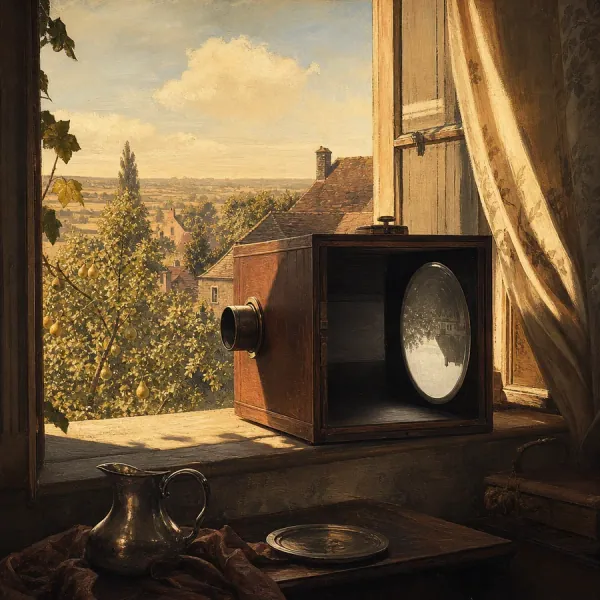
📦 The camera obscura
A completely dark room or box with a small hole, the pinhole, in one wall. The light passing through it projects onto the opposite wall an image of the outside world, reversed and upside down.
This natural phenomenon was described as early as the 4th century BC, both in Greece by Aristotle and in China by the philosopher Mozi. The Arab scholar Ibn al-Haytham (c. 965–1038), father of modern optics, is said to have been the first to actually build a camera obscura. Leonardo da Vinci described it in his notebooks. Until the 16th century, it was used mainly to study optics and to observe solar eclipses without damaging the eyes.
🔍 A drawing machine
The pinhole's flaw is its lack of light: the smaller the hole, the sharper the image, but the darker it is. In 1550, the Italian Gerolamo Cardano described adding a lens to the opening, letting in more light while keeping the image sharp; in 1568, Daniele Barbaro added a diaphragm. In 1558, Giambattista della Porta was the first to recommend the camera obscura as a drawing aid. Painters adopted it, first as a tent and then as a portable box: Canaletto used one for his views of Venice. It is said that della Porta's guests, seeing upside-down figures moving on a wall, fled in terror: they were only the actors in the next room.
🧪 Light that darkens silver
The fleeting image still had to be fixed. In 1614, Angelo Sala noticed that sunlight darkened powdered silver nitrate. Around 1717, the German Johann Heinrich Schulze discovered by chance that a slurry of chalk and acid containing silver darkened in the sun; by sticking stencils of letters on the flask, he obtained dark words, which vanished as soon as the liquid was shaken. In 1777, the chemist Carl Wilhelm Scheele showed that light breaks down silver chloride into tiny grains of metallic silver, and that ammonia dissolves the remaining chloride: without knowing it, he had a way to fix an image, one that no one would exploit.
Around 1800, the Englishman Thomas Wedgwood captured silhouettes and copies of paintings on glass on paper or leather soaked in silver nitrate. His collaborator, the famous chemist Humphry Davy, published these experiments in 1802. But neither managed to stop the image from turning completely black as soon as it was looked at in the light. The principle had been found; what was still missing was a way to stop it.
☀️ Niépce and the first photograph
Joseph Nicéphore Niépce (1765–1833) was an inventor from Chalon-sur-Saône, in Burgundy, whose family fortune allowed him to devote himself to research. He was interested in lithography, a printing technique very much in fashion at the time. A poor draftsman, he had the idea of letting light do the work for him.
🔄 Negatives that faded away
In 1816, using paper coated with silver chloride placed at the back of a small camera obscura, he obtained images. But they were negatives, dark where the scene was light, and they kept darkening in the light until they disappeared. Disappointed with silver salts, Niépce turned to other substances. He grasped one essential thing: the action of light does not have to be visible right away; it can be revealed afterward by a chemical treatment.
🛣️ Bitumen of Judea
Around 1822, he developed heliography. He used bitumen of Judea, a natural asphalt that hardens in light. A pewter plate coated with a thin layer of bitumen was exposed: where the light struck, the bitumen hardened; elsewhere, it remained soluble and washed away with a mixture of oil of lavender and white petroleum. The result was a positive image, in which the hardened bitumen formed the light areas and the bare metal the dark ones.
🏚️ The view from the window
In 1826 or 1827, depending on the source, Niépce placed a bitumen-coated pewter plate in a camera obscura, facing an upstairs window of his estate at Le Gras, in Saint-Loup-de-Varennes. The result, View from the Window at Le Gras, shows buildings, a tree and the countryside: it is the oldest surviving photograph taken from nature. The image is blurry, and strange: the sun lights both the walls on the right and those on the left. Why? The exposure was extremely long. It was long estimated at eight hours, but a researcher who repeated the experiment from Niépce's notes believes it lasted several days.
In September 1827, Niépce presented his work in England, but the Royal Society turned down his paper because he would not reveal the details of his process. The plate, donated in 1963 by the historian Helmut Gernsheim, is kept at the University of Texas at Austin.
🤝 The partnership with Daguerre
Around 1828, Niépce got in touch with Louis Daguerre, a Parisian artist famous for his Diorama shows, who supplied him with optics. In 1829 they signed a partnership agreement: Daguerre was to make the camera obscura brighter, Niépce to improve the chemistry. Exposure times, though reduced, were still counted in hours. Niépce died suddenly in 1833, leaving his notes to his partner.
Others were searching at the same time, elsewhere. In Brazil, the Frenchman Hércules Florence obtained images on silver nitrate paper around 1832–1833 and was already talking about “photographie”; unable to fix them properly, he gave up after the daguerreotype was announced.
The rest of the course
This page publishes the first 2 parts. The full course has 8: here is what the next ones cover.
- 🪞 1839: the daguerreotype, a gift to the world
Daguerre's process (a latent image developed with mercury), its announcement by Arago on January 7, 1839, its purchase by the French state, “daguerreotypomania,” the Boulevard du Temple, and the limits of this one-of-a-kind image on metal.
- 📄 Talbot, the negative and the multiplied image
The other invention of photography: the English scientist Henry Fox Talbot's negative-positive process on paper (calotype, 1841), then wet collodion and the gelatin dry plate, which sped up picture-taking and opened the industrial age of the portrait.
- 🎨 Art, science or mere technique?
The debates photography sparked in the 19th century: painters' fears, Baudelaire's attack in 1859, Pictorialism's effort to make photography an art, and scientific uses, from astronomy to Muybridge's galloping horse.
- 📸 “You press the button”: photography for everyone
The democratization of photography: George Eastman's Kodak in 1888 and its slogan, the one-dollar Brownie, the Leica's small format, the arrival of color (Autochrome, Kodachrome), and Polaroid instant photography.
- 📰 Bearing witness: the photo that makes history
Photography as testimony: from the Crimean War to printing photos in newspapers, Cartier-Bresson's decisive moment, the Magnum agency, Dorothea Lange's Migrant Mother, Earthrise, and the long history of faked photos.
- 💾 The digital age
From the first scanned image in 1957 to the CCD sensor, Steven Sasson's prototype at Kodak in 1975, digital cameras, camera phones and Instagram, all the way to Kodak's bankruptcy and algorithmically faked images.
Study “The History of Photography” with flashcards and quizzes
In Oria, you read the full course, then practice on it: flashcards, multiple-choice quizzes, open questions or the Feynman method. Cards and questions then come back in your daily review, paced by spaced repetition.
Study this topic in OriaSources
These notes draw on the sources below. If a point seems doubtful, refer back to them.