Personal growth
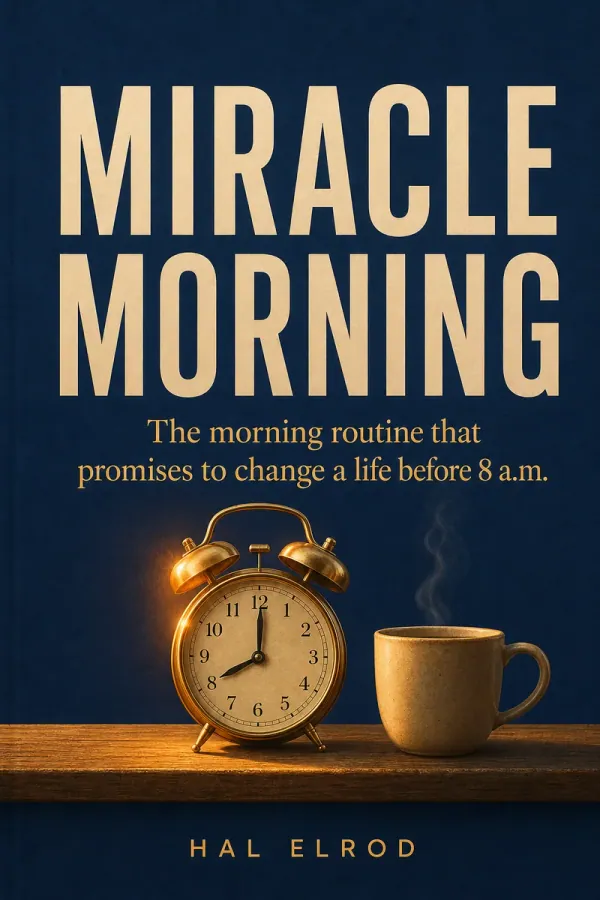
Miracle Morning by Hal Elrod: Summary and Study Notes
The morning routine that promises to change a life before 8 a.m.
Study this topic in OriaThe essentials
Published in 2012 by the American author Hal Elrod, Miracle Morning suggests starting every day with an hour devoted to yourself, before the world wakes up. With more than two million copies sold, the book launched a worldwide trend. You'll discover the story of its author, the six-practice SAVERS method, his strategy for never hitting "snooze" again, and what research on sleep and chronotypes says about its limits.
Key dates and facts
- 2012
- Publication of The Miracle Morning
- 2016
- French edition from First
- 2020
- Release of the documentary film
- 2023
- Expanded edition, more than 70 pages longer
- 1979
- Born in California
- 1999
- Serious car accident
- 2007 – 2008
- Personal crisis and the birth of the routine
- 2016
- Diagnosed with acute leukemia
🌅 A book that became a worldwide ritual
Miracle Morning is a self-help book by the American author Hal Elrod, published in 2012 under the title The Miracle Morning. Its subtitle promises a "not-so-obvious secret" that is "guaranteed" to transform your life… before 8 a.m. The central idea fits in one sentence: set aside a moment for yourself every morning, before school, work, and notifications, and use it to build yourself up.
📈 A massive success
According to the author's official website, the book has now sold more than two million copies and has been translated into 37 languages; the routine is said to be practiced in more than a hundred countries, and its online groups bring together several hundred thousand members. These figures come from the publisher and the author, not from an independent body.
In France, the book came out in 2016 from the publisher First under the title Miracle Morning : offrez-vous un supplément de vie, followed by a paperback edition. The phrase "miracle morning" then entered everyday vocabulary, to the point that in 2022 the fact-checking outlet Curieux! devoted an investigation to the question: does waking up very early really improve well-being?
📚 A small industry
The book's success gave rise to an entire collection. Starting in 2014, Elrod published versions co-written for different audiences: real estate agents, salespeople, parents, entrepreneurs, students, couples, teachers, people in recovery from addiction… These were joined by a journal to fill in, an app, a podcast, and a documentary film released in 2020, directed by Nick Conedera.
On December 12, 2023, a revised and expanded edition was published. It adds more than seventy pages, including two new chapters: "The Miracle Evening," devoted to the evening that sets up the morning, and "The Miracle Life." This shift of focus toward the evening is telling: as we'll see when we turn to sleep, it is precisely bedtime that determines whether an early wake-up is a good idea or a bad one.
🚗 Hal Elrod, the author who came back from the brink
Hal Elrod, the author of Miracle Morning, was born on May 30, 1979, in Camarillo, California. He describes himself as an average teenager, both at school and in sports. At 15, he lived out a dream by becoming a host at a local radio station. At 19, he joined Cutco, a direct-sales cutlery company, where he became, by his own account, one of the best salespeople in the company's history.
💥 The 1999 accident
On December 3, 1999, at age 20, his car was hit head-on by a drunk driver traveling at more than 70 mph. Elrod says his heart stopped for six minutes before paramedics revived him. He suffered eleven fractures and permanent brain damage, and spent six days in a coma. Doctors told him he would likely never walk again; he took his first steps three weeks later. This survival story would become the core of his talks.
📉 The crisis that gave birth to the method
The second blow was financial. During the 2007-2008 crisis, Elrod lost half his income, piled up about $52,000 in credit card debt, and risked losing his house. He then decided to combine six practices into a single morning routine. By his own account, he doubled his income within two months and began training for a 52-mile ultramarathon.
"It was never a book idea. It was my own desperate attempt to turn my life around when I was struggling."
Hal Elrod, interview with Success magazine
🎗️ Cancer, then insomnia
In 2016, at 37, while filming for his documentary had already begun, Elrod learned he had acute lymphoblastic leukemia, a rare and aggressive cancer; he was given a 20 to 30 percent chance of survival. Filming continued through treatment, and he went into remission. Later, he also described going through, from late 2019 to mid-2020, a severe bout of chronic insomnia, sleeping only two to four hours a night, accompanied by anxiety and depression. He now lives in Austin, Texas, hosts the podcast Achieve Your Goals, and published another book, The Miracle Equation, in 2019.
The rest of the course
This page publishes the first 2 parts. The full course has 8: here is what the next ones cover.
- 🧘 The six-practice SAVERS method
The heart of Miracle Morning: the six "Life SAVERS" practices (silence, affirmations, visualization, exercise, reading, writing) and their six-minute short version.
- ⏰ Never hitting snooze again
Miracle Morning's advice for waking up: the five-step strategy against the snooze button, bedtime intentions, and the three phases of the first thirty days.
- 😴 What sleep science has to say
The limits of Miracle Morning in light of sleep research: actual sleep needs by age, sleep debt, and Elrod's claim that you only need as much sleep as you believe you need.
- 🦉 Larks, owls, and chronotypes
What chronobiology says about Miracle Morning: morning and evening chronotypes, their genetic component, the shift during adolescence, "social jet lag," and a 2021 study on bedtime and depression.
- 🔬 Affirmations and visualization put to the test
What psychology says about two pillars of Miracle Morning: positive affirmations (Joanne Wood's 2009 study) and positive visualization (the work of Gabriele Oettingen and the WOOP method).
- ⚖️ Reception, criticism, and sensible use
The verdict on Miracle Morning: popular success, criticism over the pressure to perform and sacrificed sleep, and what's worth keeping from the method.
Study “Miracle Morning” with flashcards and quizzes
In Oria, you read the full course, then practice on it: flashcards, multiple-choice quizzes, open questions or the Feynman method. Cards and questions then come back in your daily review, paced by spaced repetition.
Study this topic in OriaSources
These notes draw on the sources below. If a point seems doubtful, refer back to them.