Personal growth
The 4-Hour Workweek by Tim Ferriss: Summary and Study Notes
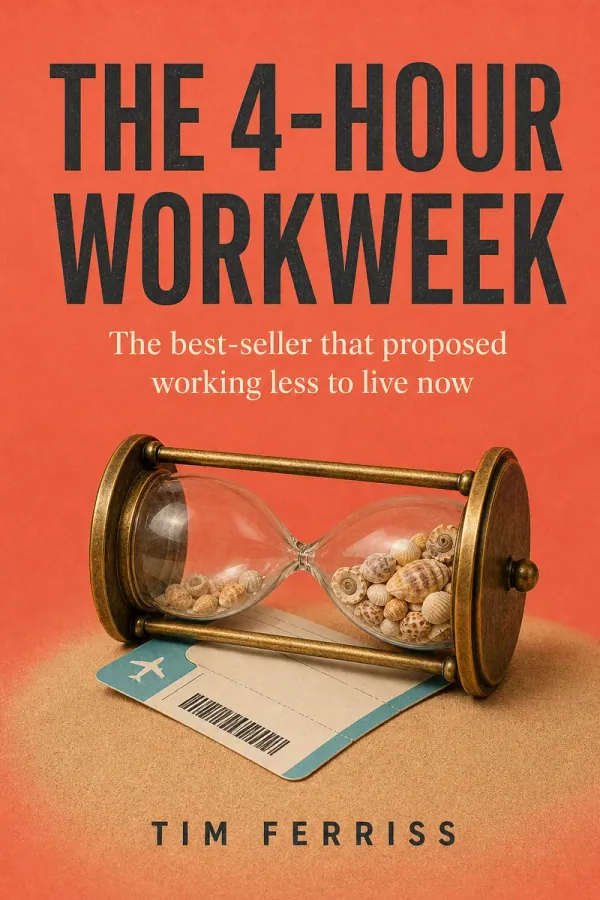
The best-seller that proposed working less to live now
Study this topic in OriaThe essentials
Published in 2007, Tim Ferriss's The 4-Hour Workweek convinced millions of readers that you don't have to wait for retirement to enjoy life. The book proposes a four-step method, DEAL, built on the Pareto principle, Parkinson's law, delegation to remote assistants, and "mini-retirements." You will discover where this manifesto came from, what it concretely recommends, who its author is, and why its promises have been as admired as they have been criticized.
Key dates and facts
- 2001
- BrainQUICKEN is founded
- 2004
- Leaves for Europe and runs a major delegation experiment
- 2007
- The 4-Hour Workweek is published
- 2009
- Expanded edition, over 100 pages longer
- 1977
- Born in East Hampton
- 2007
- The 4-Hour Workweek
- 2014
- Launches his podcast
- 2016
- Tools of Titans
📘 A manifesto born of exhaustion
The 4-Hour Workweek is a self-help book by the American Tim Ferriss, published in spring 2007 by Crown. Its subtitle sums up the program: escape the 9-to-5 office job, live wherever you want, and join the "New Rich." In France, it was published by Pearson in 2008 under the title La Semaine de 4 heures: travaillez moins, gagnez plus et vivez mieux!
😓 An entrepreneur trapped by his own company
The book grew out of personal experience. In the early 2000s, Ferriss alone ran BrainQUICKEN, a small online company selling dietary supplements for athletes. The business did well, but it consumed him: he describes twelve- to fourteen-hour days, seven days a week. During a family vacation in Florence, he recounts spending, in his own words, ten hours a day in an internet café managing his affairs.
In June 2004, on the verge of burning out, he booked a one-way ticket to Europe. The planned few weeks became a long experiment: he delegated almost everything, checked his email only once a week, and found his company kept running without him. From this he drew a conviction: much of the work we believe is essential simply isn't.
🎓 From a Princeton lecture hall to a book
The book's format took shape during talks Ferriss gave starting in 2002 in the entrepreneurship course of his former Princeton professor, Ed Zschau. Rather than explaining how to build a large company, he posed an unsettling question there: what's the point of sacrificing your best years hoping to be happy at the end? According to the preface of the expanded edition, the manuscript was rejected by 26 of 27 publishers.
In March 2007, Ferriss presented his ideas at the South by Southwest technology festival in Austin. According to computer scientist Cal Newport, who revisited the book in The New Yorker in 2021, the room was packed and influential bloggers spread the message. Within days of its release, the book entered the New York Times bestseller list.
In 2009, Ferriss published an "expanded and updated" edition, with reader case studies added. He notes it is not a "corrected" version: in his view, the principles still hold, despite the financial crisis that had just erupted.
💸 The "New Rich" versus the deferred life
The starting point of The 4-Hour Workweek, Tim Ferriss's book, is a critique of the classic life path. You work hard for forty years, take little vacation, save money, and hope to finally enjoy life in retirement. Ferriss calls this the deferred life plan and invites readers to question it.
⏳ Money is not the real goal
For the author, what people actually want is not a large bank balance for its own sake, but the free lifestyle it is supposed to make possible: traveling, learning, having time. Hence his question: can you access that lifestyle without waiting to become a millionaire?
"People don't want to be millionaires—they want to experience what they believe only millions can buy."
Tim Ferriss, The 4-Hour Workweek (2007)
He calls those who abandon the deferred life to live a chosen life right now the New Rich, whose main currency is not money but time and mobility. He names this approach lifestyle design.
🔄 Two ways of dreaming
The book contrasts the goals of "deferrers" with those of the New Rich. The deferrer wants to retire early; the New Rich person prefers to spread periods of rest and adventure throughout life. The deferrer wants to be the boss; the New Rich person wants to own a business that runs without them. The deferrer wants to have more things; the New Rich person wants to have more experiences and less clutter.
For Ferriss, the practical value of money depends on how many of the "W"s you control: what, when, where, and with whom. An employee who is low-paid but free in their time and location, he argues, can live better than a highly paid banker working eighty hours a week.
Ferriss stresses a point often overlooked: the goal is not idleness. Once work is reduced, you need to know what to do with that freed-up time, or you will merely trade office boredom for an empty void. This is the subject of one of the book's final chapters, devoted to "filling the void" after cutting away unnecessary work.
The rest of the course
This page publishes the first 2 parts. The full course has 8: here is what the next ones cover.
- 🧭 The DEAL method, in four steps
The structure of The 4-Hour Workweek: Definition, Elimination, Automation, Liberation, and what each step provides (time, income, mobility).
- ✂️ Eliminate: Pareto, Parkinson, and the low-information diet
The Elimination step of The 4-Hour Workweek: the Pareto principle (80/20), Parkinson's law, selective ignorance, and the art of saying no.
- 🤖 Automate: remote assistants and "muses"
The Automation step of The 4-Hour Workweek: delegating to virtual assistants, "geoarbitrage," and "muses," the small ventures that generate income without requiring your presence.
- 🌍 Liberate: remote work and mini-retirements
The Liberation step of The 4-Hour Workweek: negotiating remote work, possibly quitting your job, and replacing a single big retirement with mini-retirements.
- 👤 Tim Ferriss, the experimenter
Who Tim Ferriss, author of The 4-Hour Workweek, is: his education at Princeton, his companies, his other books, his podcast, his investments, and his later reconsiderations.
- ⚖️ An immense success, harsh criticism
The reception of The 4-Hour Workweek: sales, cultural influence, and criticism over exaggeration, self-promotion, its view of work, and its reliance on cheap outsourced labor.
Study “The 4-Hour Workweek” with flashcards and quizzes
In Oria, you read the full course, then practice on it: flashcards, multiple-choice quizzes, open questions or the Feynman method. Cards and questions then come back in your daily review, paced by spaced repetition.
Study this topic in OriaSources
These notes draw on the sources below. If a point seems doubtful, refer back to them.