Personal growth
The 7 Habits of Highly Effective People by Stephen R. Covey: Summary and Study Notes
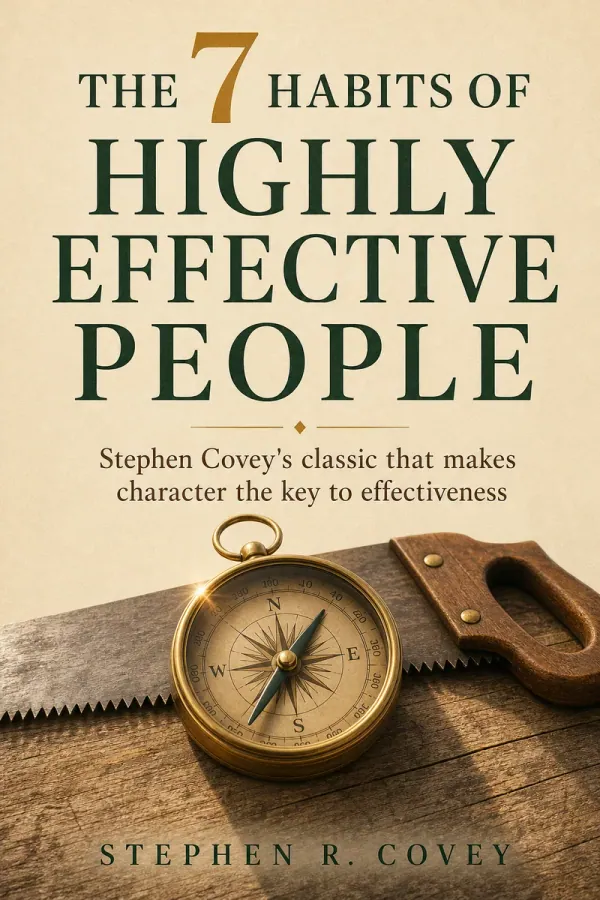
Stephen Covey's classic that makes character the key to effectiveness
Study this topic in OriaThe essentials
Published in 1989 by American author Stephen R. Covey, The 7 Habits of Highly Effective People is one of the best-selling self-help books in history. Covey argues for a “character ethic” grounded in universal principles rather than mere technique. You will discover his paradigms, the three habits of private victory, the famous urgent/important matrix, the three habits of public victory, the habit of renewal, the author’s life, and the criticisms leveled at this bestseller.
Key dates and facts
- 1989
- Published in the United States
- 1991
- Settles durably onto bestseller lists
- 1994
- Covey invited to Camp David by Bill Clinton
- 2011
- Ranked by Time among 25 influential management books
- 1932
- Born in Salt Lake City
- 1989
- Publishes The 7 Habits
- 1996
- Named by Time among the 25 most influential Americans
- 1997
- FranklinCovey is founded
- 2012
- Dies in Idaho Falls
📗 A Best-Seller Born in 1989
The 7 Habits of Highly Effective People is a self-help and management book written by American Stephen R. Covey and published in 1989 by Free Press, an imprint of the Simon & Schuster group. Its original subtitle announces the program: restoring the “character ethic.” The book has circulated under a few different titles abroad, and it was reissued in a 2004 edition with a new closing chapter.
🧭 A Book About Effectiveness… and About Character
The book lists seven principles which, once turned into habits, are meant to help people lead their lives effectively in every area: professional, but also family and civic life. For Covey, this requires following a handful of universal, timeless principles. Commentators have noted that his approach recalls older practical-psychology manuals, such as those of Dale Carnegie, but that it relies on concrete tools: written plans and progress reviews.
🗂️ A Four-Part Structure
- Paradigms and Principles: how human beings perceive the world, form habits, and can reprogram them.
- Private Victory: Habits 1 through 3, for moving from dependence to independence.
- Public Victory: Habits 4 through 6, for moving from independence to interdependence.
- Renewal: Habit 7, which maintains all the others.
📈 An Extraordinary Success
The book settled durably onto bestseller lists: it appeared on Publishers Weekly’s list starting in 1991. Its audio edition reportedly became the first nonfiction audiobook to sell more than a million copies in the United States. Sales figures vary by source: more than 15 million copies by 2004, and more than 20 million by the time of the author’s death in 2012 according to CNN; other counts put the number considerably higher.
Covey went on to extend his model across many other books: First Things First (1994), on managing priorities, The 7 Habits of Highly Effective Families (1997), and The 8th Habit (2004), which adds an eighth habit suited to the age of knowledge workers.
🔭 Paradigms and Principles
Before presenting his seven habits, Stephen Covey devotes the first part of his book to a single question: how do we see the world? For him, people only change their behavior for good once they have changed the way they perceive things.
🗺️ The Power of Paradigms
For Covey, a paradigm is the frame of reference through which each person looks at reality. It can be compared to a map: it shapes our interpretations, and a wrong map will mislead even people who try hard.
One chapter in this part carries a title that sums up the idea: the way we see the problem is the problem. Changing one’s paradigm therefore means changing one’s attitude and conduct. Covey calls this approach “inside-out”: you begin by changing yourself before trying to change others or your circumstances.
🎭 Personality Versus Character
For his doctoral thesis, Covey had studied American self-help literature. He identifies two schools of thought in it. The personality ethic, which he considers dominant in modern books, relies mainly on techniques. The character ethic, by contrast, consists in aligning one’s values with principles he calls “universal and timeless.” It is this second path that Covey defends.
He also carefully distinguishes principles from values. Values are internal and subjective; principles, he argues, are natural laws external to us. In a later book, he cites fairness, honesty, integrity, and service as examples. Our values govern our behavior, but it is principles that determine its consequences.
🧩 What Is a Habit?
A habit sits at the intersection of three elements: knowledge (what to do and why), skill (how to do it), and desire (wanting to do it). All three are needed for a behavior to become a habit.
🌱 The Maturity Continuum
Covey finally describes a three-stage path. We start out in dependence: relying on others. Through personal development, we reach independence: taking responsibility for our actions — this is “private victory.” But independence is not enough: we then discover that we need others to accomplish great things. This is interdependence, “public victory.”
To define effectiveness, Covey introduces another pair of concepts, noted P/PC: the production of desired results (P) and the production capability (PC) that allows us to keep producing them. For Covey, effectiveness requires taking care of both, not just the immediate result. This idea already anticipates the seventh habit, devoted to renewal.
The rest of the course
This page publishes the first 2 parts. The full course has 8: here is what the next ones cover.
- 🏆 Private Victory: Habits 1 to 3
Covey's first three habits: being proactive, beginning with the end in mind, and putting first things first, which carry us from dependence to independence.
- ⏱️ The Priority Matrix
The urgent-important matrix popularized by Covey in the third habit: its four quadrants, the central role of Quadrant II, and its link to Eisenhower.
- 🤝 Public Victory: Habits 4 to 6
Habits 4 through 6 of Covey's model: thinking win-win, seeking first to understand then to be understood, and synergizing, together with the emotional bank account.
- 🪚 Habit 7: Sharpen the Saw
Covey's seventh habit: renewing yourself across the physical, mental, social, and spiritual dimensions, with the image of the woodcutter and the upward spiral.
- 👤 Stephen R. Covey, the Author
The life of Stephen R. Covey (1932–2012): childhood in Salt Lake City, education, Mormon faith, career as professor and consultant, FranklinCovey, and death after a bicycle accident.
- 🌍 Influence and Criticism
The influence of The 7 Habits (Bill Clinton, Time, FranklinCovey, 'Leader in Me' schools) and the criticisms it has drawn: guru-style rhetoric, unoriginal ideas, religious roots, and apocryphal quotes.
Study “The 7 Habits of Highly Effective People” with flashcards and quizzes
In Oria, you read the full course, then practice on it: flashcards, multiple-choice quizzes, open questions or the Feynman method. Cards and questions then come back in your daily review, paced by spaced repetition.
Study this topic in OriaSources
These notes draw on the sources below. If a point seems doubtful, refer back to them.