Personal growth
Quiet by Susan Cain: Summary and Study Notes
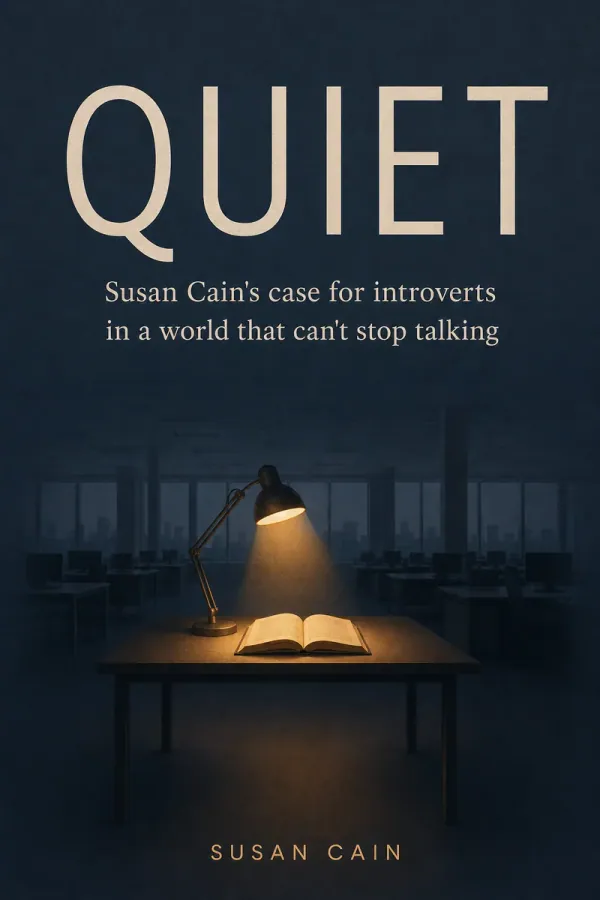
Susan Cain's case for introverts in a world that can't stop talking
Study this topic in OriaThe essentials
Published in 2012, Susan Cain's Quiet argues that Western societies, and above all the United States, underestimate introverts to the point of wasting an enormous amount of talent. The book sparked a worldwide debate about school, open-plan offices and brainstorming. You'll discover the “Extrovert Ideal” and its history, what introversion really is, what biology and psychology say about it, Cain's advice for work, relationships and school, and the criticism the book has received.
Key dates and facts
- 2012
- US publication of Quiet
- 2013
- French edition from JC Lattès
- 2015
- Founding of Quiet Revolution
- 2022
- Four million copies sold
- 1968
- Born in New York State
- 1993
- Law degree from Harvard
- 2012
- Quiet and TED talk
- 2016
- Quiet Power , for teenagers
- 2022
- Bittersweet
📘 A best-seller that got people talking about introverts
Quiet: The Power of Introverts in a World That Can't Stop Talking is a nonfiction book by the American writer Susan Cain, published on January 24, 2012 by Crown in New York. In French, it was published in October 2013 by JC Lattès as La Force des discrets, translated by Marie de Prémonville.
✍️ Seven years of work
A former corporate lawyer, Susan Cain spent seven years reading, researching and writing. She feared she had produced a project that was too personal; instead, several New York publishers competed for the manuscript. Her thesis fits into one sentence: Western societies, and the United States first of all, misunderstand and undervalue introverts, which in her view leads to “a colossal waste of talent, energy, and happiness.”
🎤 A media phenomenon
Success was immediate. On February 6, 2012, Time magazine put the subject on its cover. The same month, Cain gave a TED talk that became one of the most watched in the event's history: more than 30 million views by 2022. The book reached number four on the New York Times bestseller list and stayed there for sixteen weeks; in paperback, it was still on the list in 2019, more than three years on.
Goodreads users voted it the best nonfiction book of 2012. By 2022, it had sold four million copies and been translated into about forty languages.
🌊 Introversion becomes fashionable
In 2015, The New York Times judged that Cain had started, or at least ridden, a genuine publishing trend around introverts. In 2017, Harvard Magazine noted that after Quiet, “introversion came suddenly into vogue.” The book also had concrete effects in companies, universities and even law firms, as we will see later.
📣 The “Extrovert Ideal” and its history
In Quiet, Susan Cain describes what she calls the “Extrovert Ideal”: the belief, omnipresent in her view, that the ideal person is gregarious, dominant and comfortable in the spotlight. In this model, introversion comes across as a disappointment, or even a pathology.
“Our lives are shaped as profoundly by personality as by gender or race.”
Susan Cain, Quiet (2012)
🏛️ Ancient roots
For Cain, Western societies inherited a Greco-Roman ideal that admires oratory and ranks the man of action above the man of contemplation. She contrasts this legacy with traditional Asian cultures, which she says place greater value on reserve and caution. Psychologists do observe that some cultures, such as those of China, India or Japan, value introversion more than the United States does; but this comparison, as we will see, earned the book its sharpest criticism.
🏙️ From character to personality
For the critic Faith Zhang, of the Harvard Independent, the historical chapter is the book's most interesting. Cain draws on the historian Warren Susman, who distinguished two eras in the United States. In the 19th century, a Culture of Character prevailed: what mattered were the good deeds you performed, even when nobody was looking. At the end of the 19th century, with big industry, urbanization and mass immigration, a Culture of Personality took hold: now you had to be magnetic and charismatic, and image mattered more than truth. The journalist Zosia Bielski, of The Globe and Mail, summed up this shift as the rise of the salesman, “the move from morals to magnetism.”
According to Cain, this shift lastingly changed what we admire, how job interviews unfold, what we expect from an employee, and even how we raise our children.
🔎 Reporting from the field
To observe this ideal in action, Cain visited three places she presents as its “nerve centers”: a Tony Robbins self-help seminar, Harvard Business School and a megachurch. She describes the discomfort and struggles of introverts in these worlds that prize enthusiasm and ease. For her, all three reveal the same prejudice, rarely voiced but present everywhere.
The rest of the course
This page publishes the first 2 parts. The full course has 9: here is what the next ones cover.
- 🔋 What is an introvert?
The definition of introversion in Susan Cain's Quiet: a preference for low-stimulation environments, distinct from shyness, unsociability and autism, with the origin of the terms in Jung and Eysenck's theory.
- 🧬 Temperament: what biology and psychology say
The scientific side of Susan Cain's Quiet: the “high-reactive” infants studied by Jerome Kagan, the heritability of introversion, dopamine and the idea of a temperament that is stable but shaped by the environment.
- 🧠 The trap of the “New Groupthink”
The critique of collective work in Susan Cain's Quiet: the “New Groupthink,” the limits of brainstorming, open-plan offices, charisma mistaken for competence and the hypothesis about the 2008 financial crisis.
- 🎭 Acting the extrovert: free traits and restorative niches
Advice for introverts in Susan Cain's Quiet: you can act like an extrovert for what really matters, according to Brian Little's free trait theory, as long as you set aside “restorative niches.”
- 🏫 At work, in relationships and at school
The practical applications of Susan Cain's Quiet: leading according to your temperament, understanding a partner who is different, supporting introverted children at school, and the book's effects on offices and universities.
- ✍️ Susan Cain, the lawyer who became a public introvert
The biography of Susan Cain, author of Quiet: a childhood in New York, studies at Princeton and Harvard, seven years as a Wall Street lawyer, a fear of public speaking, a TED talk, then Quiet Power and Bittersweet.
- ⚖️ Reception, criticism and limits
The reception of Susan Cain's Quiet: praise from the press, criticism of an overly broad definition of introversion, of the chapter on Asian Americans and of its confusion with high sensitivity, and what research says about the real differences between introverts and extroverts.
Study “Quiet” with flashcards and quizzes
In Oria, you read the full course, then practice on it: flashcards, multiple-choice quizzes, open questions or the Feynman method. Cards and questions then come back in your daily review, paced by spaced repetition.
Study this topic in OriaSources
These notes draw on the sources below. If a point seems doubtful, refer back to them.