Classic novels
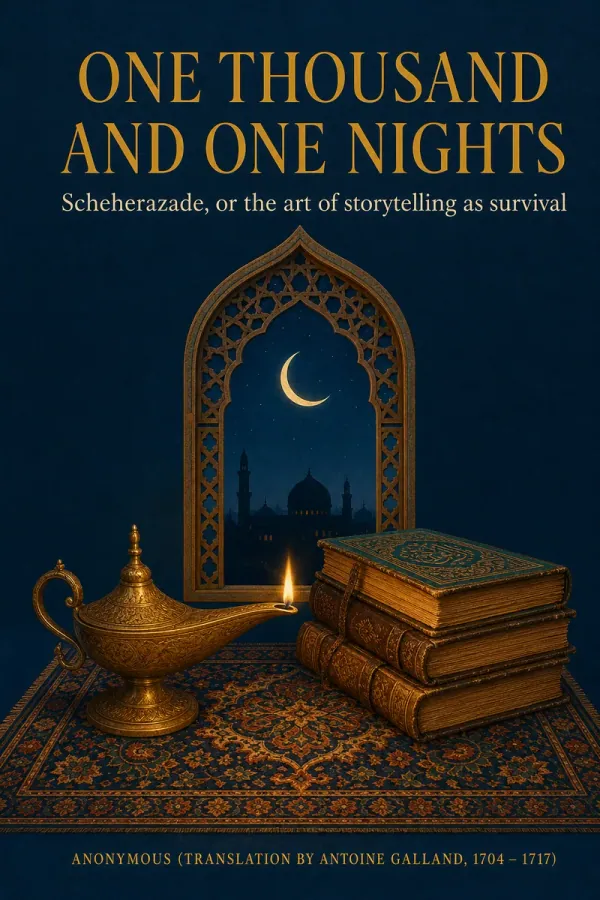
One Thousand and One Nights: Summary and Study Notes
Scheherazade, or the art of storytelling as survival
Study this topic in OriaThe essentials
One Thousand and One Nights is an anonymous collection of Arabic tales, born from a Persian model and enriched over centuries, told night after night by Scheherazade to a king who wants to have her executed. You'll discover the frame story, the collection's Persian and Indian origins, its tangled manuscript history, the decisive role of the Frenchman Antoine Galland, the real origin of Aladdin and Ali Baba, the great tales themselves, the art of the story-within-a-story, and an immense influence, from Voltaire to Disney.
Key dates and facts
- 9th century
- Oldest known fragment of the Nights
- 10th century
- Mentions by Ibn al-Nadim and al-Masudi
- 12th century
- First use of the title One Thousand and One Nights, in Cairo
- 1450 – 1593
- Copying of the Syrian manuscript used by Galland
- 1814 – 1818
- First printed Arabic edition, in Calcutta
- 1835
- Bulaq edition, in Cairo
- 1984
- Muhsin Mahdi's critical edition
- 1646
- Galland born in Rollot
- 1704
- First volume of the Nights published
- 1715
- Galland dies in Paris
👑 Shahriar and Scheherazade: the frame story
All the tales of One Thousand and One Nights are nested within a single story, the frame story. The Arabic title, Alf layla wa layla, literally means "a thousand nights and one night."
💔 Two betrayed kings
King Shahriar rules over an empire stretching from Persia to India. His brother Shahzaman, king of Samarkand, discovers that his wife is cheating on him, then finds that Shahriar's wife is doing the same. Devastated, the two brothers leave their kingdoms. By the seashore, they meet a genie who keeps a woman prisoner in a chest, and see that she too manages to deceive him. Convinced that all women are unfaithful, Shahriar returns home, has his wife executed, and decides to marry a new young woman every day, only to have her put to death the following morning.
🌙 Scheherazade's scheme
Before long, the grand vizier, tasked with finding these brides, can find no more. His eldest daughter, Scheherazade, then offers herself. In Antoine Galland's French translation, she is learned, cultured, a poet, and remarkably brave. To her terrified father, she replies:
"If I perish, my death will be glorious; and if I succeed in my plan, I will have rendered my country an important service."
One Thousand and One Nights, frame story (translated)
Her plan rests on her younger sister, Dinarzade (also called Dinazad or Dinarzad depending on the version), whom she arranges to keep by her side on her wedding night. An hour before daybreak, Dinarzade is to ask her for a story. Scheherazade begins a tale, breaks off at dawn at its most gripping moment, and the king, curious to know what happens next, puts off the execution until the next day. The following evening, she finishes the tale and immediately begins another. Every night, the same request sets the story going again. In Galland's translation, it runs: "Sister, if you are not asleep, I beg you, while we wait for the day, which will soon appear, to tell me one of those lovely tales you know."
🔚 Several possible endings
All versions agree on the essentials: in the end, the king gives up having Scheherazade executed. But the details vary. In the oldest known summary, from the 10th century, she presents him with the child she has borne him and reveals her scheme. In the printed editions of the 19th century, she has had three children with him over the thousand and one nights. In another, more elaborate tradition, she tells the king her own story without naming herself, so that he recognizes his wrongs and marries her officially. Some so-called "complete" manuscripts do not even have an ending.
🏺 From the Persian Thousand Tales to the Arabian Nights
One Thousand and One Nights has no author. It is a collection of popular tales gathered in Arabic over many centuries, drawn from material originating in Persia, India, Mesopotamia, and the Arab world. Its history reads like an investigation missing many of its pieces.
📚 A vanished Persian book
In the 10th century, two Arabic-language authors mention the Nights. The scholar Ibn al-Nadim, in a catalogue of books compiled in Baghdad, the Fihrist, explains that it is a translation of a Persian book, the Hezar Afsan, the "Thousand Tales," whose frame story he summarizes: a bloodthirsty king, executed wives, and a young woman clever enough to save herself by telling an unfinished story every evening. He notes that the book contains only two hundred stories and judges it harshly: it is, he writes, a crude book, told without warmth. In his Meadows of Gold, al-Masudi also cites this Persian book and already names Scheherazade and her sister. No copy of the Hezar Afsan has ever been found.
🐘 Indian roots
The principle of the frame story and nested tales, along with several animal fables, recall Sanskrit Indian literature, especially the Panchatantra. The motif of a young woman averting danger by telling stories has been linked to Indian sources. These fables traveled widely: translated into Persian in the 6th century, then into Arabic around 750 by Ibn al-Muqaffa. One Iraqi researcher has even proposed, based on internal clues, that he also translated the frame story of the Nights, which would place the collection's birth in the 8th century.
🔎 The oldest fragment
In the late 1940s, the American researcher Nabia Abbott published a 9th-century document bearing the opening lines of a Book of the Tale of the Thousand Nights, in which Dinarzade asks Scheherazade to tell her stories. This is the oldest known fragment. The full title One Thousand and One Nights appears for the first time in the 12th century, in Cairo, in a document mentioning a bookseller lending out the work.
🕌 Three great layers of tales
Specialists distinguish three main bodies of material: an Indo-Persian source, between the 3rd and 7th centuries; an Arabic body of material from the era of the Baghdad caliphs, between the 9th and 11th centuries; and finally a popular Egyptian body from the 12th and 13th centuries, which kept evolving until the 16th century. This is why most of the tales take place in Baghdad, Cairo, or Damascus. The Abbasid caliph Harun al-Rashid, his vizier Jafar, and the poet Abu Nuwas appear frequently, even though these real figures lived roughly two centuries after the end of the Persian empire in which the frame story is set.
The rest of the course
This page publishes the first 2 parts. The full course has 9: here is what the next ones cover.
- 📜 A book with no fixed text
Why there is no "original" version of the Nights: the Syrian and Egyptian manuscript branches, Galland's manuscript, 19th-century printed editions, Muhsin Mahdi's critical edition, and the collection's modest status within Arabic literature.
- 🖋️ Antoine Galland brings the Nights to Europe
The life of the orientalist Antoine Galland (1646 – 1715), his travels in the Ottoman Empire, his twelve-volume translation published from 1704 to 1717, his adaptations to suit the taste of Louis XIV's court, and its immediate success.
- 🪔 Aladdin, Ali Baba, and the storyteller from Aleppo
The real origin of the most famous tales: Hanna Diyab, a young Maronite from Aleppo who came to Paris, tells Galland Aladdin and Ali Baba in 1709, tales absent from every Arabic manuscript; the fake manuscripts that followed; the case of Sinbad.
- 🧞 Genies, caliphs, and merchants: what the Nights tell
A glimpse of the tales: very varied genres, genie stories, Sinbad's adventures, tales of Harun al-Rashid, the detective story of the Three Apples, the comedy of the Hunchback, the wonders of the City of Brass and the Ebony Horse, and the place of poetry.
- 🪆 The art of storytelling: stories within stories
The narrative techniques of the Nights: the frame story, stories nested across several levels, suspense, fate and self-fulfilling prophecies, foreshadowing objects, repetition, and unreliable narrators.
- 🌍 Translating the Nights, from Galland to today
The major translations after Galland: Lane, Payne, Burton, and Mardrus in the 19th century, then the scholarly translations of the 20th and 21st centuries, and the debates over censorship, exoticism, and fidelity to the Arabic text.
- ✨ From the Enlightenment to Disney: the Nights' legacy
The immense influence of the Nights in Europe and around the world: the 18th-century fashion for oriental tales, 19th-century Romantics and novelists, 20th-century writers, illustrators, film, video games, and even a moon of Saturn.
Study “One Thousand and One Nights” with flashcards and quizzes
In Oria, you read the full course, then practice on it: flashcards, multiple-choice quizzes, open questions or the Feynman method. Cards and questions then come back in your daily review, paced by spaced repetition.
Study this topic in OriaSources
These notes draw on the sources below. If a point seems doubtful, refer back to them.