Classic novels
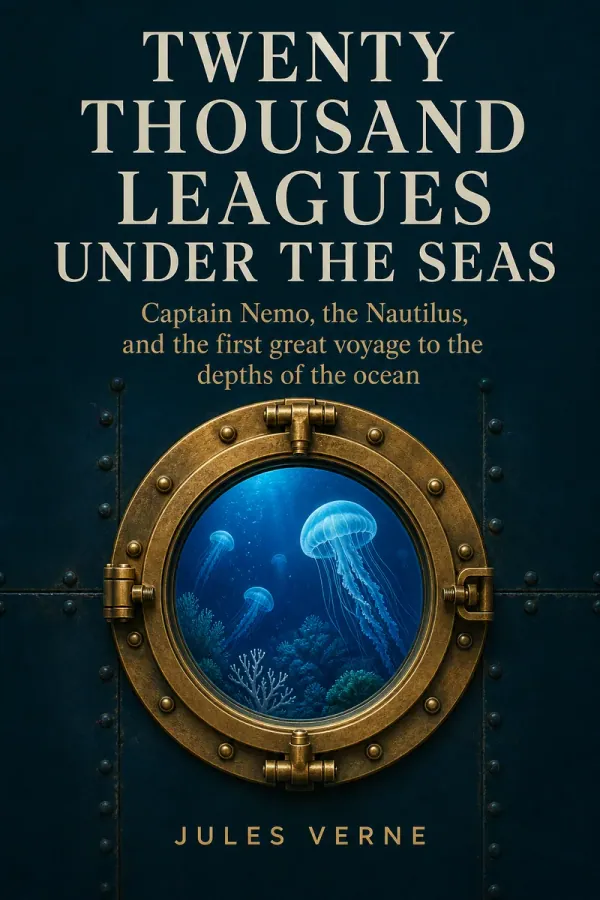
Twenty Thousand Leagues Under the Seas by Jules Verne: Summary and Study Notes
Captain Nemo, the Nautilus, and the first great voyage to the depths of the ocean
Study this topic in OriaThe essentials
Published in 1869-1870, Twenty Thousand Leagues Under the Seas is one of Jules Verne's most famous novels. A French scientist, his servant, and a Canadian harpooner set out to hunt a sea monster and end up prisoners aboard the Nautilus, the electric submarine of Captain Nemo, a genius who has broken with humanity. You'll discover the book's genesis, its stages from the Pacific to the South Pole, Nemo's secret, the novel's scientific and political ideas, and how it has fed the imagination of the whole world.
Key dates and facts
- Jul. 25, 1865
- George Sand's letter to Jules Verne
- Spring 1868
- Final title chosen
- Mar. 20, 1869
- Serial publication begins
- Nov. 1871
- Deluxe illustrated edition from Hetzel
- 1907
- Silent film by Georges Méliès
- 1954
- Disney film with James Mason and Kirk Douglas
- 1954
- Launch of the USS Nautilus, the first nuclear submarine
- 2016
- Molière Award for visual design for the Comédie-Française
🖋️ An idea suggested by George Sand
Jules Verne was born in Nantes on February 8, 1828. After beginning in theater, he found his first great success in 1863 with Five Weeks in a Balloon, published by Pierre-Jules Hetzel. Together, they launched the Voyages extraordinaires, a series of adventure novels that introduced readers to the science and geography of their time. Many first appeared in serial form in the Magasin d'éducation et de récréation, Hetzel's magazine for young readers.
✉️ George Sand's letter
The idea for Twenty Thousand Leagues Under the Seas dates back to the summer of 1865. The novelist George Sand, a friend of Hetzel's, had loved Five Weeks in a Balloon and Journey to the Center of the Earth. On July 25, 1865, she wrote Verne a letter that the writer, very proud of it, would still be showing a journalist more than thirty years later:
"I hope that you will soon take us down into the depths of the sea and have your characters travel in those diving machines that your science and your imagination are free to perfect."
George Sand, letter to Jules Verne (July 25, 1865, translated)
That same year, Verne rented a house in Le Crotoy, on the Picardy coast. It was there that he conceived the novel, before writing it in his villa, "La Solitude." He also had a small boat built, the Saint-Michel. But the project moved slowly: Hetzel had also entrusted him with an Illustrated Geography of France and Its Colonies, an enormous task that kept him busy until early 1868. Verne fumed, then threw himself into the project with passion. In March 1868, he wrote to his publisher that he had never had a finer subject in his hands.
📏 Twenty thousand leagues is a distance
Verne hesitated for a long time over the title: Journey Under the Waters, Twenty-Five Thousand Leagues Under the Oceans, A Thousand Leagues Under the Oceans... He finally settled on Twenty Thousand Leagues Under the Seas in the spring of 1868. Contrary to popular belief, the number does not refer to a depth, but to the total length of the journey. At four kilometers to the metric league, that comes to 80,000 kilometers, nearly twice the circumference of the Earth.
⚔️ An author who stands up to his publisher
Hetzel made suggestion after suggestion: lengthen the book, add comic scenes, make Nemo an enemy of slave traders. Verne refused. In a letter dated May 17, 1869, he explains that one must "keep the vagueness" about the captain's nationality, his person, and the causes of his strange existence. He did, however, accept one of the publisher's ideas: giving Nemo, in the illustrations, the features of Colonel Charras, a republican friend of Hetzel's who died in exile in 1865.
The novel was serialized from March 20, 1869, to June 20, 1870. The two volumes came out in October 1869 and June 1870. Because of the Franco-Prussian War and then the Paris Commune, the deluxe illustrated edition, with 111 drawings by Alphonse de Neuville and Édouard Riou, was not published until November 1871.
🐋 The monster of 1866
The novel opens on a mystery. The first line sets the tone:
"The year 1866 was marked by a strange event, an unexplained and inexplicable phenomenon that no one has probably forgotten."
Jules Verne, Twenty Thousand Leagues Under the Seas, I, 1 (1869, translated)
Ships of every nation report something enormous, long, fast, and phosphorescent, racing beneath the world's seas. It collides with vessels and pierces their hulls, as it did with the liner Scotia. Newspapers go wild, insurance companies threaten to raise their rates, and everyone demands that the ocean be cleared of this sea monster.
🔬 Professor Aronnax
The narrator is Pierre Aronnax, assistant professor at the Paris Museum of Natural History, a specialist in the ocean depths. Passing through New York after an expedition in Nebraska, he puts forward a scholarly hypothesis: the monster might be a giant narwhal, armed with a tusk capable of piercing steel. The American government then invites him to join the expedition tasked with hunting the creature, aboard the frigate Abraham Lincoln, commanded by Farragut.
👥 Three very different companions
Aronnax boards with his Flemish servant, Conseil, thirty years old and unshakably calm. From years spent around scientists, Conseil knows the classification of species by heart, without being able to recognize a fish on sight. He speaks to his master in the third person and follows him everywhere, literally: when Aronnax falls overboard, Conseil jumps in after him, "being in the master's service." Verne named him after a real engineer, Jacques-François Conseil, inventor of a semi-submersible boat.
Also aboard is Ned Land, a Canadian harpooner from Quebec, whom Verne presents as the king of harpooners. A giant of about forty, quick-tempered and without equal at his trade, he does not believe in the monster. There is irony in his name: "land" means dry ground, and this sailor will soon dream of nothing but getting back to it.
💥 On the monster's back
Setting out from Brooklyn, the frigate heads south, rounds Cape Horn, and scours the Pacific for months. Off Japan, it finally encounters the creature and attacks it. The collision is violent: Aronnax and Ned Land are thrown overboard, and Conseil dives in to save his master. After a night adrift, the three castaways haul themselves onto the creature's back and discover, astonished, that it is made of riveted steel plate. It is not an animal, but an underwater boat.
At dawn, eight masked men pull them inside. They meet the vessel's commander, who introduces himself simply as Captain Nemo. He spares their lives and grants them freedom to move about the ship, on one condition: they will never leave the vessel, so that his secret stays safe.
The rest of the course
This page publishes the first 2 parts. The full course has 9: here is what the next ones cover.
- ⚙️ The Nautilus, an electric marvel
Captain Nemo's submarine: its shape, its electric power, its salon-museum, its motto Mobilis in mobile, and the real submarines that inspired it.
- 🏝️ From the Pacific to the Red Sea
The first half of the voyage: hunting in an underwater forest, the wrecks of La Pérouse, running aground in the Torres Strait, the coral cemetery, and pearl fishing off Ceylon.
- 🧊 From Atlantis to the South Pole
The second half of the voyage: the gold of Crete and Vigo, the ruins of Atlantis, the slaughter of the sperm whales, the South Pole, the ice trap, and the attack of the giant squid.
- ⚓ Vengeance and the Maelstrom
The novel's ending: the Vengeur, Nemo's attack on a warship, his anguish, the three heroes' escape into the Maelstrom, and the book's final lines.
- 🏴 Nemo, the man who is no one
Captain Nemo: the meaning of his name, his hatred of oppression, his Polish origin, censored and later revealed as Indian in The Mysterious Island, and his ambiguity as both hero and avenger.
- 🔬 Science, nature, and freedom
The novel's major themes: scientific popularization and anticipation, wonder at nature, an early ecological awareness, freedom, and the critique of civilization.
- 🎬 A worldwide myth
The novel's success and legacy: translations, the manuscript held at the BnF, real submarines named Nautilus, films by Méliès and Disney, theater, comics, and popular culture.
Study “Twenty Thousand Leagues Under the Seas” with flashcards and quizzes
In Oria, you read the full course, then practice on it: flashcards, multiple-choice quizzes, open questions or the Feynman method. Cards and questions then come back in your daily review, paced by spaced repetition.
Study this topic in OriaSources
These notes draw on the sources below. If a point seems doubtful, refer back to them.