Civilizations
The Aztecs: Summary and Study Notes
The eagle people who built an empire on a lake
Study this topic in OriaThe essentials
According to their own legend, the Aztecs left the distant Aztlan to found Tenochtitlan on an island in Lake Texcoco in 1325. In less than two centuries, these newcomers came to dominate central Mexico through the Triple Alliance. You'll discover their capital of canals and floating gardens, their society, their gods and calendars, the reality of human sacrifice, their markets and tribute system, then the Spanish conquest of 1519–1521 and everything Mexico still owes them today.
Key dates and facts
- 1116?
- Departure from Aztlan according to the codices
- 1299
- Settlement at Tizapan, near Culhuacan
- 1325
- Founding of Tenochtitlan, according to tradition
- c. 1375
- Acamapichtli, first Mexica ruler
- 1428
- Destruction of Azcapotzalco, birth of the Triple Alliance
- 1440
- Moctezuma I becomes tlatoani
- 1486 – 1502
- The empire's peak under Ahuitzotl
- 1502
- Moctezuma II comes to power
- April 1519
- Cortés lands on the Veracruz coast
- Nov. 8, 1519
- Cortés meets Moctezuma II
🦅 From Aztlan to Lake Texcoco
The Aztecs, or Mexica, were an Indigenous people of Mesoamerica who spoke Nahuatl. Strictly speaking, the word refers to the inhabitants of Mexico-Tenochtitlan; more loosely, it is sometimes extended to all the Nahua peoples of central Mexico before the Spanish arrived. Their name comes from a place of origin they described in their own accounts: Aztlan. "Aztec" thus means "someone from Aztlan."
🏝️ Aztlan, a mythical place
The name Aztlan is usually translated as "place of whiteness" or "place of herons." The Aztecs' painted manuscripts, the codices, often depict it as a mountain surrounded by water, somewhere to the north. No one has ever located this city. Some historians have searched for it in northwestern Mexico or the southwestern United States; many think it is largely mythical. Historian Christian Duverger argues that its striking resemblance to Tenochtitlan suggests the Aztecs rewrote their own origins after the fact, to justify their settlement.
🚶 A long migration
According to the codices, the future Mexica left Aztlan in the year "1-Flint," usually matched to 1116, or perhaps around 1168. Guided by their tribal god Huitzilopochtli, whose effigy was carried by priests, they are said to have wandered for several generations. This god supposedly ordered them to separate from the other tribes and take the name Mexica.
When they reached the Valley of Mexico in the 13th century, the region was already home to powerful city-states. The Mexica, the last to arrive, were poorly received. Driven from the hill of Chapultepec, in 1299 they obtained from the ruler of Culhuacan the right to settle on the poor lands of Tizapan. There they intermarried with the noble families of Culhuacan, who claimed descent from the prestigious Toltecs, before being expelled once again.
🌵 The eagle on the cactus
According to tradition, the Mexica, taking refuge in the marshes, one day saw an eagle perched on a nopal cactus on a small island in Lake Texcoco. This was the sign Huitzilopochtli had promised: they were to settle there. The accepted date is the year "2-House," or 1325. In the best-known versions, the eagle is devouring a serpent. But the only Aztec monument that shows the scene has something else coming out of the bird's beak, a symbol of war; the serpent may be a later, colonial-era addition. The fruit of the nopal, for its part, symbolized the hearts of sacrifice victims.
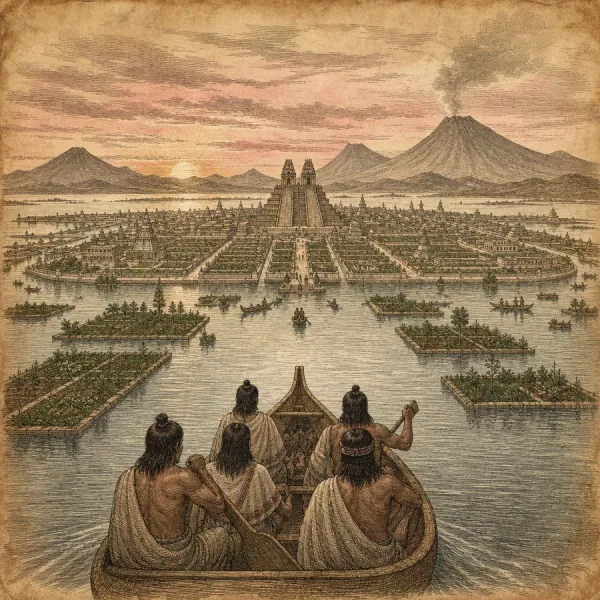
Archaeology complicates this story: the site was occupied well before 1325, and the oldest structures found date to around 1300. Still, on these marshy, resource-poor islets, the Mexica would build the capital of an empire within two centuries.
⚔️ From the Triple Alliance to empire
Around 1375, the Mexica elected their first ruler, Acamapichtli, from a noble line of Culhuacan. His title was tlatoani, "he who speaks." But Tenochtitlan was then only a small city subject to a great neighboring power: Azcapotzalco, capital of the Tepanecs. The Mexica supplied it with warriors and received, in exchange, a share of the tribute taken from conquered peoples. Little by little, their city grew richer.
🤝 1428: the Triple Alliance
When the ruler of Azcapotzalco died in 1426, a succession struggle broke out. The Mexica tlatoani Chimalpopoca died under murky circumstances, probably assassinated by Maxtla, the new master of Azcapotzalco. His successor, Itzcoatl, allied with Nezahualcoyotl, an exiled prince of Texcoco, and with the city of Tlacopan. In 1428, the three allies destroyed Azcapotzalco. This was the birth of the Triple Alliance, the foundation of what is known as the Aztec Empire. Tenochtitlan quickly became the dominant partner, while Texcoco, under Nezahualcoyotl, a patron of the arts and sciences, became the empire's intellectual capital.
🏹 The builders of the empire
Elected in 1440, Moctezuma I extended Aztec rule south and toward the Gulf of Mexico coast. His half-brother and advisor Tlacaelel reorganized the state and religion, strengthened the power of the nobility, and set down codes of law. He is also credited with destroying the old codices, to rewrite a more glorious history of the Mexica.
Facing three cities that resisted, Tlaxcala, Huexotzinco, and Cholula, Moctezuma I waged so-called "flower wars": ritualized, recurring clashes meant less to kill than to take prisoners, which also served as training. The Tlaxcalans would remain bitter enemies of the Mexica, which would matter a great deal in 1519.
🏔️ Conquests and setbacks
His successors continued the expansion. From 1469, Axayacatl annexed Tlatelolco, Tenochtitlan's twin city and home to its vast marketplace. But in 1478–1479 he suffered a heavy defeat against the Tarascans, the empire's only real rival, to the west. Under Ahuitzotl (1486–1502), the empire reached its height: it stretched from the Gulf of Mexico to the Pacific Ocean, and from the borders of the Tarascan kingdom to the Isthmus of Tehuantepec in the south.
👑 An empire of tribute
The Aztec Empire did not resemble the empires of Europe. It did not station garrisons everywhere and did not directly administer conquered territories. A defeated city generally kept its own rulers, as long as it regularly paid tribute and acknowledged Tenochtitlan's supremacy. Historians call this a hegemonic empire, held together by fear of Mexica armies, marriages between ruling families, and an ideology that made the Mexica the chosen people of the Sun. This efficient system was also fragile: it only took one power challenging the empire for subject cities to consider revolt.
The rest of the course
This page publishes the first 2 parts. The full course has 8: here is what the next ones cover.
- 🏙️ Tenochtitlan, the city on the lake
The Aztec capital: a city built on islets in Lake Texcoco, with its canals, causeways, aqueducts, chinampas, sacred precinct and the Templo Mayor, rediscovered in 1978.
- 👥 Nobles, commoners, warriors: Aztec society
How Aztec society was organized: city-states (altepetl) and neighborhoods (calpolli), nobles and commoners, advancement through war, non-hereditary slavery, compulsory education and women's place in society.
- ☀️ Gods, calendars, and sacrifice
Aztec religion: the great gods, the myth of the five Suns, the dual calendar of 260 and 365 days and the 52-year cycle, the Sun Stone, and what is actually known about human sacrifice.
- 🌽 Maize, markets, and tribute
The Aztec economy: maize farming and chinampas, crafts, markets such as Tlatelolco's, pochteca traders, cacao-bean and cotton-cloak currencies, and tribute paid by the empire's provinces.
- ⛵ 1519–1521: the Spanish conquest
The fall of the Aztec Empire: Hernán Cortés's arrival in 1519, the alliance with Tlaxcala, the meeting with Moctezuma II, the emperor's death, the Noche Triste, the smallpox epidemic, the siege and fall of Tenochtitlan on August 13, 1521, and the causes of the defeat.
- 🇲🇽 The Aztec legacy in Mexico
What remains of the Aztecs: Mexico City built over Tenochtitlan, the demographic collapse of the colonial era, the survival of elites and cities, the Nahuatl language and loanwords, cuisine, religious syncretism, and the Aztecs' place in Mexican national identity.
Study “The Aztecs” with flashcards and quizzes
In Oria, you read the full course, then practice on it: flashcards, multiple-choice quizzes, open questions or the Feynman method. Cards and questions then come back in your daily review, paced by spaced repetition.
Study this topic in OriaSources
These notes draw on the sources below. If a point seems doubtful, refer back to them.