Civilizations
The Phoenicians and Carthage: Summary and Study Notes
Sailors, merchants and carriers of the alphabet
Study this topic in OriaThe essentials
On a narrow strip of coast at the foot of Mount Lebanon, merchant cities such as Tyre, Sidon and Byblos sent their ships as far as the Atlantic. They spread the alphabet from which Greek, Latin, Hebrew and Arabic descend, and founded Carthage, which would dominate the western Mediterranean before taking on Rome. You'll discover who the Phoenicians were, how they traded, how the Carthaginian republic worked, the saga of Hannibal, and what remains of a world destroyed in 146 BC.
Key dates and facts
- 14th century BC
- Amarna letters from the kings of Tyre and Byblos
- c. 1200 BC
- Late Bronze Age crisis
- 853 BC
- Battle of Qarqar against Assyria
- 539 BC
- Start of Persian rule
- 64 BC
- Absorbed into the Roman province of Syria
- 264 BC
- Start of the First Punic War
- 218 BC
- Hannibal crosses the Alps
- 216 BC
- Hannibal's victory at Cannae
- 202 BC
- Hannibal's defeat at Zama
🌊 Phoenicia, a string of cities by the sea
The Phoenicians were the inhabitants of a series of port cities in the Levant, on the coast of what is now Lebanon, Syria and northern Israel. In the 1st millennium BC, their ships crisscrossed the entire Mediterranean. They founded trading posts as far as the Atlantic, spread the alphabet and gave birth to Carthage, one of the great powers of antiquity.
🏷️ A people named by others
The Phoenicians never defined themselves as a single people, at least not before the Hellenistic period. They called themselves people of Tyre, of Sidon or of Byblos. It was the Greeks who called them Phoinikes, as early as the time of Homer. The origin of the word is debated: it has been linked to the Greek words for “palm tree” or “purple red,” the color of one of their most famous products. Near Eastern texts, including the Bible, speak instead of the land of Canaan and of the Canaanites, a broader term. Their language, Phoenician, was a Semitic language very close to Hebrew.
⛰️ Between the sea and the mountains
Phoenicia was a thin coastal strip, running from Akko (Acre) in the south to the area of Jableh in the north, squeezed between the Mediterranean and mountains, including Mount Lebanon. Farmland was scarce, but it produced grain, wine and olive oil, and the mountains supplied the most sought-after timber in the Near East: the cedar of Lebanon. The terrain split the land into small independent kingdoms that looked out to sea.
🏙️ Byblos, Sidon, Tyre and Arwad
Each city was a kingdom built around one or two busy harbors. Byblos, one of the oldest, has yielded the earliest examples of the Phoenician alphabet. Sidon was a great city of craftsmen and merchants. Tyre, whose Phoenician name Sor means “the Rock,” was built on an island, like Arwad, which lay 2.5 km off the coast. These cities were surprisingly small: about 16 hectares at most for Tyre, 5 to 6 for Sidon and Byblos.
At their head were kings who succeeded one another by dynastic rule. They were military leaders, supreme judges and representatives of the city's patron god; some even called themselves priests of the goddess Astarte. Tyre also had a council of elders.
🔍 A people known through its neighbors
The Phoenicians left very few texts: they wrote on perishable materials, and most of their cities, still inhabited today, could only be excavated in places. We know them mainly through outside sources: Egyptian accounts, Assyrian inscriptions, the Bible, Greek and Latin authors. Yet this testimony is often biased. The Greeks admired their skill as sailors, merchants and craftsmen, but also described them as cunning traders, even pirates, clichés that say as much about the Greeks as about the Phoenicians.
📜 From Canaanites to empires: the history of the Phoenician cities
Phoenician civilization did not appear out of nowhere. Its cities already existed in the 2nd millennium BC, during the Bronze Age, when historians speak of Canaanite culture. In the 14th century BC, the kings of Tyre, Byblos and Sidon wrote to the pharaohs in the famous Amarna letters. The great port of Ugarit, in Syria, already shows how important sea trade was in the region.
🌪️ The crisis of 1200
Around 1200 BC, a great crisis shook the entire Near East. The Hittite empire vanished, Egypt lost its influence in the Levant, and Ugarit was destroyed. This destruction is attributed to invaders the Egyptians called the “Sea Peoples,” a phenomenon that is still poorly understood. The Phoenician cities seem to have weathered it better than their neighbors; freed from the great empires, they became autonomous and ambitious. An Egyptian tale, the Story of Wenamun, shows the king of Byblos treating an envoy sent from Egypt to fetch timber with open disdain.
👑 The height of Tyre
In the 10th and 9th centuries BC, Tyre became the most powerful of the Phoenician cities. According to the Bible and the historian Flavius Josephus, its king Hiram helped King Solomon build the Temple in Jerusalem and lent him ships for distant expeditions. Another king of Tyre, Ithobaal I, married his daughter Jezebel to King Ahab of Israel. At the end of the 9th century BC, Tyre founded its most important colonies, starting with Carthage.
⛓️ Facing the great empires
From the 9th century BC, Assyria imposed tribute on the Phoenician cities. In 853 BC, several of them joined a coalition against the Assyrian king Shalmaneser III at the battle of Qarqar, without lasting success. In the 8th century BC, the Assyrians began annexing their territory. Sidon, in revolt, was sacked by Esarhaddon; Tyre lost some of its trading rights. Yet these cities remained prosperous, and the pressure of tribute may even have encouraged their expansion overseas.
After the fall of Assyria, the Babylonian king Nebuchadnezzar II besieged Tyre for thirteen years. Then, from 539 BC, the cities came under the rule of the Achaemenid Persians, who were more flexible: they kept their kings in exchange for tribute and their fleets. The ships of Tyre, Sidon and Arwad thus fought in the Persian Wars against the Greeks.
🏛️ From Alexander to Rome
When Alexander the Great reached Phoenicia, after 333 BC, most of the cities went over to him. Only Tyre resisted: Alexander had a causeway built to link the island to the mainland and took the city after a hard siege. In the Hellenistic period, the Phoenician kings were replaced by magistrates, and the elites adopted Greek language and culture. In 64 BC, Phoenicia was absorbed into the Roman province of Syria. The Phoenician language died out in the Levant at the beginning of the Common Era, replaced by Greek and Aramaic.
The rest of the course
This page publishes the first 2 parts. The full course has 9: here is what the next ones cover.
- ⛵ Sailors, merchants and craftsmen
The Phoenicians' know-how: their ships and sea routes, the goods they traded (metals, purple dye, cedar, wine), the great voyages reported by the Greeks, and their crafts (purple dye, glass, ivory).
- 🔤 The alphabet, the Phoenicians' great gift
The Phoenician alphabet: its 22 consonant letters, its origins, how acrophony works, its spread across the Mediterranean, and its Greek, Latin, Cyrillic, Hebrew and Arabic descendants.
- 🐂 Dido and the birth of Carthage
Phoenician expansion across the Mediterranean, the founding of Carthage (c. 814 BC according to tradition), the legend of Dido, and Carthage's rise to dominance over the western Mediterranean.
- 🏛️ The republic of Carthage: suffetes, fleet and gods
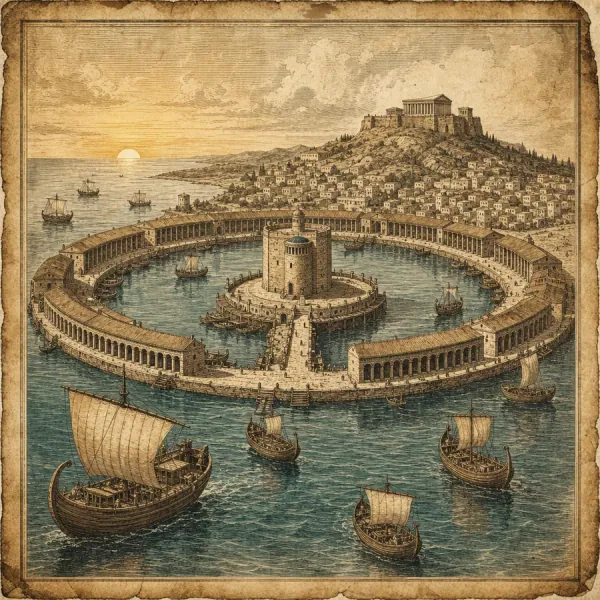
How Carthage worked: its political system (suffetes, council, the Tribunal of the One Hundred and Four, the popular assembly), its mercenary army, its fleet and circular harbor, its farming and its religion, including the debate over the tophet.
- 🐘 Rome against Carthage: the First Punic War and Hannibal
The first two Punic Wars (264–241 and 218–201 BC): the war for Sicily, the Mercenary revolt, the Barcids in Spain, then Hannibal, the crossing of the Alps, Cannae and the defeat at Zama.
- 🔥 146 BC: “Carthage must be destroyed”
The Third Punic War (149–146 BC): its causes, Rome's demands, the three-year siege, the destruction of Carthage, and the myth of salt sown on its ruins.
- 🌿 What remains of the Phoenicians and Carthage
The Phoenician and Punic legacy: the survival of the Punic language in Roman Africa, the image of Carthage among its enemies, Phoenicianism in Lebanon, the site of Carthage in Tunisia, and the myth of Phoenicians in America.
Study “The Phoenicians and Carthage” with flashcards and quizzes
In Oria, you read the full course, then practice on it: flashcards, multiple-choice quizzes, open questions or the Feynman method. Cards and questions then come back in your daily review, paced by spaced repetition.
Study this topic in OriaSources
These notes draw on the sources below. If a point seems doubtful, refer back to them.