Business & money
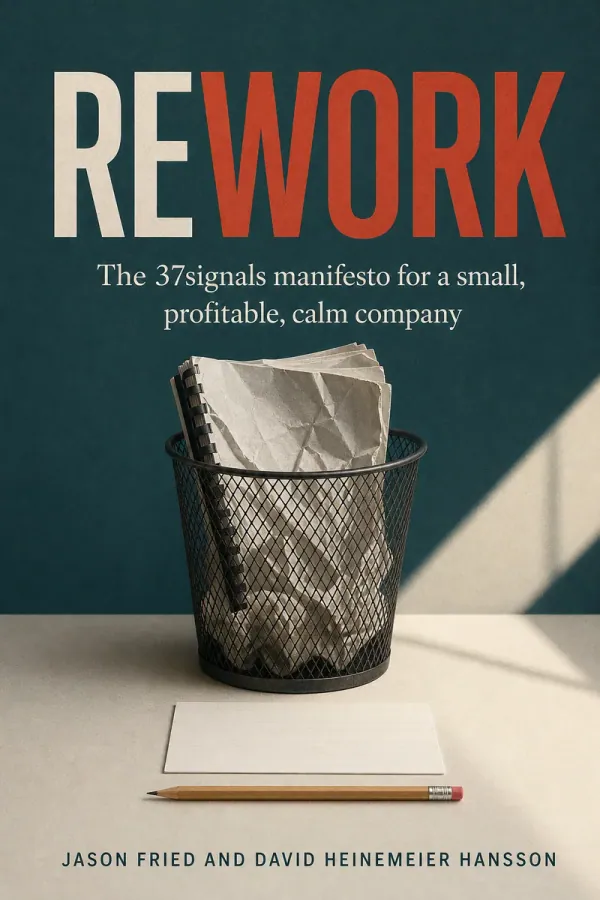
Rework by Jason Fried and David Heinemeier Hansson: Summary and Study Notes
The 37signals manifesto for a small, profitable, calm company
Study this topic in OriaThe essentials
Published in 2010, Rework gathers in short chapters the philosophy of Jason Fried and David Heinemeier Hansson, the founders of the software company 37signals, known for Basecamp and Ruby on Rails. The book attacks the dogmas of the business world: long-term plans, growth at all costs, fundraising, meetings, the cult of overwork. You'll discover its big ideas on how to get started, build a product, work, get noticed and hire, then what critics and the company's own history say about its limits.
Key dates and facts
- 1999
- 37signals founded in Chicago
- 2004
- Launch of Basecamp and Ruby on Rails
- 2006
- First book, Getting Real
- 2010
- Publication of Rework
- 1979
- David Heinemeier Hansson born in Copenhagen
- 1999
- Jason Fried co-founds 37signals
- 2004
- Ruby on Rails released as open source
- 2012
- Hansson's first 24 Hours of Le Mans
📘 A manifesto born on a blog
Rework is the work of two partners at the American software company 37signals, based in Chicago: Jason Fried and David Heinemeier Hansson. The book gathers the working philosophy they had been advocating for years on their blog, which had made their small company a reference in the world of online software.
🏢 A small company that became famous
37signals was founded in 1999 by Jason Fried, Carlos Segura and Ernest Kim as a web design agency. Its name refers to the 37 radio signals identified by the astronomer Paul Horowitz as possible extraterrestrial messages. In 2004, unhappy with existing project management tools, the team built its own: Basecamp, which became its flagship product. To build it, the Danish programmer David Heinemeier Hansson developed a web development framework, Ruby on Rails, released as open source the same year and widely adopted by web developers since.
In 2006, the company published a first book, Getting Real, about designing simple web applications. The same year, Jeff Bezos took a minority stake in the company through his personal investment firm.
📖 The book
Rework was published on March 9, 2010 by Crown Business, an imprint of Random House, and became a New York Times best-seller. A French translation, Rework : réussir autrement, came out from Maxima in 2011, followed by a second edition in 2012.
Its format is original: nearly ninety very short chapters, often one to three pages long, grouped into major parts (“First,” “Takedowns,” “Go,” “Progress,” “Productivity,” “Competitors,” “Evolution,” “Promotion,” “Hiring,” “Damage Control,” “Culture”). Each chapter has a slogan for a title, and the book is illustrated with line drawings by the illustrator Mike Rohde.
💬 The tone: experience over theory
From the introduction, the authors make clear that they are speaking not as professors, but as practitioners. At the time of writing, their company had only sixteen people spread across eight cities on two continents; it was profitable and claimed more than three million users. The book, they insist, rests not on academic theories but on their own experience.
🧨 Tearing down conventional wisdom
The first part of Rework, Jason Fried and David Heinemeier Hansson's book, lines up a series of Takedowns. It goes after the ideas that business founders hear over and over without anyone ever questioning them.
🌍 “Ignore the real world”
When you suggest a new idea, someone often replies that it would never work in the real world. For the authors, this so-called real world is mostly a collection of habits and fears. What is true for others isn't necessarily true for you.
❌ Learning from mistakes is overrated
The startup world readily celebrates failure as a school. The authors disagree: knowing what didn't work doesn't tell you what will. For them, you learn more from your successes, which show you what to do again.
🔮 “Planning is guessing”
This is one of the most quoted chapters. The authors see five-year plans as an illusion: the market, competitors, customers and the economy change too fast to be predicted. Calling a guess a “plan” gives a false sense of control and makes people cling to it even when reality has changed. They prefer to decide as they go, focusing on the week ahead rather than the year after.
📏 Why grow?
In the business world, a company that doesn't get bigger is seen as a failure. The authors ask the opposite question: why should size be a goal in itself? A small, profitable company that finds its right size and sticks to it is anything but a failed project. Growing too fast multiplies costs, meetings and bureaucracy.
😵 Against the cult of overwork
The book devotes an entire chapter to workaholism, the cult of endless days. For the authors, working nonstop is no proof of commitment: it wears you out, creates artificial crises and pushes you to solve problems by sheer hours rather than by thinking. The people who stay latest at the office aren't the ones with the best ideas.
Finally, they propose doing away with the word “entrepreneur,” which they find intimidating: you can simply talk about people who start something.
The rest of the course
This page publishes the first 2 parts. The full course has 9: here is what the next ones cover.
- 🚀 Starting with almost nothing
Rework's advice for getting started: solve your own problem, find the time, take a stand, avoid outside money and build a business rather than a startup to sell.
- ✂️ Do less, but better
Rework's ideas on building a product: embrace constraints, build half a product rather than a half-baked one, cut, say no, and do less than your competitors.
- ⏱️ Meetings, interruptions and false heroes
Rework's productivity advice: protect uninterrupted time, beware of meetings, aim for “good enough,” sleep, and break down tasks and decisions.
- 📣 Getting noticed by teaching
Rework's vision of marketing: build an audience, out-teach your competitors, emulate great chefs, show what goes on behind the scenes and be wary of press releases.
- 🤝 Hiring and building a calm culture
Rework's advice on hiring, handling mistakes and company culture: hire late, recruit good writers, trust people, go home at 5.
- ✍️ Jason Fried and David Heinemeier Hansson
The two authors of Rework: Jason Fried, co-founder and head of 37signals, and David Heinemeier Hansson, the Danish creator of Ruby on Rails and a racing driver, along with how their company evolved.
- ⚖️ Reception, criticism and limits
Rework's success and the praise it received, then its limits: advice tailored to a small software company, an argument based on a single case, and Basecamp's internal crisis in 2021.
Study “Rework” with flashcards and quizzes
In Oria, you read the full course, then practice on it: flashcards, multiple-choice quizzes, open questions or the Feynman method. Cards and questions then come back in your daily review, paced by spaced repetition.
Study this topic in OriaSources
These notes draw on the sources below. If a point seems doubtful, refer back to them.