Business & money
Shoe Dog by Phil Knight: Summary and Study Notes
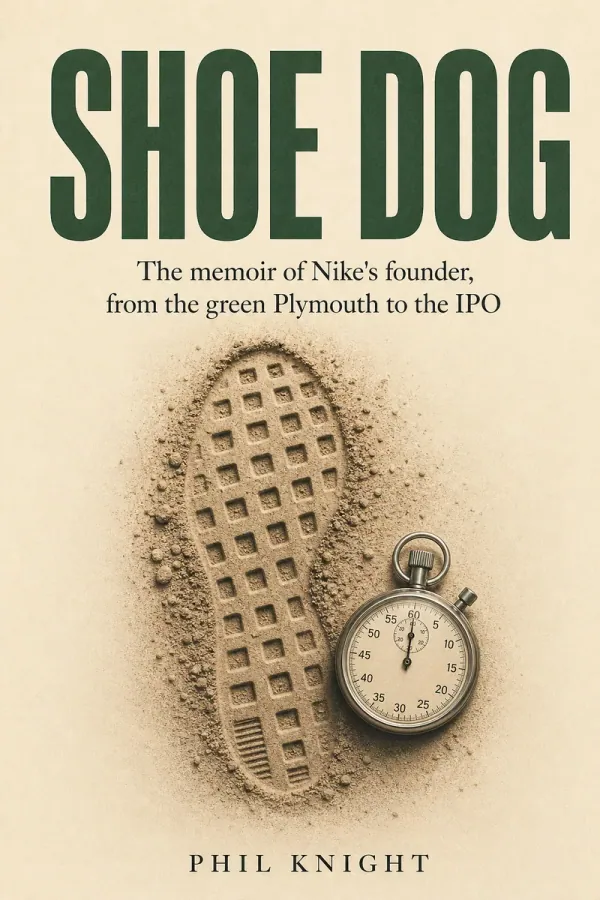
The memoir of Nike's founder, from the green Plymouth to the IPO
Study this topic in OriaThe essentials
Published in 2016, Shoe Dog tells the story of Nike's birth in the words of its founder, Phil Knight, long known for avoiding the press. The story covers mainly the years 1962 to 1980: a trip to Japan, a handshake with coach Bill Bowerman, shoes sold out of a car trunk, a brutal break with the Japanese supplier, and years of debt. You'll also discover who Phil Knight is, how the book was received, and what this first-person account leaves out.
Key dates and facts
- 1962
- Phil Knight's trip to Japan
- 1964
- Blue Ribbon Sports is founded
- 1980
- Nike's IPO
- 2016
- Shoe Dog is published
- 1964
- Knight and Bowerman's agreement
- 1966
- First store, in Santa Monica
- 1967
- Expansion to the East Coast
- 1969
- Knight finally commits to the company full time
- 1938
- Born in Portland
- 1964
- Founds Blue Ribbon Sports
📘 The boss who never talked finally tells his story
Shoe Dog is the memoir of Phil Knight, Nike's co-founder. It was published on April 26, 2016 in the United States by Scribner, an imprint of Simon & Schuster, and in French in 2017 by Hugo Doc under the title L'Art de la victoire. In the trade, the phrase "shoe dog" describes someone completely obsessed with shoes: making them, selling them, obsessing over every detail.
🤫 A long-discreet man
When the book came out, Knight was about to step down as chairman of Nike's board, a role he officially gave up at the end of June 2016. He had run the company for four decades while almost never telling his own story. The book's back cover makes the point explicit: the man behind the famous logo had remained a mystery, and this book was said to be the first time he told his own story himself.
Like many executive memoirs, the text wasn't written alone. It was put together with the help of J. R. Moehringer, an American journalist who won the Pulitzer Prize in 2000 and who would later work as a ghostwriter on Prince Harry's memoir, Spare (2023). That partly explains the book's very literary tone, far from the usual management handbook.
🗓️ A story that stops in 1980
The book doesn't tell the whole history of Nike. It mainly follows the start-up years, from 1962 to the December 1980 IPO, with a retrospective glance at what came after. The narrative blends business decisions, money worries, and family life. Wikipedia sums it up this way: it follows the company from its beginnings as Blue Ribbon Sports to its growth into one of the most profitable brands in the world.
The book was a major success. It made the New York Times bestseller lists, Bill Gates named it one of his five favorite books of 2016, and Warren Buffett called it the best book he read that year. An abridged edition for young readers came out in 2017.
🌏 1962: a Japanese bet and a trip around the world
At the start of Shoe Dog, Phil Knight is 24 years old. A former middle-distance runner at the University of Oregon, he has just finished an MBA at Stanford and doesn't want a conventional career at a big corporation. He has an idea in mind, one that seems quite risky at the time.
📷 Shoes like cameras
During a small-business class at Stanford, Knight wrote a paper with a telling title: could Japanese athletic shoes do to German shoes what Japanese cameras had done to German cameras? At the time, German shoes dominated the market. Knight bet that a Japanese manufacturer could produce quality shoes, more cheaply, and conquer the American market.
The idea was far from obvious in the early 1960s: running wasn't yet a mass hobby in the United States. It would only become one in the 1970s, with the jogging boom.
✈️ The trip to Kobe
After graduating in 1962, Knight borrowed $50 from his father, according to the publisher's description, and set off on a trip around the world. In November 1962, he stopped in Kobe, Japan. There he discovered the Tiger running shoes made by the Onitsuka company, founded in 1949 by Kihachiro Onitsuka and later folded into Asics.
Impressed by the shoes' quality and price, Knight got a meeting with Mr. Onitsuka himself. By the end of the meeting, he walked away with the distribution rights for Tiger shoes in the western United States. For a young graduate with no stock and no customers, it was a bold first bet.
⏳ A long wait
The first samples would take more than a year to arrive. In the meantime, Knight returned to Portland and took a job as an accountant. He went on to work for accounting firms Coopers & Lybrand and then Price Waterhouse, and also taught management at Portland State University. For years, then, Nike was the side project of a man who kept another job to pay his bills.
The rest of the course
This page publishes the first 2 parts. The full course has 8: here is what the next ones cover.
- 🤝 Blue Ribbon Sports: a handshake and a car trunk
The founding of Blue Ribbon Sports in 1964 by Phil Knight and Bill Bowerman, trackside sales from a Plymouth Valiant, and the small early team.
- 🧇 Bill Bowerman, the inventor-coach
Bill Bowerman's role in Shoe Dog: Oregon's legendary coach, inventor of the Cortez and the waffle sole, and mentor to Steve Prefontaine.
- ⚔️ The break with Onitsuka and the birth of Nike
The crisis with Japanese supplier Onitsuka in the early 1970s, the choice of the name Nike and the Swoosh logo, and the lawsuit that followed the split.
- 💸 Debts, bankers, and high-stakes gambles until 1980
The second half of Shoe Dog: rapid growth financed on credit, wary bankers, a federal investigation, advertising, and the December 1980 IPO.
- 👟 Phil Knight, the author
Who is Phil Knight, the author of Shoe Dog: an Oregon runner, an accountant, Nike's boss from 1964 to 2004, then a philanthropist and owner of the Laika studio.
- ⚖️ Reception, criticism, and limits
The success of Shoe Dog (Gates, Buffett, the Netflix project), then its limits: a first-person account written with a ghostwriter, pages judged tedious, and topics left out, such as subcontracted factories.
Study “Shoe Dog” with flashcards and quizzes
In Oria, you read the full course, then practice on it: flashcards, multiple-choice quizzes, open questions or the Feynman method. Cards and questions then come back in your daily review, paced by spaced repetition.
Study this topic in OriaSources
These notes draw on the sources below. If a point seems doubtful, refer back to them.