Business & money
Steve Jobs: Biography and Study Notes
Apple's co-founder, caught between product genius and a feared management style
Study this topic in OriaThe essentials
An adopted child of Silicon Valley, Steve Jobs co-founded Apple in his family's garage in 1976, launched the Macintosh, and was then forced out in 1985. With NeXT and Pixar, he bounced back, before returning to save Apple in 1997 and going on to launch the iMac, the iPod, the iPhone, and the iPad. You will follow his life step by step, his illness, his way of working, and the criticism it drew, to understand why he remains one of the most influential — and most debated — entrepreneurs of his time.
Key dates and facts
- 1976
- Apple founded, April 1
- 1977
- Apple II launched
- 1980
- Apple goes public
- 1984
- Macintosh launched
- 1998
- iMac launched
- 2001
- iPod launched
- 2007
- iPhone unveiled, January 9
- 2010
- iPad unveiled
- 2003
- Diagnosed with pancreatic cancer
- 2009
- Liver transplant in Memphis
🏡 An Adopted Childhood in California
Steven Paul Jobs was born on February 24, 1955, in San Francisco, California. His biological mother, Joanne Schieble, was an American graduate student of Swiss-German descent; his biological father, Abdulfattah “John” Jandali, a Syrian doctoral student in political science. Joanne's father objected to their relationship. Pregnant, she chose to put the baby up for adoption and asked that he be placed with college graduates.
👨👩👦 Paul and Clara Jobs
The lawyer couple originally chosen backed out upon learning the baby was a boy. Steve was ultimately adopted by Paul Jobs, a former coast guardsman turned machinist, and his wife Clara, an Armenian-American bookkeeper. Since they had no college degrees, Joanne Schieble at first refused to sign the adoption papers, then agreed once they promised to pay for their son's education. For the rest of his life, Steve Jobs considered Paul and Clara his real parents, “1,000%,” he would later tell his biographer. In 1957, the couple adopted a daughter, Patty.
🔧 The Garage Workbench
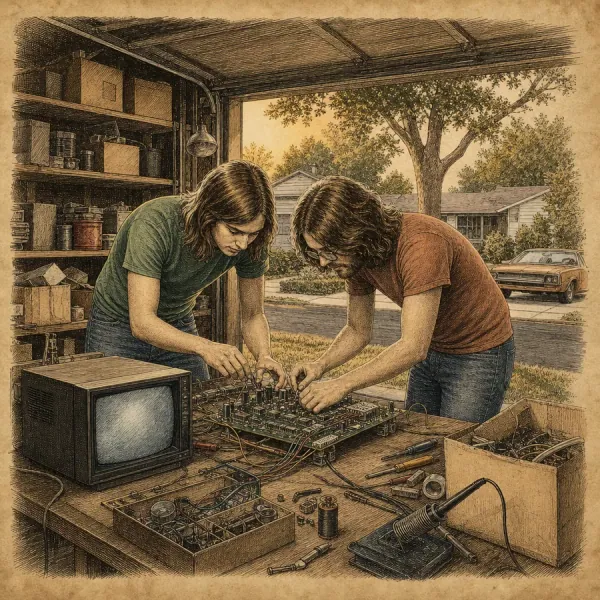
The family settled in Mountain View, south of San Francisco, at the heart of what would become Silicon Valley. Paul set up a workbench for his son in the garage and passed on to him his love of careful craftsmanship along with some basic electronics. Steve admired his father, who could build almost anything.
At school, the boy was quick-witted but chafed at authority: he pulled pranks and was sent home for a few days on several occasions. He skipped a grade, then, bullied in middle school, gave his parents an ultimatum: either they moved him to another school, or he would quit altogether. In 1967, the family spent its entire savings to buy a house in Los Altos, in a better school district. At thirteen, Steve called Bill Hewlett, co-founder of Hewlett-Packard, directly to ask for electronic parts: he got them, along with a summer job at the company.
📞 Meeting Wozniak
At Homestead High School, a classmate, Bill Fernandez, introduced him to Steve Wozniak, a few years his senior and an electronics genius. The two became friends. Jobs was also drawn to music and literature, from Shakespeare to Plato, and to hippie counterculture. In 1971, inspired by an article in Esquire magazine, Wozniak built a “blue box,” a small device that mimicked the phone network's signals to place free, illegal long-distance calls. Jobs came up with the idea of selling them and splitting the profits. He would later say that without those boxes, there would have been no Apple: they showed the two of them that they could take on big companies.
A region south of the San Francisco Bay, in California, home to a huge concentration of electronics and computing companies, such as Hewlett-Packard, Intel, and Apple. Steve Jobs's high school already had close ties to these companies.
🧘 Reed College, India, and the Counterculture
In September 1972, Steve Jobs enrolled at Reed College in Portland, Oregon, an expensive school his parents could barely afford. After a single semester, he dropped out without telling them: he did not want to spend their money on an education that felt meaningless to him. He kept attending classes that interested him as an unofficial auditor, though.
✒️ The Calligraphy Class
He lived with almost no money at the time: he slept on the floor in friends' dorm rooms, collected bottle deposits to buy food, and walked across town every week for a free meal at a Hare Krishna temple. Among the classes he audited was a calligraphy class, the art of beautiful handwriting. Years later, he would say that it was thanks to this class that the Macintosh became the first computer with beautiful typography. Around this time, he became a vegetarian, grew interested in Eastern spirituality, and experimented with LSD, an experience he would later describe as one of the most important of his life.
🕹️ Atari
In February 1974, he moved back in with his parents and got hired as a technician at Atari, a trendy video game maker. His boss, Nolan Bushnell, would later describe him as difficult but valuable, often the smartest person in the room, and not shy about saying so.
🕉️ The Trip to India
In mid-1974, he traveled to India with his friend Daniel Kottke in search of spiritual teaching. The guru he had hoped to meet, Neem Karoli Baba, had died the previous year. After seven months, Jobs returned to the United States with a shaved head, dressed in Indian clothing. He went on to practice Zen Buddhism under teacher Kōbun Chino Otogawa and went on long meditation retreats. Zen would leave a lasting mark on his taste for simplicity, later visible in his products' design.
🧱 The Breakout Episode
Back at Atari in 1975, he was assigned to design the circuit board for the game Breakout using as few chips as possible, with a bonus promised for every chip saved. He brought in Wozniak, who, over four days, cut the circuit down to 45 chips. Jobs told him they had earned a few hundred dollars and gave him half; according to several witnesses, including Bushnell, the actual bonus was around $5,000. Wozniak would not learn the truth until ten years later and was hurt by it, while insisting he would gladly have given the money to his friend had Jobs simply asked.
In 1975, the two Steves began attending the Homebrew Computer Club, a gathering of computer enthusiasts who traded ideas and machine designs. It was there that the idea for Apple would be born.
The rest of the course
This page publishes the first 2 parts. The full course has 9: here is what the next ones cover.
- 🍎 Apple, from the Family Garage to a Fortune
The founding of Apple on April 1, 1976 with Wozniak, the Apple I, the success of the Apple II, the 1980 IPO, the Xerox PARC visit, the birth of his daughter Lisa, and John Sculley's arrival.
- 🖥️ The Macintosh and the Ouster
The January 1984 Macintosh launch and the '1984' ad, the 'reality distortion field,' its relatively weak sales, the power struggle with Sculley, and Jobs's departure in September 1985.
- 🎬 NeXT and Pixar: The Wilderness Years
Jobs's years outside Apple (1985–1997): the company NeXT and its brilliant but overpriced computers, the Pixar acquisition and the success of Toy Story, his marriage, and discovering his biological family.
- 🔄 The Return to Apple
Apple's 1997 acquisition of NeXT, Jobs's return to lead a company on the brink of bankruptcy, product cuts, the deal with Microsoft, the 'Think different' campaign, and the 1998 iMac.
- 📱 iPod, iPhone, iPad: A Decade of Revolutions
Apple's transformation under Jobs in the 2000s: iTunes, Apple Store, and the iPod (2001), the iTunes Store (2003), the iPhone (2007) and App Store, the iPad (2010), keynotes, and Apple's standing in 2011.
- 🕯️ Illness and Death
Steve Jobs's pancreatic cancer diagnosed in 2003, his initial refusal of surgery, the Stanford speech (2005), the liver transplant (2009), his resignation in August 2011, and his death on October 5, 2011.
- ⚖️ An Admired and Criticized Boss: Style and Legacy
Steve Jobs's management style (perfectionism, design, closed systems), the criticism it drew (harshness, ethics, philanthropy), and his legacy in industry and culture.
Study “Steve Jobs” with flashcards and quizzes
In Oria, you read the full course, then practice on it: flashcards, multiple-choice quizzes, open questions or the Feynman method. Cards and questions then come back in your daily review, paced by spaced repetition.
Study this topic in OriaSources
These notes draw on the sources below. If a point seems doubtful, refer back to them.