Business & money
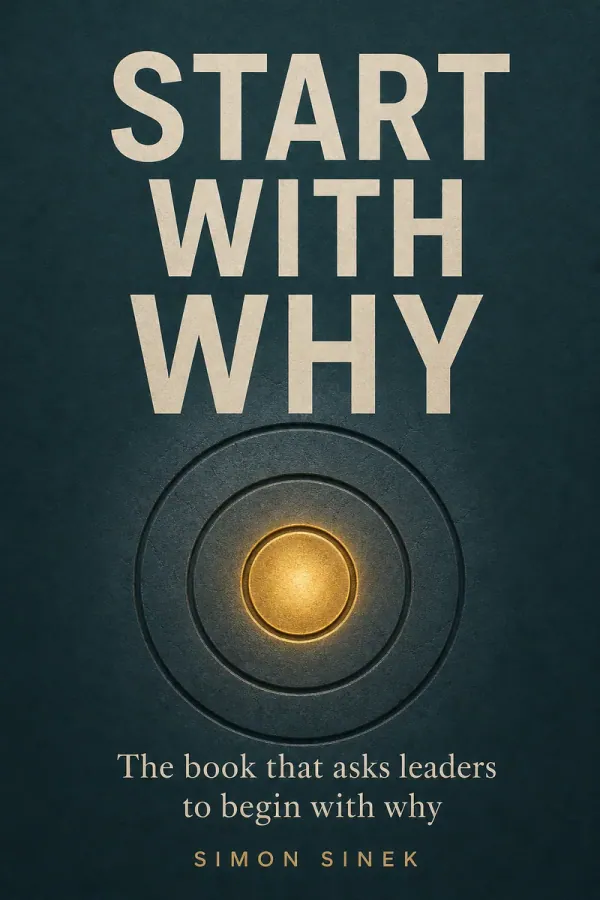
Start with Why by Simon Sinek: Summary and Study Notes
The book that asks leaders to begin with why
Study this topic in OriaThe essentials
Published in 2009, Simon Sinek's Start with Why became a classic of leadership training, carried along by one of the most-watched TED talks ever. Its idea: organizations that inspire explain first why they exist, before saying how they work and what they sell. You'll discover the golden circle, the difference between manipulating and inspiring, the examples of Apple, the Wright brothers, and Martin Luther King, the celery test, and the criticism aimed at the model's oversimplified neuroscience.
Key dates and facts
- 2009
- Book published and TEDx talk given
- 2014
- Leaders Eat Last , Sinek's second book
- 2017
- Find Your Why , a practical guide
- 2019
- The Infinite Game
- 1898
- Langley receives $50,000 from the War Department
- Oct. 7, 1903
- First failure of Langley's Aerodrome
- Dec. 8, 1903
- Second failure, Langley gives up
- Dec. 17, 1903
- First flight by the Wright brothers
- 1973
- Born in Wimbledon
- 2009
- Start with Why and the TEDx talk
📘 From a 2009 book to a viral talk
Start with Why: How Great Leaders Inspire Everyone to Take Action is a management book by Simon Sinek, published in 2009 in the United States by Portfolio, an imprint of Penguin. It runs to about 250 pages.
🎤 A talk that goes around the world
The book owes much of its fame to a talk. In September 2009, at a TEDx event held in the Puget Sound area, near Seattle, Sinek presented the central idea of his book, under the title How Great Leaders Inspire Action. Later distributed by TED, the video became one of the most-watched TED talks: by late 2013, it already ranked among the site's most popular, with more than ten million views.
Success in bookstores followed. According to NPD BookScan figures published by Forbes, Start with Why was the best-selling leadership book in the United States between mid-2016 and mid-2017, with 171,000 paperback copies sold eight years after its release. In 2019, an academic article estimated its sales at more than a million copies.
🗂️ A book in six parts
The book follows a simple progression:
- a world that doesn't start with why, where people manipulate more than they inspire;
- a different perspective: the golden circle and its supposed biological basis;
- leaders need people who follow them: trust and the spread of ideas;
- how to bring together those who share our convictions;
- the biggest challenge is success: what happens when an organization grows and loses its why;
- finding your why.
The book is aimed at business leaders, but also at anyone who needs to win over a team, an association, or an audience. It presents itself less as a step-by-step method than as a new way of looking at why some organizations inspire loyalty and others don't.
🥕 Manipulating or inspiring
In Start with Why, Simon Sinek starts from an observation: there are two broad ways to influence people's behavior, manipulation and inspiration. The rest of the book argues that the second is more powerful and longer-lasting.
🔍 Distrust what you think you know
The first chapter urges readers to question their assumptions. According to Sinek, our decisions often rest on things we believe to be true without having checked them, and organizations keep repeating recipes that seem obvious to them. He also makes room for intuition: good leaders, he argues, know how to recognize the value of what can't be seen, like trust or loyalty.
🍬 The carrot and the stick
The second chapter lists the manipulations companies use to sell, and that political leaders use to persuade:
- price, for instance lowering rates to attract customers;
- promotions: special offers, free gifts, discounts;
- fear of what might happen if you don't buy;
- aspirations: promising you'll become the person you dream of being;
- peer pressure, the "everyone's doing it" argument;
- novelty, the appeal of the latest innovation.
Sinek doesn't claim these techniques fail: they work, and they can be very profitable. But their effect is short-term. A customer drawn in by a low price will leave for a competitor as soon as they find something cheaper. Manipulations produce transactions, not loyalty. They also get more and more expensive, since the offer has to be renewed constantly to bring the customer back.
✨ What inspiration delivers
By contrast, an organization that inspires attracts people who come back without being pushed, because they share what it believes in. Sinek presents great leaders as the ones who give people a sense of belonging or purpose, which has little to do with an external reward. This idea sets up the heart of the book: to inspire, you need to know and say why you do what you do.
The book also broadens its scope beyond business. It presents leadership as a key to bringing together a team, a community, and even a nation around a shared interest, and encourages taking the risk of going against the status quo.
The rest of the course
This page publishes the first 2 parts. The full course has 9: here is what the next ones cover.
- 🎯 The golden circle: why, how, what
Simon Sinek's central model: three circles (why, how, what), communicating from the inside out, and the example of Apple.
- 🧠 "It's not opinion, it's biology"
Simon Sinek's neurological justification for the golden circle (neocortex and limbic system), and what current neuroscience says about it.
- ✈️ The Wright brothers and Martin Luther King
Two of Simon Sinek's flagship examples to illustrate why: the Wright brothers versus Samuel Langley, and Martin Luther King in 1963, with the nuances history adds.
- 📈 Trust and the law of diffusion of innovation
How, according to Simon Sinek, an idea or product spreads: trust as a feeling, Rogers' diffusion curve, the tipping point, and TiVo's failure.
- 🥬 Clarity, discipline, consistency, and the celery test
The practical tools of Start with Why: clarity of why, discipline of how, consistency of what, "why" and "how" profiles, the celery test, and the risk of losing your why.
- ✍️ Simon Sinek, the author
The life and career of Simon Sinek, author of Start with Why: a childhood split across several countries, studies, advertising, talks, and books.
- ⚖️ Reception, criticism, and limits
How Simon Sinek's Start with Why was received, and its limits: success in training programs, objections from salespeople, academic criticism, outdated neuroscience, and a method built on examples.
Study “Start with Why” with flashcards and quizzes
In Oria, you read the full course, then practice on it: flashcards, multiple-choice quizzes, open questions or the Feynman method. Cards and questions then come back in your daily review, paced by spaced repetition.
Study this topic in OriaSources
These notes draw on the sources below. If a point seems doubtful, refer back to them.