Geography & countries
South Africa: Summary and Study Notes
The rainbow nation, from apartheid to democracy
Study this topic in OriaThe essentials
South Africa, at the tip of the continent, has some of the oldest human fossils, spectacular landscapes and Africa's leading industrial economy. For nearly half a century, a white minority imposed apartheid there, a system of racial segregation written into law, before a negotiated transition brought Nelson Mandela to power in 1994. You'll discover its geography, its history from colonization to democracy, its peoples and cultures, its economy, its institutions, its place in the world and the challenges facing one of the most unequal countries on the planet.
Key dates and facts
- 1652
- The Cape outpost is founded
- 1838
- Battle of Blood River
- 1886
- Gold discovered on the Witwatersrand
- 1910
- The Union of South Africa is created
- 1990
- Nelson Mandela is released
- 1994
- First elections open to all
- 1996
- New Constitution
- 2024
- The ANC loses its absolute majority
🏔️ Between two oceans, at the tip of Africa
South Africa occupies the southern tip of the African continent. Its roughly 2,800 kilometers (1,700 miles) of coastline are washed by the Atlantic Ocean to the west and the Indian Ocean to the east. It shares borders with Namibia, Botswana, Zimbabwe, Mozambique and Eswatini, and completely surrounds a small independent state, Lesotho. At about 1.22 million km² (470,000 square miles), it is a little more than twice the size of mainland France, or nearly twice the size of Texas.
⛰️ A high plateau ringed by mountains
The interior of the country is a vast plateau lying between 1,000 and 2,100 meters (3,300 to 6,900 feet) above sea level. It is surrounded by the Great Escarpment, whose highest part, in the east, forms the Drakensberg range; its highest point, Mafadi, reaches 3,450 meters (11,320 feet). On the plateau, the well-watered Highveld is home to the big commercial farms and the country's largest urban area, around Johannesburg. To the south and west stretch the semi-desert lands of the Karoo, which merge with the Kalahari Desert in the northwest.
🌤️ Contrasting climates
The climate is generally temperate, thanks to altitude and the oceans. The Cape region, in the far southwest, has a Mediterranean climate, with dry summers and rainy winters: it is the only place in sub-Saharan Africa where most rain falls in winter, and the heart of wine production. The east, along the Indian Ocean, is humid and subtropical, while the northwest is desert. Droughts are frequent: in 2018, the city of Cape Town came close to running out of water entirely and required every resident to use less than 50 liters (13 gallons) a day.
🦁 A treasure trove of biodiversity
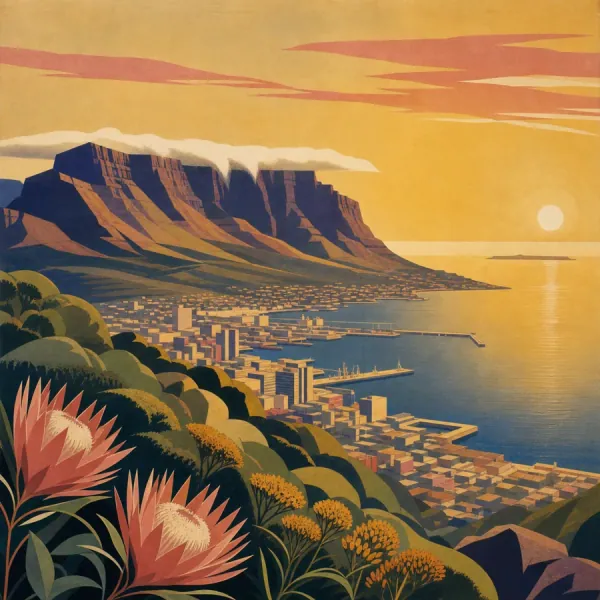
South Africa is one of the 17 so-called “megadiverse” countries. It has more than 22,000 plant species, about 9% of the world's total. Fynbos, a shrubland vegetation unique to the Cape region, alone holds more than 9,000 species, including the spectacular proteas. In the northeast, Kruger National Park, created in 1926 and covering nearly 20,000 km² (7,500 square miles), is home to lions, leopards, cheetahs, rhinos, hippos and giraffes; rhino poaching remains a serious threat (a record 1,215 animals were killed in the country in 2014).
🏛️ Nine provinces and three capitals
The country is divided into nine provinces. Unusually, it has not one but three capitals: Pretoria, seat of the president and the government; Cape Town, seat of Parliament; and Bloemfontein, seat of the Supreme Court of Appeal. The largest city is Johannesburg, born of the gold rush, followed by Cape Town and Durban, a major port on the Indian Ocean.
🦴 Cradle of humankind and African kingdoms
South Africa has some of the world's most important archaeological and paleontological sites for understanding the origins of our species.
🦴 The “Cradle of Humankind”
Near Johannesburg, a group of caves listed as a UNESCO World Heritage Site, the Cradle of Humankind, has yielded an exceptional number of fossils, notably at Sterkfontein. In 1924, the “Taung Child,” discovered in the north of the country, became the first australopithecine fossil ever identified. These finds show that several hominin species, from Australopithecus africanus to Homo naledi, lived here over the past three million years or so. Modern humans have been present for at least 170,000 years, and a South African cave has produced art objects about 75,000 years old, among the oldest known.
🏹 San, Khoikhoi and Bantu-speaking farmers
The earliest known inhabitants are the San, hunter-gatherers, and the Khoikhoi, who also herded livestock; they are often grouped together as the Khoisan. Their rock paintings still cover many rock shelters. About 1,500 to 2,000 years ago, Bantu-speaking peoples, iron-working farmers and herders from Central and West Africa, settled south of the Limpopo River. They pushed back or absorbed some of the Khoisan. The Xhosa, the southernmost of them, even incorporated some of the “clicks” of the Khoisan languages into their own language.
👑 Mapungubwe, a kingdom of gold
Around 1220, in the Limpopo valley, an elite settled on top of the flat hill of Mapungubwe. By around 1250, its capital had about 5,000 inhabitants and controlled a territory of 30,000 km² (11,600 square miles), enriched by Indian Ocean trade, which linked southern Africa to Asia. The kingdom vanished around 1300, when trade routes shifted north, to the benefit of Great Zimbabwe. Later, in the 17th century, the Venda kingdom took shape in the same region.
⛵ The Cape of Storms
In 1488, the Portuguese navigator Bartolomeu Dias became the first European to round the tip of Africa. He named the headland the “Cape of Storms”; King John II renamed it the Cape of Good Hope, because it opened the route to the riches of the Indies. In 1497–1498, Vasco da Gama took this route to reach India (see the chapter “The Age of Discovery”).
The rest of the course
This page publishes the first 2 parts. The full course has 9: here is what the next ones cover.
- ⛵ Settlers, wars and the gold rush
Dutch and then British colonization, the Mfecane and the Zulu kingdom, the Great Trek and the Boer republics, the discovery of diamonds and gold, the Boer Wars and the birth of the Union of South Africa.
- 🚫 Apartheid, racism written into law
The apartheid regime from 1948 to 1994: racial classification and segregation laws, Bantustans and forced removals, resistance, Sharpeville, Soweto, international sanctions.
- 🌈 From transition to rainbow nation
The negotiated end of apartheid, the 1994 elections, the 1996 Constitution, the Truth Commission and the successive presidencies up to the 2024 government of national unity.
- 🗣️ Twelve official languages and a plural culture
South Africa's population: population groups, twelve official languages, religions, and a culture rich in music, literature, sport and food.
- 💎 Gold, platinum and inequality: Africa's leading industrial power
South Africa's economy: mineral wealth, industry, finance, agriculture, the electricity crisis, mass unemployment and record inequality.
- ⚖️ A constitutional democracy and a voice of the Global South
South Africa's institutions, the political landscape since 2024, how international indexes rate the country, and its diplomacy (BRICS, G20, African Union, International Court of Justice).
- 🔧 Today's challenges
South Africa's major challenges: youth employment, crime, HIV, public services, corruption, land and climate.
Study “South Africa” with flashcards and quizzes
In Oria, you read the full course, then practice on it: flashcards, multiple-choice quizzes, open questions or the Feynman method. Cards and questions then come back in your daily review, paced by spaced repetition.
Study this topic in OriaSources
These notes draw on the sources below. If a point seems doubtful, refer back to them.