Essays & strategy
The Black Swan by Nassim Nicholas Taleb: Summary and Study Notes
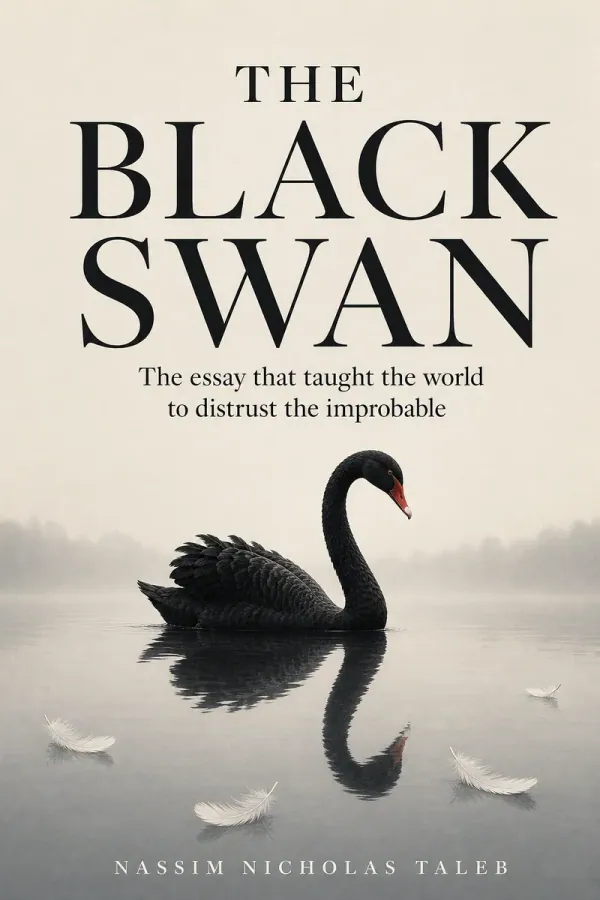
The essay that taught the world to distrust the improbable
Study this topic in OriaThe essentials
Published in 2007, The Black Swan by Nassim Nicholas Taleb, a former trader turned philosopher of chance, argues that a handful of rare, unexpected, and massive events explain most of history, markets, and even our own lives. You'll discover what a "black swan" is, the parable of the turkey, the illusion of narratives, the difference between Mediocristan and Extremistan, the scandal of prediction, and the barbell strategy. You'll also see who Taleb is and why statisticians and critics praised his insights while denouncing his exaggerations.
Key dates and facts
- 2001
- Fooled by Randomness , Taleb's first book for a general audience
- 2007
- The Black Swan published by Random House
- 2008
- The financial crisis makes the book famous
- 2010
- Expanded second edition
- 2nd century
- Juvenal compares something rare to a black swan
- 1697
- Europeans observe black swans in Australia
- 2001
- Taleb talks about black swans in finance
- 2007
- He extends the idea to all of human history
- 1960
- Born in Amioun, Lebanon
- 1983
- MBA from the Wharton School
📘 A book published just before the storm
The Black Swan: The Impact of the Highly Improbable is an essay by Nassim Nicholas Taleb, a former options trader turned professor and philosopher of chance. It was published on April 17, 2007 by Random House in the United States.
The author himself presents it as an essay carried by a single idea: our blindness to randomness, and above all to giant deviations, those events that fall completely outside the ordinary. The book is dedicated to the mathematician Benoît Mandelbrot, whose work on "wild" randomness heavily influenced Taleb.
🧭 A book that reads like a conversation
The book doesn't read like a statistics textbook. It opens with literary and psychological topics, then gradually shifts toward science, economics, and finance, before ending with advice on living with uncertainty… and profiting from it. Taleb mixes personal anecdotes, memories of his youth in Lebanon, short fictions, and philosophical reflections. He even acknowledges a contradiction: he criticizes our taste for stories, yet uses stories to do it, because, he argues, only a narrative can dislodge another one.
📚 A volume of the "Incerto"
The Black Swan belongs to a set Taleb calls the Incerto, a five-volume meditation on uncertainty: Fooled by Randomness (2001), The Black Swan (2007), The Bed of Procrustes (2010), Antifragile (2012), and Skin in the Game (2018). In 2010, an expanded second edition added a long essay on robustness and fragility, with ten principles for a society able to withstand black swans.
🚀 A best-seller turned prophetic
Success was immediate: the book spent 36 weeks on the New York Times bestseller list (17 in hardcover, 19 in paperback). By February 2011, it had sold close to three million copies. It has been translated into more than thirty languages, and as many as fifty according to some sources.
Its fame exploded with the 2008 financial crisis. Taleb had criticized banks' risk models, which he argued were unable to see crashes coming. Many credited him with having predicted the disaster. The Sunday Times ranked it among the twelve most influential books since World War II.
🦢 What is a black swan?
In The Black Swan, Nassim Nicholas Taleb names a category of events we struggle to think about. To understand it, we have to go back to an old Latin phrase.
🏛️ From Juvenal to Dutch sailors
In the 2nd century, the Roman poet Juvenal describes in his Satire VI something "rara avis in terris nigroque simillima cygno," a bird as rare on Earth as a black swan. For the Romans, a black swan simply didn't exist. In 16th-century London, the phrase was still used to mean the impossible: every swan ever observed was white, so all swans had to be white.
Then, in 1697, Dutch explorers led by Willem de Vlamingh became the first Europeans to see black swans, in Western Australia. A single observation was enough to destroy a certainty built over centuries. From then on, the expression changed meaning: it came to describe what we thought was impossible and that ends up happening. In the 19th century, philosopher John Stuart Mill used it to talk about the refutation of a theory.
🔺 The three traits of a black swan
For Taleb, an event that combines three features: it is rare and falls outside everything we expected, it has an extreme impact, and after the fact we invent explanations that make it look as though it was predictable.
The third trait is the subtlest. Once the event has happened, journalists, experts, and historians reconstruct a chain of causes so convincing that we end up telling ourselves we should have seen it coming. Taleb speaks of retrospective predictability, never prospective.
His examples: the rise of the Internet, the personal computer, World War I, the collapse of the Soviet Union, or the September 11, 2001 attacks. According to him, a small handful of black swans explains almost everything: the success of ideas and religions, the dynamics of history, but also entire chunks of our personal lives. They can be negative (a crash, a war) or positive (a discovery, an unexpected success).
👀 It all depends on the observer
A black swan isn't a property of the world, but a surprise for someone. The September 11 attacks were one for almost everyone, except those who had planned them. Taleb also distinguishes grey swans, rare but conceivable, from white swans, severe but expected. During the Covid-19 pandemic, some authors called it a black swan, others a grey swan; Taleb himself called it a white swan, since a global pandemic had long been considered inevitable.
The rest of the course
This page publishes the first 2 parts. The full course has 9: here is what the next ones cover.
- 🦃 The turkey, induction, and the confirmation trap
The parable of the turkey fed every day until Thanksgiving, the philosophical problem of induction, and the error of looking only for what confirms our beliefs.
- 📖 The trap of narratives and silent evidence
How our taste for stories distorts our understanding of the past: the opacity of history, the narrative fallacy, silent evidence, epistemic arrogance, and the antilibrary.
- ⚖️ Mediocristan and Extremistan
Taleb's two statistical "countries": Mediocristan, where no individual can move the average, and Extremistan, where a single case can overturn everything, plus a critique of the bell curve.
- 🔮 The scandal of prediction and the ludic fallacy
Why experts, economists, and models fail to predict big events, what Taleb calls the ludic fallacy, and the difference between known risks and unknown unknowns.
- 🏋️ Living with the unpredictable: the barbell strategy
Taleb's practical advice: don't try to predict, protect yourself from negative black swans, expose yourself to positive ones, adopt the barbell strategy, and build robust systems.
- ✍️ Nassim Nicholas Taleb, trader turned philosopher
The author's life: a childhood in Lebanon, studies in Paris and at Wharton, twenty years of trading, a fortune made during crashes, teaching at New York University, and the Incerto series.
- ⚖️ Reception, criticism, and limits
The praise The Black Swan received, notably from Daniel Kahneman, and the criticism from statisticians and journalists over its style, its exaggerations, and its lack of data.
Study “The Black Swan” with flashcards and quizzes
In Oria, you read the full course, then practice on it: flashcards, multiple-choice quizzes, open questions or the Feynman method. Cards and questions then come back in your daily review, paced by spaced repetition.
Study this topic in OriaSources
These notes draw on the sources below. If a point seems doubtful, refer back to them.