Essays & strategy
Silent Spring by Rachel Carson: Summary and Study Notes
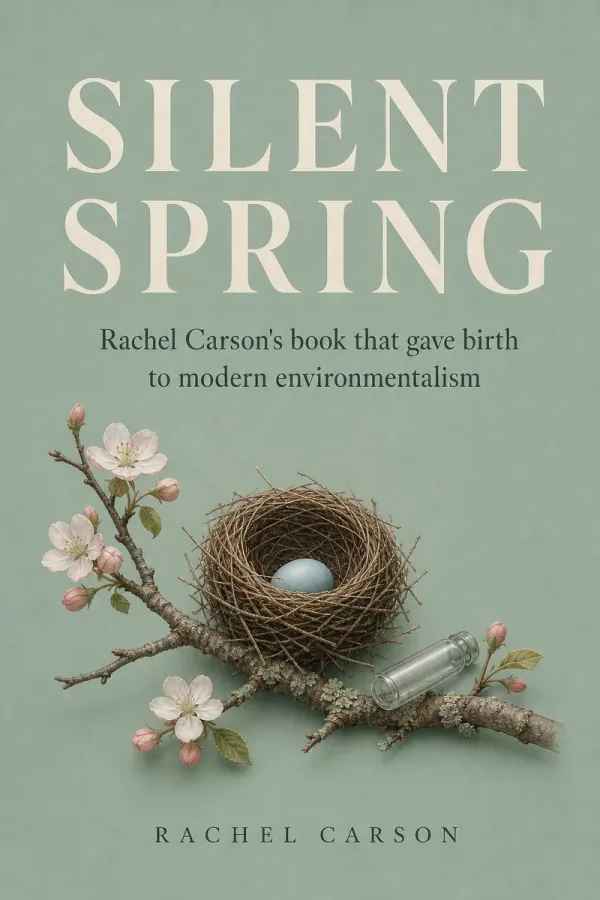
Rachel Carson's book that gave birth to modern environmentalism
Study this topic in OriaThe essentials
Published in 1962 by the American biologist Rachel Carson, Silent Spring revealed to the general public the damage that synthetic pesticides, starting with DDT, were doing to birds, rivers and human health. Despite a fierce campaign by the chemical industry, it led to the banning of DDT in the United States and then in much of the world, and launched the environmental movement. You'll discover the author, how the book came about, its big ideas, from “biocides” to the food chain and insect resistance, the storm it unleashed, its worldwide legacy, and the debates that still surround it.
Key dates and facts
- 1907
- Born in Pennsylvania
- 1936
- Biologist at the Bureau of Fisheries
- 1951
- The Sea Around Us , a best-seller
- 1962
- Silent Spring
- 1957
- Spraying against the fire ant
- 1958
- Olga Huckins's letter
- June 1962
- Serialized in The New Yorker
- Sept. 27, 1962
- Book published
- Sept. 1962
- Publication and industry backlash
- April 1963
- Special episode of CBS Reports
🌊 A biologist of the sea
Rachel Carson, the author of Silent Spring, was born on May 27, 1907 on a family farm near Springdale, Pennsylvania, on the Allegheny River, not far from Pittsburgh. As a child she explored the farm and devoured books; at ten, she published her first story in a children's magazine. The natural world, and above all the ocean, was the common thread of her favorite reading.
🔬 A zoologist working for the government
She began studying English at the Pennsylvania College for Women in Pittsburgh, then switched to biology. A stay at the Marine Biological Laboratory in Woods Hole, Massachusetts, introduced her to the sea. In 1932 she earned a master's degree in zoology from Johns Hopkins University, but had to give up on a doctorate during the Great Depression to support her family. In 1936 she became the second woman hired for a full-time scientific position by the US Bureau of Fisheries, later the Fish and Wildlife Service, where she eventually became editor-in-chief of publications.
📖 The sea trilogy
Alongside her job, Carson wrote. Under the Sea Wind (1941) sold poorly, but The Sea Around Us (1951) became a best-seller: 86 weeks on the New York Times list and the National Book Award in 1952. This success allowed her to leave her job and write full-time. The Edge of the Sea (1955) completed a trilogy exploring ocean life, from the shoreline to the depths. Carson made her name with prose that was both precise and poetic, blending scientific data and storytelling.
⚠️ A long-standing concern
As early as 1945, she took an interest in DDT, a new insecticide then nicknamed the “insect bomb,” whose safety and ecological effects were only just beginning to be studied. But editors found the subject unappealing, and she would publish nothing on it until 1962. In the late 1950s her life changed: in 1957 she adopted her five-year-old grandnephew Roger, who had been orphaned, while also caring for her elderly mother, and she closely followed the large federal insecticide-spraying programs. The danger of pesticides became the fight of the rest of her life.
✉️ From a letter to a book
In the late 1950s, several cases pushed Rachel Carson to devote her next book, Silent Spring, to pesticides. In 1957, the US Department of Agriculture (USDA) launched a vast program to eradicate the fire ant in the southern United States, spraying DDT and other pesticides mixed with fuel oil from airplanes, including over private land. On Long Island, near New York, landowners sued to stop the spraying. They lost, but the Supreme Court recognized their right to seek injunctions in the future against potential environmental damage.
🐦 Olga Huckins's letter
In January 1958, a friend of Carson's, Olga Owens Huckins, wrote to a Boston newspaper describing birds dying around her property in Duxbury, Massachusetts, after aerial spraying of DDT against mosquitoes. She sent a copy to Carson, who later wrote that this letter prompted her to study the problems caused by the overuse of chemical pesticides. The project was first meant to be co-written with a journalist; when The New Yorker commissioned a long article from her, Carson carried it out alone.
🔎 Four years of research
Carson gathered hundreds of cases of exposure, human illness and ecological damage. She relied on her contacts among government scientists, some of whom gave her confidential information, and discovered two camps: those who dismissed any danger for lack of absolute proof, and those who, being cautious, were already interested in biological control. At the library of the National Institutes of Health, she met cancer researchers, including Wilhelm Hueper of the National Cancer Institute, who classified many pesticides as carcinogens. In 1959, the scandal of cranberries contaminated by a herbicide and the hearings that followed convinced her of how aggressive the chemical industry's representatives were.
Illness slowed the writing. In 1960 Carson underwent a mastectomy; in December she learned that she had breast cancer that had already spread. She kept going regardless.
🎶 A title borrowed from Keats
The title comes from a poem by John Keats, La Belle Dame sans Merci, in which the sedge has withered from the lake and no birds sing. First intended only for the chapter on birds, it was chosen in August 1961 for the whole book, at the suggestion of her literary agent Marie Rodell: the image of a bleak future for the entire living world. The text was serialized in The New Yorker in three installments, on June 16, 23 and 30, 1962, then published as a book by Houghton Mifflin on September 27, 1962.
The rest of the course
This page publishes the first 2 parts. The full course has 8: here is what the next ones cover.
- 🌸 A fable for tomorrow, and “biocides”
The opening and the thesis of Silent Spring: the fable of a spring without birds, the idea that pesticides are “biocides,” the speed of modern chemistry versus the slow time of living things, and the story of DDT.
- 🔗 The chain of poison
The effects of pesticides on ecosystems described in Silent Spring: the elm leaf, earthworm, robin cycle, poison moving up the food chain, biomagnification, salmon, and the thinning of eggshells.
- 🦟 Our health, and the insects strike back
The chapters of Silent Spring on human health and cancer, citizens' right to know, insect resistance to pesticides, and the final proposal: the “other road” of biological control.
- 🌪️ The storm of 1962
The reception of Silent Spring: the chemical industry's campaign and the personal attacks on Carson, the 1963 CBS broadcast, the scientific report ordered by Kennedy, and Carson's death in 1964.
- 🦅 From DDT to modern environmentalism
The legacy of Silent Spring: the creation of the EPA, the 1972 US ban on DDT and the timeline of bans around the world, the Stockholm Convention, the return of the bald eagle, and Carson's place in the environmental movement.
- ⚖️ Limits and controversies
What research and critics say about Silent Spring: current knowledge about DDT and cancer, criticism of the choice of sources, and the myth that Carson was responsible for millions of malaria deaths.
Study “Silent Spring” with flashcards and quizzes
In Oria, you read the full course, then practice on it: flashcards, multiple-choice quizzes, open questions or the Feynman method. Cards and questions then come back in your daily review, paced by spaced repetition.
Study this topic in OriaSources
These notes draw on the sources below. If a point seems doubtful, refer back to them.