Essays & strategy
The Communist Manifesto by Karl Marx and Friedrich Engels: Summary and Study Notes
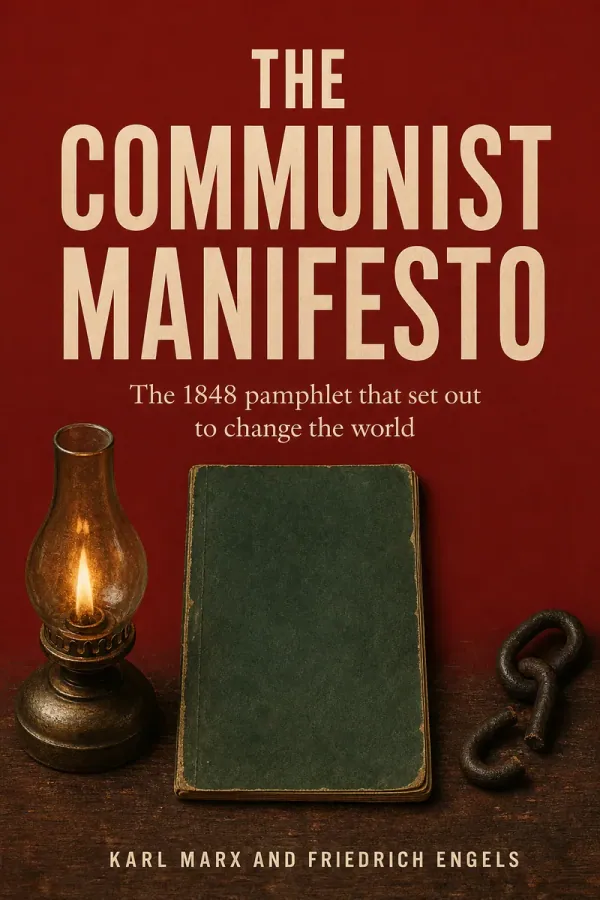
The 1848 pamphlet that set out to change the world
Study this topic in OriaThe essentials
Commissioned by a small organization of German workers in exile, written mostly by Karl Marx and published in London in February 1848, The Communist Manifesto sums up in a few pages a view of history based on class struggle. Almost forgotten for twenty years, it then became a key text for workers' movements around the world, and later required reading in the communist regimes of the 20th century. You'll discover how it was written, what its four chapters say, how it traveled the globe, and the criticisms it has faced for more than a century.
Key dates and facts
- 1846
- Communist Correspondence Committee in Brussels
- June 1847
- The League of the Just becomes the Communist League
- Oct. 1847
- Engels writes the Principles of Communism
- Dec. 1847
- The London congress commissions the Manifesto
- 1850
- First English translation, by Helen Macfarlane
- 1872
- Reissued under the title The Communist Manifesto
- 1920
- Chen Wangdao's Chinese edition in Shanghai
- 2013
- Inscribed on UNESCO's Memory of the World Register
🕯️ 1847: a small league of exiles places an order
The Communist Manifesto was not born inside a big party: in 1847, no communist party existed. The word “party” then referred, broadly, to all supporters of communism. The text was commissioned by an organization of émigré German workers and craftsmen, active especially in London and Paris: the League of the Just.
👥 Two young Germans in exile
In the late 1840s, the League of the Just was the main organization of the German-speaking workers' movement. Its doctrine remained vague, inspired by German philosophy and an abstract socialism. In 1846, two young intellectuals living in Brussels, Karl Marx, born in 1818 in Trier, and Friedrich Engels, born in 1820 in Barmen, founded a “Communist Correspondence Committee” to link scattered groups and spread their materialist conception of history. In the spring of 1847 they joined the League and quickly gained influence within it.
❓ From catechism to manifesto
At its first congress, from June 2 to 9, 1847, the League of the Just renamed itself the Communist League and adopted a motto that was to become famous: “Proletarians of all countries, unite!” It asked Engels to draft a program. He first wrote a draft “confession of faith” in the form of 22 questions and answers, like a catechism. In October, in Paris, he discovered that another activist, Moses Hess, had written his own version; he criticized it severely and won the right to write a new one. This was the Principles of Communism, 25 questions with more detailed answers, which already contain several ideas of the future Manifesto.
On November 23, 1847, Engels wrote to Marx that it would be better to drop the catechism format: what was needed, in his view, was a text containing “a certain amount of history” (translated), and he proposed the name manifesto.
🏛️ The London congress
The two men met in Ostend on November 28, then traveled to London for the League's second congress, held from November 29 to December 8, 1847 at the premises of a German workers' educational association in Soho. For ten days, the debates were heated. Marx eventually imposed his views against what the British political scientist Harold Laski called “stiff and prolonged opposition.” The congress commissioned him, together with Engels, to write the League's manifesto. Marx was 29, Engels 27.
✍️ Written in a rush, published in a storm
Back in Brussels, Karl Marx was in no hurry. According to his biographer Francis Wheen, he engaged in “ceaseless procrastination”: he lectured on political economy to an association of German workers, wrote articles, gave a long speech on free trade, and even spent a week in Ghent, from January 17 to 26, 1848, to found a democratic association.
⏰ The ultimatum
Having heard nothing for nearly two months, the League's central committee sent him an ultimatum at the end of January: the text had to be delivered by February 1. Marx, who worked poorly without a deadline, then seems to have finished at top speed. The historian Eric Hobsbawm sees a sign of this haste in the absence of drafts: only one handwritten page has ever been found. In all, the Manifesto was written in six or seven weeks. Engels is the co-signatory, but the final version is in Marx's hand; Engels wrote in 1883 that the text's basic idea belongs “solely and exclusively” to Marx (translated). Historians nonetheless note how close it is to Engels's own Principles of Communism.
📄 Twenty-three dark green pages
At the end of February 1848, the text appeared anonymously in London, printed for a German workers' association based at 46 Liverpool Street. It was a 23-page pamphlet in German, with a dark green cover, titled Manifest der Kommunistischen Partei. It opens with a sentence that has remained famous:
“A spectre is haunting Europe—the spectre of Communism. All the Powers of old Europe have entered into a holy alliance to exorcise this spectre: Pope and Czar, Metternich and Guizot, French Radicals and German police-spies.”
Karl Marx and Friedrich Engels, The Communist Manifesto, preamble (1848) (translated by Samuel Moore, 1888)
The timing was striking: at that very moment, the banning of a republican banquet in Paris on February 22 set off a revolution that overthrew the monarchy. Europe went up in flames: this was the “Springtime of Peoples.” On March 4, Marx was expelled by the Belgian police. Around March 20, a thousand copies reached Paris, then Germany in early April.
🌫️ A tiny influence at first
The preamble announced editions in English, French, German, Italian, Flemish and Danish. In reality, the first printings were all in German; Polish and Danish translations followed, then a Swedish one at the end of 1848. The first English version appeared in November 1850 in a Chartist newspaper, translated by Helen Macfarlane, which revealed the authors' names for the first time.
During the revolutions, the text played a role only in Germany, where Marx ran a revolutionary daily in Cologne until it was banned in May 1849. The counterrevolution won everywhere. In November 1852, League leaders arrested by the Prussian police were sentenced in Cologne to three to six years in prison, and the League dissolved. The Manifesto fell into oblivion.
The rest of the course
This page publishes the first 2 parts. The full course has 8: here is what the next ones cover.
- ⚔️ “Bourgeois and proletarians”: history as class struggle
The first chapter: all history is the history of class struggles, and modern society now pits two camps against each other, the bourgeoisie and the proletariat.
- 🌍 A bourgeoisie that “creates a world after its own image”
The vision of the world market, the machine and the making of the proletariat, up to the famous idea that the bourgeoisie produces its own grave-diggers.
- 📜 “Proletarians and Communists”: what the communists want
The second chapter: the role of the communists, the reply to opponents' objections, and the ten measures proposed for the transition.
- 📣 Against the other socialisms, and the final call
Chapters III and IV: the critique of rival socialisms, the country-by-country strategy, and the closing line, “Working men of all countries, unite!”
- 📈 From oblivion to a world tour
How the Manifesto, almost impossible to find in the 1860s, became after 1872 and then 1917 one of the most widely circulated political texts in the world, from Europe to China.
- ⚖️ Reception and criticism: predictions, regimes and debates
What admirers and critics have said: the predictions that failed, the debate over the communist regimes of the 20th century, and the text's place today.
Study “The Communist Manifesto” with flashcards and quizzes
In Oria, you read the full course, then practice on it: flashcards, multiple-choice quizzes, open questions or the Feynman method. Cards and questions then come back in your daily review, paced by spaced repetition.
Study this topic in OriaSources
These notes draw on the sources below. If a point seems doubtful, refer back to them.