Essays & strategy
The Prince by Niccolò Machiavelli: Summary and Study Notes
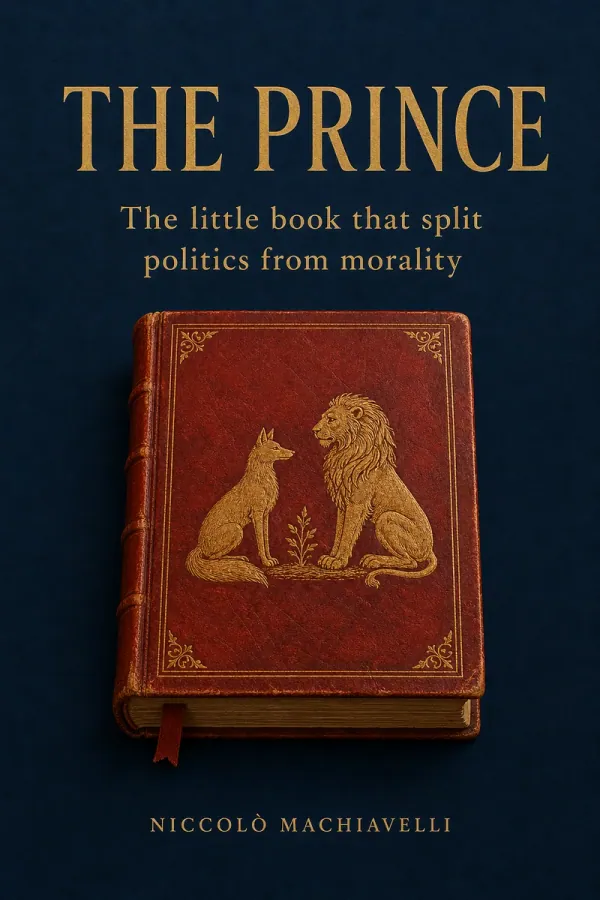
The little book that split politics from morality
Study this topic in OriaThe essentials
In 1513, Niccolò Machiavelli, the former secretary of the Republic of Florence cast out by the Medici's return, wrote a short treatise at his exile's farmhouse: how to conquer a state, and how to keep it. With no moral detour, he explains that a prince must know how to be feared, to be as cunning as the fox and as fierce as the lion. You'll discover the war-torn Italy of the Italian Wars, Machiavelli's career and downfall, the structure of the book, its key ideas (virtù, fortuna, Cesare Borgia), and five centuries of debate over the word “Machiavellian.”
Key dates and facts
- 1494
- Charles VIII's invasion; the Medici fall in Florence
- 1511
- Julius II forms the Holy League against France
- 1512
- Medici return; the republic falls
- 1527
- Sack of Rome by the troops of Charles V
- Feb. 20, 1513
- Machiavelli is arrested and tortured
- Dec. 10, 1513
- Letter to Vettori announcing The Prince
- June 21, 1527
- Machiavelli dies in Florence
- 1532
- First printing of The Prince
⚔️ Florence and the Italy of the Italian Wars
The Prince, the political treatise written in 1513 by the Florentine Niccolò Machiavelli, was born of a country in pieces. At the end of the 15th century, Italy was not a single state but a mosaic of rival powers: the Duchy of Milan, the Republic of Venice, the Republic of Florence, the Papal States around the pope, the Kingdom of Naples, and a host of small lordships. Their quarrels would throw the door open to foreign armies.
🇫🇷 1494: The French Invasion
The French king Charles VIII claimed the Kingdom of Naples, an inheritance from the House of Anjou. Encouraged by Ludovico Sforza, who governed Milan, he crossed the Alps at the Montgenèvre Pass on September 2, 1494, with an army backed by 70 light, maneuverable cannon. Italians were terrified by massacres in Romagna, and Florence fell without a fight on November 17. This was the start of the Italian Wars, a series of eleven conflicts that, for more than half a century, turned the peninsula into the battlefield of France, Spain, and the Empire.
🔥 Florence Without the Medici
That same year, 1494, the Florentines drove out the Medici, who had dominated the city for some sixty years, and restored the republic. The Dominican friar Savonarola, a fiery preacher, became the city's moral master and welcomed Charles VIII as an envoy of God. His rule ended at the stake, condemned for heresy. Pisa, Florence's port, used the chaos to declare its independence, and Florence would exhaust itself for years trying to take it back.
💰 Princes Without Armies
The Italian states fought their wars with condottieri, mercenary captains who rented their troops to the highest bidder. Machiavelli would later accuse them of having led Italy “into slavery and degradation.” Meanwhile, the great powers kept shifting alliances: Louis XII of France conquered Milan, Pope Alexander VI helped his son Cesare Borgia carve out a state in Romagna, and then Pope Julius II formed the Holy League against the French in 1511.
In 1512, the French, Florence's allies, were forced to withdraw from Lombardy. The pope then let Spanish troops restore the Medici to power. The Florentine republic fell, and with it the career of one of its most active servants: Machiavelli. It was out of this experience of powerlessness that The Prince was born.
🏛️ Machiavelli, Secretary of the Republic
Niccolò Machiavelli was born in Florence on May 3, 1469, into an old family with neither fortune nor political standing. His father, Bernardo, was a doctor of law. Young Niccolò read widely: he never mastered Greek, but discovered in Latin the historians and philosophers of antiquity, from Livy to Thucydides, and in 1497 copied out the poem of the Roman Lucretius. This grounding in ancient history would nourish every page of The Prince.
✒️ A Young Man at the Head of the Chancery
In 1498, shortly after Savonarola's execution, Machiavelli was appointed on June 19 to head Florence's Second Chancery, then became secretary to the Ten of Liberty and Peace, the council in charge of war and diplomacy. He was only 29 and had no experience. He was never an ambassador, a title reserved for the great families, but he became the man for discreet missions: observing, negotiating, reading the intentions of the powerful. He married Marietta Corsini in 1501.
🌍 A Diplomat's Eye
His missions put him in contact with the leading figures of his age. In 1500, at the French court, he answered Cardinal Georges d'Amboise, who claimed that Italians understood nothing of war — to which Machiavelli replied that the French, for their part, understood nothing of statecraft. From 1502 to 1503, he followed Cesare Borgia through Romagna and witnessed his revenge against his mutinous captains at Sinigaglia on December 31, 1502. In 1503, he was in Rome for the election of Pope Julius II. His dispatches and letters were already early sketches of The Prince.
🛡️ The Florentine Militia
The election of Piero Soderini as gonfalonier, head of the republic, in 1502, strengthened his position. Noting that the mercenaries hired to retake Pisa were expensive and fought poorly, Machiavelli convinced the government to raise a citizen army by conscription. In February 1506, four hundred equipped and armed peasants marched in parade. In June 1509, Pisa was retaken, partly thanks to this militia: the high point of his career.
The fall was swift. In August 1512, Spanish troops crushed the Florentine militia at Prato, Soderini fled, and the Medici returned. In early November 1512, Machiavelli was removed from office and had to pay an enormous bond. Fourteen years in the service of the state were over; from then on he would write about power instead of wielding it.
The rest of the course
This page publishes the first 2 parts. The full course has 8: here is what the next ones cover.
- ⛓️ Disgrace, Torture, and Exile at Sant'Andrea
Machiavelli's arrest and torture in 1513, his exile at Sant'Andrea in Percussina, the letter to Vettori announcing The Prince, his other works, and his death in 1527.
- 📑 A Small Book in Twenty-Six Chapters
How The Prince is built: the dedication to Lorenzo de' Medici the Younger, the book's five main blocks of chapters, the posthumous 1532 publication, and what sets it apart from the “mirrors for princes.”
- 🎲 Virtù and Fortuna: Energy Against Chance
The Prince's two central concepts: virtù, political skill and energy, and fortuna, the part played by chance, compared to a river in flood (chapters VI, VII, and XXV).
- 🦁 Feared or Loved? The Lion and the Fox
The Prince's most famous advice (chapters XV to XIX): the “effective truth,” well-used cruelty, being feared rather than loved without being hated, the lion and the fox, and appearances.
- 🗡️ Cesare Borgia, the Unfinished Model
Why Machiavelli uses Cesare Borgia as his example in chapter VII: the conquest of Romagna, the execution of Remirro de Orco at Cesena, the Sinigaglia trap, and the fall after Alexander VI's death.
- 🌍 Machiavellianism and Readings of The Prince
The reception of The Prince since 1532: condemnation by the Church, the birth of the word “Machiavellian,” the Anti-Machiavel, the republican reading by Diderot and Rousseau, Hegel, Gramsci, and Strauss.
Study “The Prince” with flashcards and quizzes
In Oria, you read the full course, then practice on it: flashcards, multiple-choice quizzes, open questions or the Feynman method. Cards and questions then come back in your daily review, paced by spaced repetition.
Study this topic in OriaSources
These notes draw on the sources below. If a point seems doubtful, refer back to them.