Essays & strategy
The Selfish Gene by Richard Dawkins: Summary and Study Notes
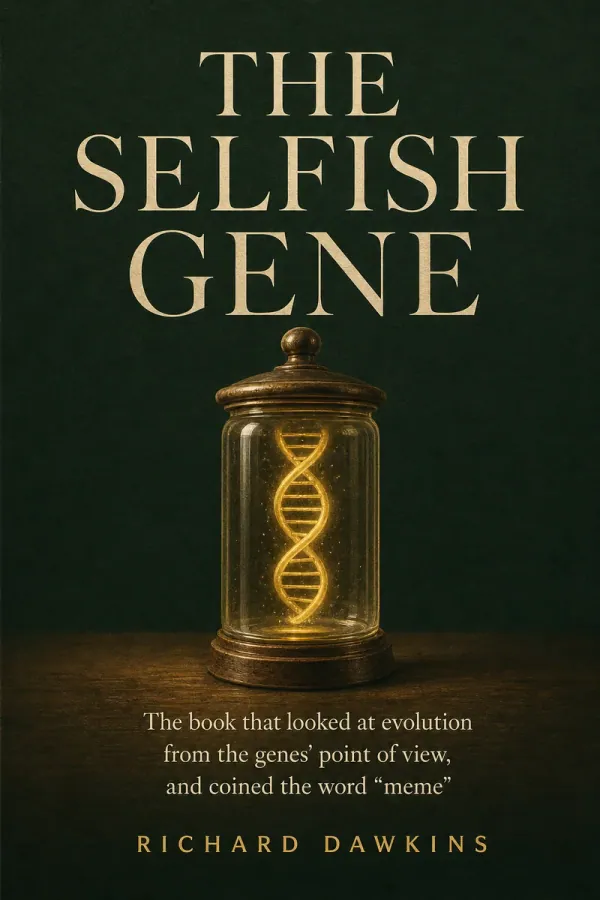
The book that looked at evolution from the genes' point of view, and coined the word "meme"
Study this topic in OriaThe essentials
Published in 1976 by British zoologist Richard Dawkins, The Selfish Gene popularized a powerful idea: natural selection is best understood from the point of view of genes, those "replicators" that build bodies in order to be passed on. You'll discover why a "selfish" gene can produce altruistic animals, what evolutionarily stable strategies are, how Dawkins coined the word "meme," and why the book has been as widely admired as it has been contested.
Key dates and facts
- 1966
- George C. Williams' Adaptation and Natural Selection
- 1976
- The Selfish Gene published by Oxford University Press
- 1989
- Second edition, with two added chapters
- 2003
- French translation published by Odile Jacob
- 1980
- Japanese translation, which popularizes sociobiology in Japan
- 1982
- The Extended Phenotype
- 2006
- 30th-anniversary edition and a symposium at the London School of Economics
- 2016
- The Extended Selfish Gene , 40th-anniversary edition
- 1941
- Born in Nairobi, Kenya
- 1962
- Zoology degree from Oxford
📘 A 1976 book that changed how we look at things
The Selfish Gene is a popular science book by the British zoologist Richard Dawkins, published in 1976 by Oxford University Press. It defends what biologists call the gene-centered view of evolution: to understand natural selection, you need to look at it from the point of view of genes rather than of individuals or species.
🧪 Ideas born in the 1960s
Dawkins does not claim to invent a new theory. He draws on two biologists:
- George C. Williams, who argued in 1966, in Adaptation and Natural Selection, that behaviors do not evolve "for the good of the group" but through selection acting at the level of genes;
- W. D. Hamilton, who showed in 1963-1964 how an altruistic behavior can spread if it benefits related individuals carrying the same genes: this is kin selection.
At the time, many still explained animal cooperation by appeal to the interest of the species. Dawkins wants to show, in language accessible to everyone, that this explanation does not hold up and that the gene's-eye view sheds far more light on living things.
"We are survival machines—robot vehicles blindly programmed to preserve the selfish molecules known as genes."
Richard Dawkins, The Selfish Gene, preface to the first edition (1976)
🏷️ A title that sparked debate
The book has a provocative title. Tom Maschler, to whom Dawkins had shown the manuscript, liked the book but not its title, and suggested The Immortal Gene. Dawkins later admitted he might have been right: too many people, he regrets, judged the book by its title alone. Because The Selfish Gene is not about a gene that makes people selfish: a large part of the book is devoted to the evolution of altruism.
📚 Successive editions
The first edition has eleven chapters, with a foreword by biologist Robert Trivers. In 1989, a second edition adds two chapters and numerous notes. In 2006, the 30th-anniversary edition is accompanied by a collection of tributes, and in 2016, for the 40th anniversary, Dawkins publishes an expanded version, The Extended Selfish Gene. The book has sold more than a million copies and has been translated into more than twenty languages.
🧬 From replicators to survival machines
In The Selfish Gene, Richard Dawkins tells the story of evolution as a long tale of molecules copying themselves. The first chapter opens with an ambitious idea: intelligent life comes of age the day it works out why it exists. For Dawkins, that moment arrived with Charles Darwin.
🌊 In the beginning, soup
Dawkins imagines the beginnings of life in a "primeval soup" of molecules. One day a molecule appears that is able to produce copies of itself: the first replicator. The copies are not always perfect, and the variants that copy themselves best become more numerous. This is already a form of natural selection.
He even proposes seeing Darwin's "survival of the fittest" as a special case of a more general law: the survival of the stable. The universe is populated with things that are either stable enough to last or common enough to deserve a name; replicators are structures that keep themselves going by multiplying.
An entity capable of producing copies of itself, like a DNA molecule. For Dawkins, it is replicators that sit at the heart of evolution: bodies are merely their means of transport.
🚗 Bodies as vehicles
Over time, replicators are thought to have surrounded themselves with increasingly elaborate protection: cells, then bodies made of billions of cells. Dawkins calls these bodies survival machines. Today, replicators go by the name of genes, segments of DNA that are used to make proteins. Living things, ourselves included, would be the machines that genes have built in order to last and to be passed on.
🚣 A crew of rowers
A gene never works alone. Dawkins compares the organism to a boat steered by a crew of rowers: each one has to row well together with the others for the boat to move forward. A gene succeeds if it works well within the environment formed by the other genes. Each generation, sexual reproduction reshuffles the deck: bodies are unique and perish, but genes themselves pass from body to body.
This is why Dawkins considers genes potentially "immortal," not as molecules, but as copies of the same information. He borrows the definition of the gene proposed by George C. Williams: whatever segregates and recombines with appreciable frequency from one generation to the next.
🧠 Machines that plan ahead
Dawkins also describes the evolution of behavior. Genes do not control every action in real time; they build brains capable of learning and even of simulating the future. He sees the emergence of consciousness as the culmination of this capacity for simulation, and calls it the deepest mystery facing modern biology.
The rest of the course
This page publishes the first 2 parts. The full course has 8: here is what the next ones cover.
- 🤝 A "selfish" gene that produces altruism
How the gene-centered view explains cooperation: kin selection, social insects, reciprocal altruism, and honest signals.
- 🦅 Hawks, doves, and stable strategies
Game theory applied to evolution: evolutionarily stable strategies, the hawk-dove game, conflicts between parents and offspring, between males and females.
- 💡 Coining the word "meme"
The last chapter of the 1976 edition coins the word "meme," a unit of cultural transmission, giving rise to memetics and, much later, Internet memes.
- 📚 Extensions: from the extended phenotype to selfish DNA
What The Selfish Gene gave rise to in biology: the extended phenotype (1982), "selfish" DNA, the anniversary editions, and its worldwide spread.
- ✍️ Richard Dawkins, the author
The life of Richard Dawkins, born in Nairobi in 1941: a student of Tinbergen at Oxford, professor for the public understanding of science, then a leading figure of atheism.
- ⚖️ Success, criticism, and debates
The book was praised as a classic of popular science, but criticized for its metaphors, its reductionism, and its conception of the gene as the unit of selection.
Study “The Selfish Gene” with flashcards and quizzes
In Oria, you read the full course, then practice on it: flashcards, multiple-choice quizzes, open questions or the Feynman method. Cards and questions then come back in your daily review, paced by spaced repetition.
Study this topic in OriaSources
These notes draw on the sources below. If a point seems doubtful, refer back to them.