Essays & strategy
The Republic by Plato: Summary and Study Notes
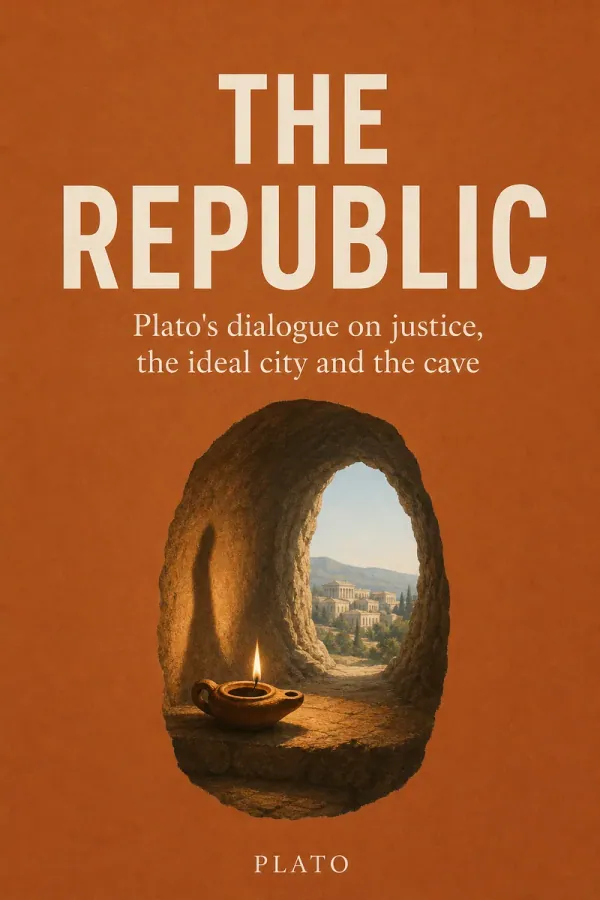
Plato's dialogue on justice, the ideal city and the cave
Study this topic in OriaThe essentials
Written around 375 BC, Plato's Republic is one of the most influential books in the history of philosophy. In searching for what justice is, Socrates and his friends imagine an ideal city ruled by philosophers, describe the human soul in three parts and tell the allegory of the cave. You'll discover the Athenian context, the dialogue book by book, from Thrasymachus and the Ring of Gyges to the five political regimes and the myth of Er, and the great debates it has sparked for twenty-four centuries, between totalitarian and ironic readings.
Key dates and facts
- 428/427 BC
- Plato born in Athens
- 399 BC
- Trial and death of Socrates
- 387 BC
- Founding of the Academy
- c. 375 BC
- Republic written
- 1934
- Gadamer reads the city as a heuristic utopia
- 1945
- Popper denounces a totalitarian state
- 2001
- Voted greatest philosophical text
- 2021
- Most-taught book at American universities
🏛️ Athens, Socrates and the Academy
The Republic is a dialogue by the Greek philosopher Plato, written around 375 BC. Its Greek title, Politeia, refers to the constitution, the political organization of a city; the title we use comes from the Latin De re publica, the name of a dialogue by Cicero written about three centuries later. It is Plato's most famous work and one of the most influential books in the entire history of philosophy and political thought.
👤 An aristocrat, and a student of Socrates
Plato was born in Athens in 428 or 427 BC, into an aristocratic family: two of his mother's relatives, Critias and Charmides, were among the Thirty, the tyrants who seized power in Athens in 404 BC after the defeat by Sparta, with their share of confiscations, banishments and massacres. The young Plato became a student of Socrates, who never wrote anything and did philosophy by questioning his fellow citizens. His teacher's death sentence at the hands of Athenian democracy, in 399 BC, and the success of the sophists fed his distrust of the democracy of his time and of all existing cities, which he saw as undermined by division.
🏫 The Academy
After a journey to Sicily, Plato founded a school in Athens in 387 BC, near the gymnasium of Akademos, called the Academy, where he taught for forty years and which lasted for three centuries. According to the hypothesis most widely accepted today, the Republic was written between that founding and his return from another stay in Syracuse, around 370 BC: it is a work of his maturity. Later, Plato would try, without success, to advise the tyrant Dionysius II of Syracuse. He died in Athens around 348–347 BC.
🎭 A dialogue in Piraeus
Like almost all of Plato's works, the Republic is a dialogue: Socrates converses with several interlocutors, and it is through his mouth that Plato sets out most of his ideas. The scene takes place in Piraeus, the port of Athens, in the house of the old and wealthy Cephalus, during the Peloponnesian War. Around Socrates are Polemarchus, Cephalus's son, the sophist Thrasymachus, the politician Clitophon, and two of Plato's brothers, Glaucon and Adeimantus. The text is divided into ten books, a division that may go back to the scholars of Alexandria.
The question that guides the whole work is simple and dizzying: is it always better to be just than unjust? To answer it, the conversation ranges across politics, education, psychology, the theory of knowledge, art and the fate of the soul.
⚖️ What is justice? From Thrasymachus to Gyges
Book I of Plato's Republic puts three common definitions of justice to the test, as Socrates often did: by showing that ready-made answers do not hold up.
🪙 Giving everyone what you owe them?
Old Cephalus, asked about old age, explains that his wealth has allowed him to live without cheating or lying, to give everyone what he owed them, and therefore not to fear the afterlife. Justice would then be telling the truth and giving back what you have received. Socrates objects with an example: if a friend lent us a weapon, then went mad and asked for it back, it would not be just to return it. His son Polemarchus, drawing on the poet Simonides, then suggests that justice consists in doing good to your friends and harm to your enemies. Socrates leads him to admit that harming is the work of the unjust man, and that justice cannot permit wronging others.
💪 The rule of the stronger
The sophist Thrasymachus then bursts in brutally. For him, fine speeches about justice fool no one:
“I say that justice is nothing other than the advantage of the stronger.”
Plato, Republic, Book I (translated)
Every regime, he explains, makes laws for its own benefit: democracy for the people, aristocracy for the aristocrats, the tyrant for himself. Socrates replies that rulers can be mistaken about their own interest, and above all that a true ruler, like a true doctor or a true shepherd, aims at the good of those in his care. He ends up arguing that justice is wisdom and virtue, and that it makes people happy. But he admits that they still have not defined what justice is.
💍 The Ring of Gyges
In Book II, Glaucon relaunches the debate by playing devil's advocate. According to a widespread opinion, justice is only a compromise: unable to commit injustice with impunity and afraid of suffering it, people agree on laws. We would be just only out of fear of punishment. To show this, he tells the story of the shepherd Gyges, who, after a violent storm, finds in the ground a ring that makes its wearer invisible when the bezel is turned. Gyges uses it to seduce the queen, kill the king and seize power. Who, Glaucon asks, would act differently in his place? Plato may have drawn on an account by the historian Herodotus of the fall of Candaules, ruler of Lydia.
Glaucon pushes the reasoning all the way: the clever unjust man will pass for just and be honored, while the just man who neglects appearances may be despised, persecuted, even put to death. For, he says, “the height of injustice is to seem just without being so.” His brother Adeimantus adds that justice is always recommended for the reputation it brings, never for its own sake. The challenge is set: Socrates must prove that justice is better than injustice, even with no reward and no witness.
This thought experiment has come down through the centuries, from Cicero to Rousseau; some also see it as a possible source for the ring in Tolkien's The Lord of the Rings, which makes its wearer invisible and corrupts him.
The rest of the course
This page publishes the first 2 parts. The full course has 9: here is what the next ones cover.
- 🏗️ Building a city in words
Books II and III of the Republic: justice sought in the city, the birth of the city and the division of labor, the education and censorship of the guardians, the myth of the metals, and Kallipolis.
- 🦁 Four virtues and three parts of the soul
Book IV of the Republic: the four virtues of the city (wisdom, courage, moderation, justice), the theory of the tripartite soul, and justice as inner harmony.
- 👑 Female guardians and philosopher kings
Books V and VI of the Republic: equal education for female guardians, the sharing of property and children, philosopher kings, the distinction between knowledge and opinion, and the parable of the ship of state.
- 🔦 The sun, the line and the cave
Books VI and VII of the Republic: the Form of the Good, the analogy of the sun, the divided line, the allegory of the cave, and the long training of philosopher kings up to the age of fifty.
- 📉 From best to worst: the five regimes
Books VIII and IX of the Republic: the decline of the ideal city into timocracy, oligarchy, democracy and then tyranny, the tyrannical man enslaved to his desires, and the final answer to Glaucon's challenge.
- 🎭 The poets banished and the myth of Er
Book X of the Republic: the condemnation of imitative poetry (mimesis), the proof of the immortality of the soul, and the myth of Er about the choice of lives.
- 🌍 Twenty-four centuries of debate
The legacy of the Republic: Aristotle, the Stoics, Cicero and Augustine, Ibn Rushd and Thomas More, Rousseau and Hegel, then the great 20th-century debate between the totalitarian reading (Popper) and the ironic reading (Strauss, Bloom), and its cultural influence.
Study “The Republic” with flashcards and quizzes
In Oria, you read the full course, then practice on it: flashcards, multiple-choice quizzes, open questions or the Feynman method. Cards and questions then come back in your daily review, paced by spaced repetition.
Study this topic in OriaSources
These notes draw on the sources below. If a point seems doubtful, refer back to them.