Essays & strategy
The Social Contract by Jean-Jacques Rousseau: Summary and Study Notes
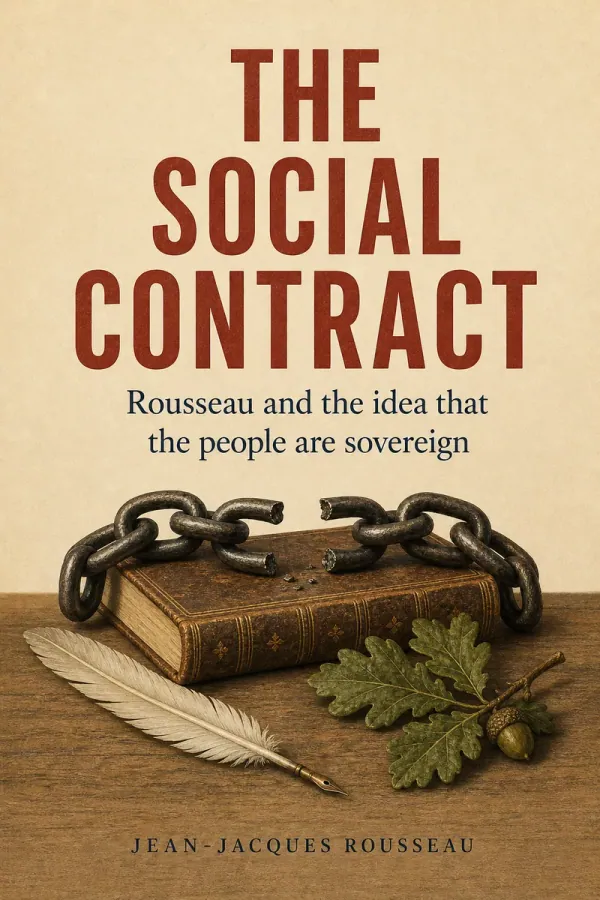
Rousseau and the idea that the people are sovereign
Study this topic in OriaThe essentials
Published in Amsterdam in 1762 and promptly burned in Geneva, The Social Contract asks a dizzying question: under what conditions can political power be legitimate? Rousseau's answer, a pact in which each person gives himself to all so as to obey only himself, fed the French Revolution, the thought of Kant and democrats from Japan to China. You'll discover how the book came about, its four books step by step, its key concepts (social pact, general will, sovereignty, civil religion), the scandal of 1762 and the debate that still goes on: is Rousseau the father of democracy, or of its excesses?
Key dates and facts
- 1743 – 1744
- Embassy secretary in Venice
- 1755
- Discourse on the Origin of Inequality
- Dec. 1760
- The Geneva Manuscript shown to Rey
- 1762
- Published in Amsterdam
- June 9, 1762
- The Parlement of Paris condemns Emile
- June 1762
- Geneva burns The Social Contract
- 1763 – 1764
- Letters Written from the Mountain
- 1765
- Rousseau driven out of Môtiers
- Aug. 1789
- Article 6 of the Declaration of Rights
- Oct. 11, 1794
- Rousseau enters the Panthéon
📜 From a grand project to a small book
Jean-Jacques Rousseau, born in Geneva on June 28, 1712, was not a legal scholar: having lost his mother very young and grown up in a working-class milieu, he was a writer and musician who had become famous through his discourses. His interest in politics grew out of hands-on experience. Between July 1743 and October 1744, he was secretary to the French ambassador to the Republic of Venice. There he watched up close how a political regime nearly a thousand years old actually worked, and he conceived the plan for a great work to be called Political Institutions.
🧩 The groundwork
The project matured slowly. As early as 1752, in the preface to Narcissus, Rousseau wrote that vices belong less to man than to “man badly governed.” In 1755, in the article “Political Economy” for the Encyclopédie, he argued that peoples become, in the long run, what their government makes them. The same year saw the publication of the Discourse on the Origin and Basis of Inequality Among Men, which imagines a state of nature: not a historical era, but a working hypothesis, arrived at by stripping away from man everything society has given him. That Discourse tells how agriculture and property gave rise to inequality; The Social Contract would look for the conditions under which a society could, on the contrary, be just.
✂️ Burning the rest
In 1759, realizing how vast the task was, Rousseau decided to keep only part of his Institutions and burn the rest. In December 1760, he showed a first version, known as the Geneva Manuscript, to his publisher Marc-Michel Rey, who had come to see him at Montmorency, near Paris. He then reworked it thoroughly, notably cutting a chapter that refuted Diderot's article “Natural Right,” to avoid any controversy. This first version would not be published until the late 19th century.
📖 A title and a motto
The book came out in 1762 in Amsterdam, from Rey, under the title Of the Social Contract, or Principles of Political Right. Its epigraph is a line from Virgil (Aeneid, XI): “foederis aequas dicamus leges,” which can be translated as “let us set equal terms for the pact.” The book is short, divided into four books. From the opening lines, Rousseau signs as a citizen: born in a free state and a member of the sovereign, he says, the right to vote there is enough to impose on him the duty of studying public affairs. The same year, 1762, saw the publication of his treatise on education, Emile: the two books, which mark the summit of his thought, would also bring about his misfortune.
⛓️ “Man is born free”
The first chapter of The Social Contract opens with one of the most famous sentences in political philosophy. Rousseau does not claim to explain how men lost their freedom: he wants to know what could make the obedience they owe today legitimate.
“Man is born free, and everywhere he is in chains. One who thinks himself the master of others is nonetheless a greater slave than they. How did this change come about? I do not know. What can make it legitimate? I believe I can answer that question.”
Jean-Jacques Rousseau, The Social Contract, I, 1 (1762) (translated)
The program is set out from the opening: to find out whether there can be, in the civil order, some legitimate and reliable rule of administration, “taking men as they are, and laws as they might be.” Rousseau adds that the social order is a sacred right, but that it does not come from nature: it therefore rests on conventions.
👨👩👧 The family is not a model of power
The only natural society, according to Rousseau, is the family, and even then: children remain bound to their father only as long as they need him. Once grown, they are their own masters, and if they stay together, it is by choice. One can see the family as a first model of political societies, but with a major difference: the father loves his children, whereas in the state, the pleasure of commanding takes the place of that love.
💪 Might does not make right
Rousseau then takes on the thinkers who base power on domination, like Grotius and Hobbes, or who, like Aristotle, held that some men are born for slavery. For him, this confuses cause and effect: if there are slaves by nature, it is because there were slaves against nature. The expression “right of the strongest” is meaningless: yielding to force is an act of necessity, at best of prudence, never a duty. And the strongest is never strong enough to remain master forever unless he turns his force into right and obedience into duty. Rousseau concludes that “force does not make right,” and that one is obliged to obey only legitimate powers.
🚫 You cannot sell yourself
That leaves the idea that a people could, by contract, give itself to a king the way a man might sell himself into slavery. Rousseau demolishes it. A slave at least sells himself for his subsistence; but a people, which feeds the king instead of being fed by him, buys at best only “tranquillity,” and one lives tranquilly in dungeons too. Above all, renouncing one's freedom means renouncing one's quality as a human being: such a convention is “illegitimate and null.”
🌳 A multitude or a people?
So we must go back to a first convention. A multitude subjected to a master is only an aggregation: if the leader disappears, it scatters, like an oak consumed by fire that collapses into a heap of ashes. A people, on the other hand, is an association. Before asking how a people gives itself a king, we need to know by what act a people becomes a people: that is the subject of the social pact.
The rest of the course
This page publishes the first 2 parts. The full course has 9: here is what the next ones cover.
- 🤝 The social pact
The heart of Book I (chapters 6 to 9): the formula of the pact, total alienation, the body politic, “forced to be free,” natural, civil and moral liberty.
- 🗳️ The general will and the law
Book II: an inalienable and indivisible sovereignty, the difference between the will of all and the general will, the law, the Lawgiver and equality.
- 🏛️ Sovereign and government
Book III: government as a mere executor, the forms of government, democracy “for a people of gods,” the rejection of representatives.
- 🕊️ Voting, Rome and civil religion
Book IV: majority and unanimity, election and selection by lot, Roman institutions (tribunate, dictatorship, censorship) and civil religion.
- 🔥 A condemned book
The 1762 condemnation in Paris and Geneva, Rousseau's flight, the Letters Written from the Mountain and Voltaire's reaction.
- 🌍 A book that traveled the world
The influence of The Social Contract on the French Revolution, Kant and the American Founding Fathers, and its reception in Japan, China, the Arab world and Turkey.
- ⚖️ Liberator or menace? The great debate
The criticisms leveled at The Social Contract (Constant, Hegel, Talmon, Russell, Berlin), the defenses of Rousseau and what the book still offers.
Study “The Social Contract” with flashcards and quizzes
In Oria, you read the full course, then practice on it: flashcards, multiple-choice quizzes, open questions or the Feynman method. Cards and questions then come back in your daily review, paced by spaced repetition.
Study this topic in OriaSources
These notes draw on the sources below. If a point seems doubtful, refer back to them.