Classic novels
Wuthering Heights by Emily Brontë: Summary and Study Notes
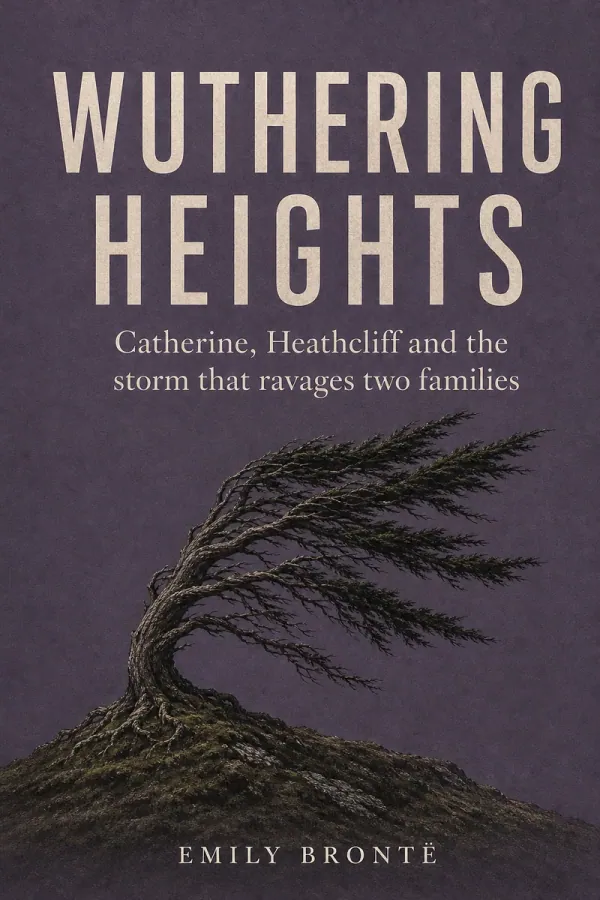
Catherine, Heathcliff and the storm that ravages two families
Study this topic in OriaThe essentials
Emily Brontë's only novel, published in 1847 under the pseudonym Ellis Bell, Wuthering Heights tells how Heathcliff, a foundling taken in by the Earnshaw family, passionately loves Catherine and then, rejected, takes revenge across two generations. Judged savage and immoral when it appeared, it has become one of the greatest novels in the English language. You'll discover Emily Brontë's secretive life, the plot step by step, the art of its nested narrators, the great debates about love, possession, money and Heathcliff's origins, and the book's astonishing legacy, from Virginia Woolf to Kate Bush.
Key dates and facts
- 1818
- Born in Thornton
- 1838
- Teacher at Law Hill
- 1842
- Stay in Brussels
- 1846
- Poems by Ellis Bell
- 1847
- Published under the name Ellis Bell
- 1848
- Death of Emily Brontë
- 1850
- Edition revised by Charlotte
- 1784
- Catherine dies, Cathy is born
- 1801
- Lockwood rents Thrushcross Grange
- 1802
- The story's ending
🌬️ Emily Brontë, the elusive sister
Emily Jane Brontë was born on July 30, 1818, in Thornton, Yorkshire, the fifth of six children of the Anglican clergyman Patrick Brontë, who came from a poor Irish family, and Maria Branwell. In 1820, the family moved to Haworth, a Pennine village on the edge of the moors. Her mother died in September 1821; Emily was three. In 1824, she was sent with her three elder sisters to the school at Cowan Bridge: at six, she was the youngest pupil. After the deaths of Maria and Elizabeth in 1825, she returned to Haworth, where the children were thereafter taught at home.
🗺️ Gondal, the secret kingdom
The Brontë children read everything they could lay their hands on: The Arabian Nights, Walter Scott, Blackwood's Magazine, Byron. Starting from wooden soldiers given to their brother Branwell, they invented imaginary worlds. Around 1831, Emily and her younger sister Anne, inseparable, “like twins” according to a friend, created their own kingdom, Gondal, which they kept alive into adulthood. Emily's Gondal poems, peopled with tragic, passionate heroes, already foreshadow Heathcliff.
🏡 Always going back to Haworth
At seventeen, Emily entered Roe Head school, where Charlotte was teaching; she lasted only a few months, so homesick that Charlotte feared she would die of it. In September 1838, she became a teacher at Law Hill school, near Halifax: seventeen-hour days and pupils she did not much like, to the point of saying she preferred the company of the house dog. In April 1839, she came home for good. At Haworth, she helped the servant in the kitchen, taught herself German, became an accomplished pianist, and wrote.
🇧🇪 Brussels
In 1842, she went with Charlotte to the Pensionnat Heger in Brussels. Older than the other pupils, a Protestant in a Catholic setting, mocked for her old-fashioned clothes, she made few friends. But her teacher, Constantin Heger, considered her even more brilliant than Charlotte:
“She should have been a man – a great navigator.”
Constantin Heger, on Emily Brontë, quoted by Elizabeth Gaskell
The death of their aunt, in October 1842, brought the sisters back to Haworth, where Emily stayed on to keep house.
📓 The notebooks discovered
In 1844, Emily copied her poems into two notebooks, one of them titled “Gondal Poems.” In the fall of 1845, Charlotte came across them by chance. Emily was furious at the intrusion, then agreed to a joint publication when Anne revealed that she too wrote in secret. The collection appeared in 1846, at the authors' expense, under the names Currer, Ellis and Acton Bell: Emily became Ellis Bell. Only two copies sold, but a reviewer in the Athenaeum praised in Ellis a power capable of reaching heights not yet attempted.
📜 Ellis Bell and a disturbing book
In 1846, each of the three sisters submitted a novel. Charlotte's, The Professor, was rejected; Emily's and Anne's, Wuthering Heights and Agnes Grey, were accepted by the London publisher Thomas Cautley Newby, on unfavorable terms. Newby dragged his feet. He made up his mind only after the triumph of Jane Eyre, published by Charlotte in October 1847, and brought out the two books at the end of 1847 (late November or December, depending on the source), as a three-volume set: the first two volumes for Emily's novel, the third for Anne's. The first American edition appeared in New York in April 1848.
😨 “A strange book”
Critics acknowledged the book's power and imagination but were baffled by its structure and shocked by the savagery and selfishness of its characters. The Atlas called it a “strange, inartistic story” shot through with a “sort of rugged power.” The Examiner delivered its verdict:
“This is a strange book. It is not without evidences of considerable power: but, as a whole, it is wild, confused, disjointed, and improbable.”
The Examiner, 1848
The Victorian public and many critics assumed the author was a man. When it later emerged that it was a woman, the book seemed even more disturbing: transgressions accepted from a man were deemed unthinkable from a woman. The poet Dante Gabriel Rossetti, who admired it, called it in 1854 “a fiend of a book,” whose “action is laid in hell.”
⚰️ Emily's death
Emily enjoyed none of the fame. Her brother Branwell died on September 24, 1848. At his funeral a week later, she caught a cold; her condition worsened, but she refused to see doctors. She died at the parsonage on December 19, 1848, at thirty, probably of tuberculosis. Her dog, Keeper, lay beside her. Her coffin was only 40 centimeters wide. Anne died in turn in May 1849. A letter from the publisher suggests Emily had begun a second novel; the manuscript has never been found.
✂️ Charlotte, first editor and first myth-maker
In 1850, Charlotte published a new edition of the novel, this time under her sister's real name. She corrected the punctuation and spelling, but she also softened the Yorkshire dialect of the old servant Joseph, which she thought incomprehensible to southern readers. In her preface, she presented Emily as an untutored child of the moors who “did not know what she had done.” Biographers now see this as a smokescreen: Charlotte, admiring but disconcerted, shaped an image of Emily more acceptable to the public.
The rest of the course
This page publishes the first 2 parts. The full course has 9: here is what the next ones cover.
- 🏚️ Two houses, two narrators
The setting (the Heights and Thrushcross Grange, the moors, possible real-life places) and the nested narration of Lockwood and Nelly Dean.
- 💔 Catherine and Heathcliff, a childhood on the moor
The first part of Nelly's story: Heathcliff's arrival, his friendship with Catherine, Hindley's humiliations and Catherine's choice to marry Edgar Linton.
- ⚔️ Heathcliff's return and Catherine's death
Heathcliff returns rich, seizes the Heights through Hindley's debts and marries Isabella Linton for revenge; Catherine dies giving birth to Cathy.
- 🌱 Cathy, Hareton and the end of the storm
The second generation: Cathy's forced marriage to Linton, Heathcliff's domination, then the reconciliation of Cathy and Hareton and Heathcliff's death.
- 🔥 A love story, really?
The great debate about the nature of the bond between Catherine and Heathcliff: absolute love, destructive possession or a story of violence.
- 💰 Land, money and origins: Heathcliff the outsider
The novel's social dimensions: property law, social class, and the debate over Heathcliff's ethnic origins.
- 🎬 From Virginia Woolf to Kate Bush
The novel's critical rehabilitation in the 20th century and its countless adaptations and rewritings around the world, up to the 2026 film.
Study “Wuthering Heights” with flashcards and quizzes
In Oria, you read the full course, then practice on it: flashcards, multiple-choice quizzes, open questions or the Feynman method. Cards and questions then come back in your daily review, paced by spaced repetition.
Study this topic in OriaSources
These notes draw on the sources below. If a point seems doubtful, refer back to them.