Essays & strategy
A Brief History of Time by Stephen Hawking: Summary and Study Notes
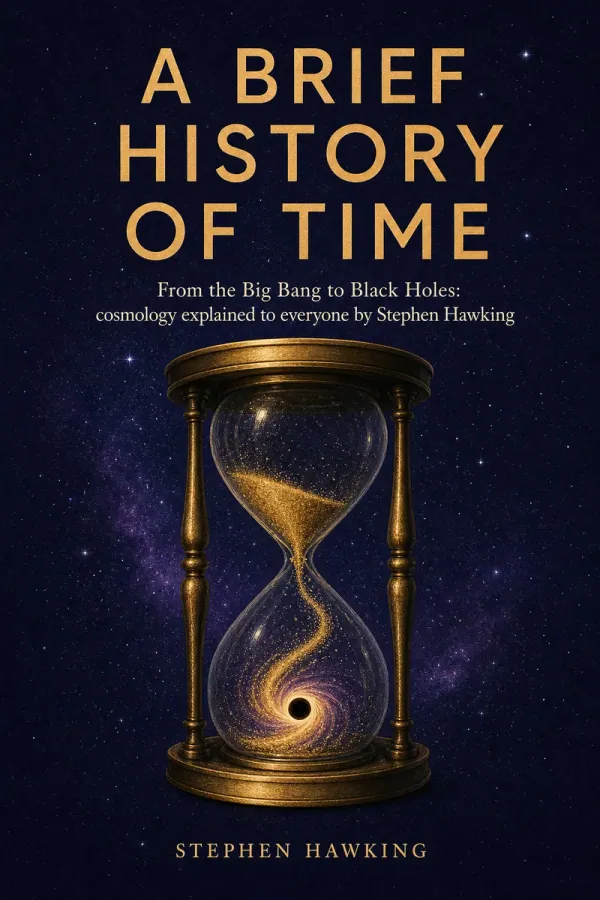
From the Big Bang to Black Holes: cosmology explained to everyone by Stephen Hawking
Study this topic in OriaThe essentials
Published in 1988, Stephen Hawking's A Brief History of Time explains the origin, structure, and fate of the universe without equations. Sold in the millions, it has also been nicknamed "the least-read book of all time." You'll discover how it came to be, its big ideas (relativity, the expanding universe, quantum mechanics, evaporating black holes, arrows of time, the quest for a theory of everything), its extraordinary author, and what science has confirmed or corrected since.
Key dates and facts
- 1982
- Hawking decides to write for a general audience
- 1985
- Tracheotomy: he loses the use of speech
- 1988
- Published in the United States, the United Kingdom, and France
- 1996
- Illustrated, updated edition
- 1942
- Born in Oxford
- 1963
- Diagnosed with his disease, at 21
- 1974
- Discovery of black hole radiation
- 1979
- Appointed to the Lucasian Chair at Cambridge
- 2018
- Dies in Cambridge, at 76
🚀 A physics book for airport bookshelves
A Brief History of Time is a work of popular science written by the British physicist Stephen Hawking and published in 1988. Its ambition is immense: to explain to readers with no scientific background what physics knows about the origin, structure, and fate of the universe, without resorting to mathematics.
💸 A project born of a very practical need
In 1982, Hawking was already a respected theoretical physicist at Cambridge, suffering from a disease that was gradually paralyzing him. To pay for his children's education and the household's expenses, he decided to write a book about the universe that anyone could read. In 1983, he pitched the idea to Simon Mitton, the astronomy books editor at Cambridge University Press. Mitton was worried: the manuscript contained too many equations for the readers Hawking wanted to reach, the kind of people who buy a book in an airport bookshop.
Rather than sign with a university press, Hawking went with a mainstream publisher, Bantam Books, which paid him a substantial advance. A first version was finished in 1984. In his acknowledgments, he recalls being warned that every equation he included would halve the book's sales. The book therefore keeps only one, the most famous equation in physics: E=mc^2.
🗣️ Writing without a voice
In 1985, during a stay at CERN, Hawking caught severe pneumonia. A tracheotomy saved his life but cost him what remained of his speech. He now communicated through a computer-controlled speech synthesizer. One of the first messages he composed with the device asked his assistant to help him finish the book. His editor at Bantam, Peter Guzzardi, made him rewrite the manuscript again and again so that every idea would be understandable without jargon, to the author's great irritation.
📦 Publication
The book came out in April 1988 in the United States, then in June in the United Kingdom, with an introduction by astronomer Carl Sagan. That foreword later disappeared from subsequent editions, since its rights belonged to Sagan rather than the publisher. The French translation by Isabelle Naddeo-Souriau appeared the same year from Flammarion, under the title Une brève histoire du temps : du big bang aux trous noirs. In 1996, an illustrated, updated edition added a new chapter on time travel, among other things.
🌍 From Aristotle to Newton: our picture of the universe
Stephen Hawking opens A Brief History of Time with an anecdote. A famous scientist (some say it was the philosopher Bertrand Russell) once gave a public lecture explaining that the Earth orbits the Sun, and the Sun orbits the center of our Galaxy. At the end, an old woman stood up to say that the world was flat and rested on the back of a giant tortoise.
"And what is the tortoise standing on?" ... "You're very clever, young man, very clever," said the old lady. "But it's turtles all the way down!"
Stephen Hawking, A Brief History of Time (1988)
The story brings a smile, but it raises the real question at the heart of the book: how do we know what we think we know about the universe?
🌑 A round Earth at the center of the world
Hawking goes back to the Greek philosopher Aristotle, who had worked out that the Earth is round. He relied on two observations: the Earth's shadow on the Moon during eclipses is always round, and the North Star appears higher in the sky the further north one travels. But Aristotle placed the Earth motionless at the center of everything, with the Sun, the Moon, and the stars moving around it on perfect circles. In the second century AD, the astronomer Ptolemy turned this into a detailed model, geocentrism, that could predict the positions of the heavenly bodies.
☀️ The Copernican revolution
In 1514, the Polish priest Nicolaus Copernicus put forward a detailed argument for a model in which the planets orbit the Sun. Nearly a century later, the Italian Galileo turned a telescope toward the sky and discovered moons orbiting Jupiter: so not everything revolves around the Earth. The German Johannes Kepler showed that the planets follow ellipses rather than circles. Finally, in his Principia Mathematica of 1687, Isaac Newton explained these motions with a single law, universal gravitation.
⏳ Did the universe have a beginning?
One question remained even more dizzying. Aristotle believed the universe was eternal, with neither beginning nor end. Christian theologians, such as Saint Augustine, argued the opposite: that it had been created at a specific moment, and that time itself had been born with it. The philosopher Immanuel Kant, for his part, held that time could not have had a beginning.
For Hawking, this debate shifted in the twentieth century, when astronomer Edwin Hubble discovered that galaxies are moving away from one another. If the universe is growing, it must once have been much smaller and denser, and the question of its beginning becomes a question of physics. To answer it, scientists have two major theories, general relativity and quantum mechanics, which do not agree with each other. The whole book is the story of the search for a theory able to unite them.
The rest of the course
This page publishes the first 2 parts. The full course has 9: here is what the next ones cover.
- ⏱️ Space and time: the end of absolute time
The second chapter of Hawking's book: from Galileo and Newton to Einstein, the speed of light, special relativity, E = mc², time dilation, the light cone, and general relativity.
- 💥 The expanding universe and the big bang
The chapters of Hawking's book on the expansion of the universe, redshift, the cosmic microwave background, singularities, inflation, and his idea of a 'no-boundary' universe.
- 🎲 The uncertainty principle and elementary particles
The chapters of Hawking's book on quantum mechanics: the end of Laplace's determinism, Planck's quanta, Heisenberg's uncertainty principle, wave-particle duality, quarks, spin, and the fundamental forces.
- 🕳️ Black holes that aren't so black
The chapters of Hawking's book on black holes: stellar collapse, the Chandrasekhar limit, the event horizon, the bet on Cygnus X-1, entropy, and Hawking radiation.
- ➡️ Arrows of time, wormholes, and the theory of everything
The final chapters of Hawking's book: the three arrows of time, the question of time travel through wormholes, string theory, and the hope for a unified theory.
- 🎓 Stephen Hawking, the author
Who was Stephen Hawking, the author of A Brief History of Time: his studies at Oxford and Cambridge, his diagnosis at age 21, his work on singularities and black holes, the Lucasian chair, and his worldwide fame.
- ⚖️ Success, criticism, and limits
The reception of A Brief History of Time: record sales, its reputation as a book 'bought but not read,' criticism, and what science has confirmed or corrected since 1988.
Study “A Brief History of Time” with flashcards and quizzes
In Oria, you read the full course, then practice on it: flashcards, multiple-choice quizzes, open questions or the Feynman method. Cards and questions then come back in your daily review, paced by spaced repetition.
Study this topic in OriaSources
These notes draw on the sources below. If a point seems doubtful, refer back to them.