Essays & strategy
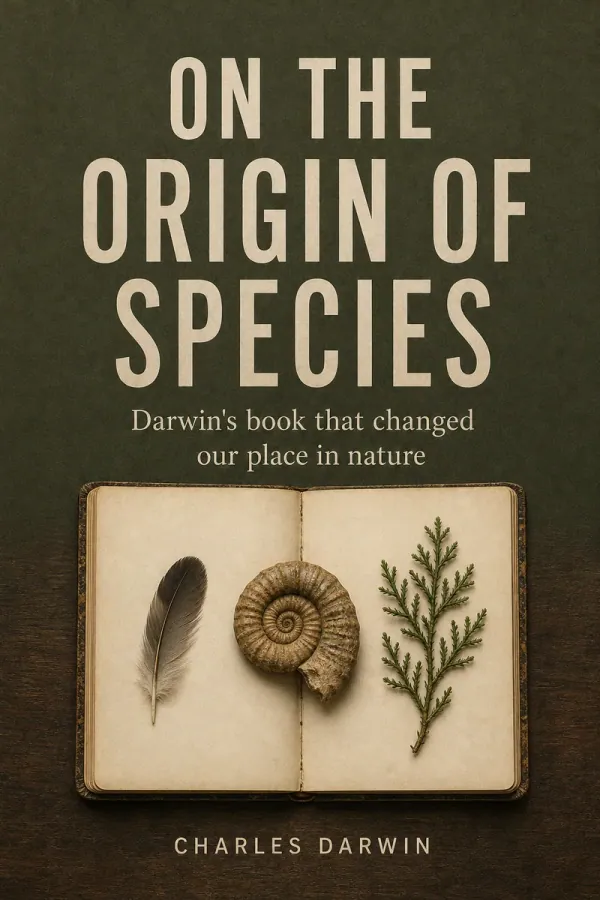
On the Origin of Species by Charles Darwin: Summary and Study Notes
Darwin's book that changed our place in nature
Study this topic in OriaThe essentials
Published in London on November 24, 1859, On the Origin of Species was, in Darwin's mind, only an “abstract,” written in a hurry after he received Alfred Russel Wallace's manuscript. It became one of the most influential books ever written. This chapter tells the story of the book itself: its long gestation, Wallace's letter, its construction as “one long argument,” from domestic pigeons to the “entangled bank,” the objections Darwin confronted, its six editions and translations, the storm of its reception and what Darwin still did not know.
Key dates and facts
- 1831 – 1836
- Voyage of the Beagle
- July 1837
- First tree of life in Notebook B
- Sept. 1838
- Reads Malthus
- 1844
- 230-page essay, unpublished
- June 18, 1858
- Darwin receives Wallace's manuscript
- July 1, 1858
- Joint reading at the Linnean Society
- July 20, 1858
- Darwin starts writing the “abstract”
- Nov. 24, 1859
- Published by John Murray
⛵ Twenty years for one book
Charles Darwin, born in Shrewsbury, England, on February 12, 1809, was no revolutionary. A medical student in Edinburgh, then a theology student at Cambridge, he learned science within the framework of natural theology, which saw the adaptation of living things as proof of divine design. From December 27, 1831, to October 2, 1836, he sailed around the world aboard HMS Beagle. On board he read Charles Lyell's Principles of Geology, and in South America he found fossils of giant animals that resembled species still living on the same continent.
🐦 The clues
Back in London, specialists examined his collections. In March 1837, the ornithologist John Gould announced that the mockingbirds brought back from the Galápagos Islands formed three distinct species, each unique to one island, and that several very different birds from the archipelago were all finches. Darwin began to wonder in his notebooks whether one species could turn into another. In July 1837, in his “Notebook B,” he drew a first family tree of life and wrote above it: “I think.”
📈 The Malthus spark
At the end of September 1838, he read Thomas Malthus's Essay on the Principle of Population, which argues that human populations grow faster than their resources. Darwin applied the idea to all of nature: if every species produces more offspring than can survive, favorable variations will be preserved and the others eliminated. In December 1838, he linked this natural sorting to the kind breeders practice. He now had a “theory by which to work.”
⏳ Why so long?
Yet he did not publish it. In 1842, he wrote a 35-page sketch in pencil; in 1844, a 230-page “Essay,” to be published if he died prematurely. That same year, a best-selling anonymous book, Vestiges of the Natural History of Creation, argued for the transformation of species and drew the wrath of scientists: Darwin, who scorned its errors, then carefully reexamined his own arguments. He went on to spend eight years studying barnacles (acorn and goose barnacles), becoming the leading expert on them, before devoting himself full-time to evolution from 1854. Why the delay? Biographers have pointed to fear of religious scandal, his illness or concern for the feelings of those close to him; the historian John van Wyhe has shown that the idea of a deliberate delay dates only from the 1940s, and that Darwin simply finished each book before starting another. In 1856, urged on by Lyell, he began an enormous technical treatise, his “big book,” Natural Selection.
✉️ The letter from the Moluccas
On June 18, 1858, while working on his big treatise, Darwin received a package sent from the Moluccas, in present-day Indonesia, by a young naturalist he had encouraged: Alfred Russel Wallace. Twenty pages described a mechanism of evolution very close to his own. Darwin wrote to Lyell that “your words have come true with a vengeance” and that “all my originality, whatever it may amount to, will be smashed.”
🤝 A joint publication
Lyell and the botanist Joseph Hooker found a solution: on July 1, 1858, before the Linnean Society of London, Wallace's paper was read together with extracts from Darwin's 1844 essay and from an 1857 letter to the American botanist Asa Gray. The meeting caused almost no stir. Darwin considered Wallace's idea identical to his own, but historians note differences: Darwin compared natural selection to the selection practiced by breeders and emphasized competition between individuals, whereas Wallace did not mention breeding and stressed environmental pressures.
✍️ A 500-page “abstract”
Darwin then decided to write an “abstract” of all his work. He began on July 20, 1858, on vacation at Sandown on the Isle of Wight, writing partly from memory. The text kept growing: by October, he realized it would need a small separate volume. Lyell found him a publisher, John Murray, who agreed without even reading the manuscript. Murray refused to have the word “abstract” in the title; Darwin insisted on keeping “natural selection.” After several drafts, the title was settled: On the Origin of Species by Means of Natural Selection, or the Preservation of Favoured Races in the Struggle for Life. The word “races” there refers, as it often did at the time, to varieties within a species, from cabbages to domestic animals.
📦 Sold out on release
The book came out on Thursday, November 24, 1859, priced at 15 shillings, in a print run of 1,250 copies. Offered to booksellers two days earlier, all available copies, about 1,170, were immediately spoken for, 500 of them by Charles Mudie's lending library, which put the book in the hands of many subscribers. Darwin, then 50, would receive £180 for this first edition; by his death in 1882, the book had earned him nearly £3,000.
The rest of the course
This page publishes the first 2 parts. The full course has 9: here is what the next ones cover.
- 🕊️ From pigeons to natural selection
Chapters I to V: variation in domestic animals and in nature, the struggle for existence, natural selection, divergence and the tree of life.
- 🦇 Darwin faces the objections
Chapters VI to VIII: the absence of intermediate forms, complex organs such as the eye, the evolution of instincts and the fertility of hybrids.
- 🦴 Fossils, islands and bones
Chapters IX to XIII: the imperfection of the geological record, the distribution of species across the Earth, classification, homologies, embryos and rudimentary organs.
- 🌿 The entangled bank
The last chapter: the recapitulation, the famous closing sentence, the discreet place of human beings in the book and the addition “by the Creator.”
- 📖 Six editions and unfaithful translations
How the book changed from 1859 to 1872, from the second to the sixth edition, and how it traveled to Germany, France, the United States, Russia and China.
- 🔥 An intellectual storm
The book's reception: criticism from Owen and Wilberforce, Huxley's defense, the 1860 Oxford debate, religious reactions, its welcome in Germany, Russia and France, and political uses.
- 🧬 What Darwin didn't know, and what has lasted
The book's errors and gaps (heredity, the age of the Earth, its share of Lamarckism), the “eclipse of Darwinism,” the modern synthesis and the book's place today.
Study “On the Origin of Species” with flashcards and quizzes
In Oria, you read the full course, then practice on it: flashcards, multiple-choice quizzes, open questions or the Feynman method. Cards and questions then come back in your daily review, paced by spaced repetition.
Study this topic in OriaSources
These notes draw on the sources below. If a point seems doubtful, refer back to them.