Essays & strategy
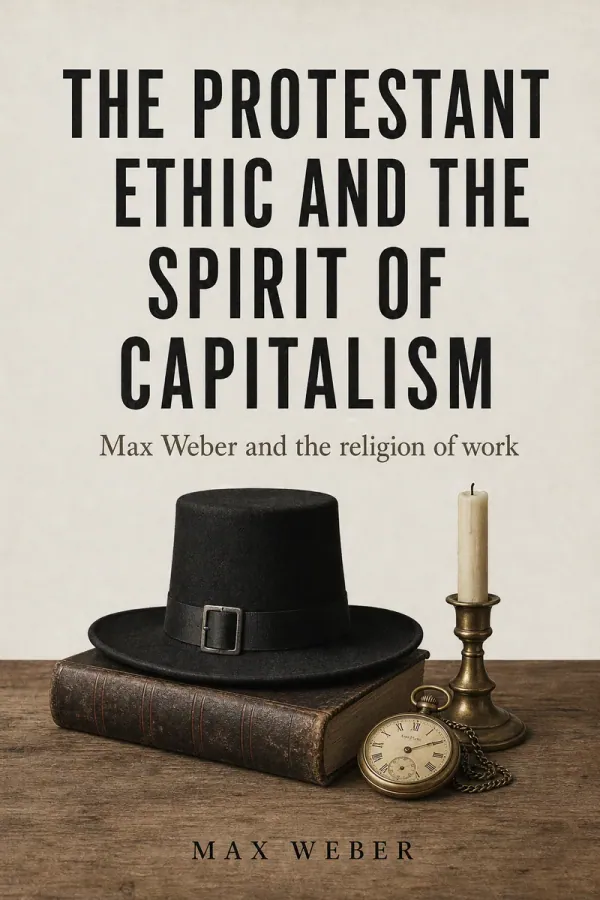
The Protestant Ethic and the Spirit of Capitalism by Max Weber: Summary and Study Notes
Max Weber and the religion of work
Study this topic in OriaThe essentials
Published as two articles in 1904 and 1905, the German sociologist Max Weber's essay asks a bold question: why did modern, methodical, rational capitalism develop first in the Protestant West? His answer runs through Luther, Calvin and the Puritans, for whom relentless work and the rejection of luxury were religious duties. You'll discover Weber's life, the starting point of his inquiry, the notions of the “spirit of capitalism,” Beruf and predestination, the famous “iron cage,” and the many criticisms that historians and economists around the world have leveled at this thesis.
Key dates and facts
- April 21, 1864
- Born in Erfurt
- 1896
- Professor at Heidelberg
- 1897
- His father dies; a severe depression begins
- 1904
- Trip to the United States
- 1904 – 1905
- Published as two articles in the Archiv
- 1920
- Revised edition; Weber dies in Munich
- 1930
- English translation by Talcott Parsons
- 1964
- First French translation
🎓 Max Weber, from law to sociology
Max Weber was born on April 21, 1864 in Erfurt, in the Kingdom of Prussia. The eldest of eight children, he grew up in Charlottenburg, near Berlin, where his family settled in 1869. His father, a lawyer and civil servant, was a deputy for the National Liberal Party: his salon welcomed scholars and public figures, such as the philosopher Wilhelm Dilthey and the historian Theodor Mommsen.
⛪ Between two models of life
His mother, Helene Fallenstein, was descended in part from a French Huguenot family that had grown rich in international trade and textiles. She was a fervent Calvinist, deeply involved in charity work. The couple did not get along: the father loved material pleasures and had no interest in religion, while the mother lived her faith austerely. These tensions left a deep mark on the young Weber, who gradually took his mother's side.
⚖️ A brilliant jurist
A pupil who was bored in class, he secretly devoured Goethe's complete works and read Kant before finishing secondary school. In 1882 he began studying law in Heidelberg, then continued in Berlin and Göttingen. As a student he drank a great deal of beer and took part in dueling fencing, which left scars on his face. In 1889 he defended a doctoral thesis in legal history on the trading companies of medieval Italian cities, followed by a habilitation on Roman agrarian history. In 1893 he married Marianne Schnitger, who would herself become a writer and feminist activist. A professor of economics in Freiburg im Breisgau in 1894, he obtained a chair at Heidelberg in 1896, where his home became a meeting place for intellectuals.
🌑 The crisis of 1897
In June 1897, Weber quarreled violently with his father over the way he treated his mother. His father died two months later, without any reconciliation. Weber then sank into a deep depression: nervousness, insomnia, inability to teach. He stayed in sanatoriums, traveled to Corsica and Italy, and eventually gave up teaching in 1903; he would not return to it until 1918.
🚢 The American journey
Once recovered, he became in 1904 one of the editors of the journal Archiv für Sozialwissenschaft und Sozialpolitik, alongside Werner Sombart and Edgar Jaffé. That same year he traveled with Marianne to the United States for a scientific congress held during the World's Fair in St. Louis. The couple crisscrossed the country for nearly three months: towns of German immigrants, African American communities, distant relatives in North Carolina. Weber closely observed American social, economic and religious life, and tested it against the thesis he was in the middle of writing.
📰 Two articles that became a global classic
The Protestant Ethic and the Spirit of Capitalism did not first appear as a book. It consisted of two long articles, published in 1904 and 1905 in the journal Weber co-edited, the Archiv für Sozialwissenschaft und Sozialpolitik. The German title is Die protestantische Ethik und der Geist des Kapitalismus.
🗂️ A two-part plan
| Part | Chapters |
|---|---|
| I. The Problem | 1. Religious Affiliation and Social Stratification; 2. The “Spirit” of Capitalism; 3. Luther's Conception of the Beruf |
| II. The Idea of the Beruf in Ascetic Protestantism | 1. The Religious Foundations of Worldly Asceticism; 2. Asceticism and the Spirit of Capitalism |
Weber planned a sequel but gave it up, in part because his colleague, the theologian Ernst Troeltsch, published in 1912 a vast study of the social teachings of the Christian churches that covered the subject.
✏️ The 1920 edition
In 1920, Weber published a revised and expanded version, with many additions, at the head of his Collected Essays in the Sociology of Religion. The often-quoted introduction exists only in this edition. That same year he separately published a text on the Protestant sects in the United States, a country he had visited. The book thus became the first part of an immense comparative program: Weber went on to study the religions of China (Confucianism and Taoism), of India (Hinduism and Buddhism) and ancient Judaism, to understand why rational capitalism developed in the West and not elsewhere.
🕯️ Weber's death
Weber did not live to see his essay's worldwide success. Having returned to teaching in Vienna in 1918, then in Munich in 1919, he fell ill in early June 1920. He died of pneumonia on June 14, 1920 in Munich, aged 56, probably after catching the Spanish flu. His widow, Marianne Weber, then published his great unfinished treatise, Economy and Society.
🌍 A worldwide success
The English translation by the American sociologist Talcott Parsons, in 1930, made the book known in the English-speaking world. France discovered it later: the first French translation, by Jacques Chavy, appeared in 1964, followed by others, including one by Isabelle Kalinowski. In 1998, the International Sociological Association ranked it fourth among the most important sociology books of the 20th century. It is considered a founding text of economic sociology.
The rest of the course
This page publishes the first 2 parts. The full course has 8: here is what the next ones cover.
- 📊 The starting point: religion and economic success
The observation that launches the inquiry: in Germany around 1900, Protestants seem more present in business and technical occupations, and modern capitalism has very particular features.
- ⏰ The “spirit of capitalism”: time is money
What Weber calls the spirit of capitalism: Benjamin Franklin's ethic, gain as an end in itself, and the clash with economic traditionalism.
- ✝️ Luther and the Beruf: when a trade becomes a calling
Luther's religious transformation of work: the German word Beruf, meaning both occupation and calling, and the new value given to everyday work.
- 🔒 Calvin, predestination and the anxiety of salvation
The heart of the thesis: the Calvinist doctrine of predestination, the inner loneliness it produces, and the search for signs of election in work.
- ⛓️ From asceticism to capital, then the “iron cage”
How Puritan asceticism drives people to accumulate and reinvest, and how, once faith has faded, capitalism becomes a constraint that Weber compares to an iron cage.
- 🌐 A thesis debated around the world
Criticism from historians and economists, from Sombart and Braudel to recent statistical studies, and the work that has instead extended the thesis to Asia and Latin America.
Study “The Protestant Ethic and the Spirit of Capitalism” with flashcards and quizzes
In Oria, you read the full course, then practice on it: flashcards, multiple-choice quizzes, open questions or the Feynman method. Cards and questions then come back in your daily review, paced by spaced repetition.
Study this topic in OriaSources
These notes draw on the sources below. If a point seems doubtful, refer back to them.