Essays & strategy
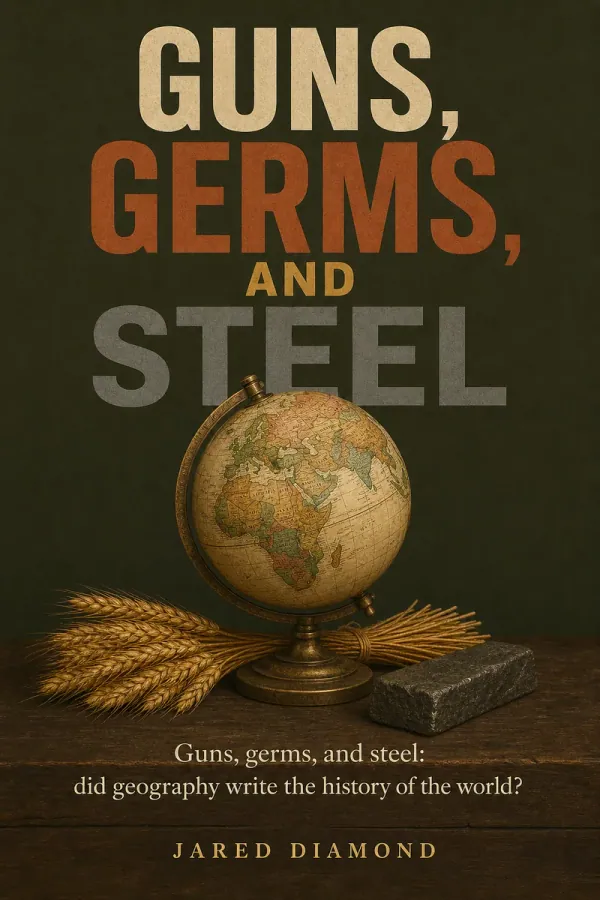
Guns, Germs, and Steel by Jared Diamond: Summary and Study Notes
Guns, germs, and steel: did geography write the history of the world?
Study this topic in OriaThe essentials
Published in 1997 as Guns, Germs, and Steel, this essay by Jared Diamond won the 1998 Pulitzer Prize. It asks why societies from Eurasia came to dominate other continents, rejecting any idea of biological superiority. You'll discover his chain of causes, from domesticable plants and animals to germs and weapons, his famous theory of continental axes, and then the sharp criticism from historians, geographers, and anthropologists, who accuse him of geographic determinism.
Key dates and facts
- 1997
- Guns, Germs, and Steel published by W. W. Norton
- 1998
- Pulitzer Prize for general nonfiction
- 2000
- French translation published by Gallimard
- 2005
- National Geographic documentary aired on PBS
- 10,000 years ago
- Agriculture in the Fertile Crescent and New Guinea
- 9,000 years ago
- Rice and millet domesticated in China
- 4,500 years ago
- Maize, beans, and squash in Central America
- 4,000 years ago
- Agricultural centers in the Andes, the Sahel, and Ethiopia
- 1937
- Born in Boston
- 1961
- PhD in physiology from Cambridge
❓ Yali's question
Guns, Germs, and Steel is an essay by the American biologist and geographer Jared Diamond, published in 1997 in the United States. In the United Kingdom, it carries a subtitle that sums up its ambition: a "short history of everybody for the last 13,000 years." The book won the 1998 Pulitzer Prize for general nonfiction.
🗣️ A conversation in New Guinea
It all starts with a conversation between Diamond and Yali, a local politician in Papua New Guinea. In New Guinea, the word "cargo" is used for inventions and manufactured goods that come from elsewhere. Yali asks a simple question, one that Diamond places at the heart of his book.
"Why is it that you white people developed so much cargo […], but we black people had little cargo of our own?"
Yali's question, as reported by Jared Diamond, Guns, Germs, and Steel (1997)
Diamond widens the question to the whole planet. Why did peoples from Eurasia conquer, colonize, or displace the peoples of the Americas, Australia, and much of Africa, rather than the other way around? Why, even after independence, have the gaps in wealth and power persisted?
🚫 Not a matter of genes
Diamond immediately rules out the racist explanation, which would attribute European dominance to superior intelligence or morality. He recounts that the Papua New Guineans he has known for decades strike him as at least as sharp as the average Westerner. For him, the answer has to be sought in the environment: the initially very unequal distribution, among continents, of cultivable plants, domesticable animals, and natural barriers.
His method rests on a central distinction. The proximate causes of conquest are well known: firearms, steel swords, horses, ships, writing, and above all epidemic diseases. But why did all these advantages end up on the same side? Diamond wants to trace things back to ultimate causes, rooted more than 10,000 years earlier, at the end of the last ice age.
🧩 A synthesis of several sciences
The book blends biology, archaeology, linguistics, geography, and history. Diamond himself acknowledges that he is pulling together ideas that originated with others: as early as the start of the 20th century, the Russian thinker Georgi Plekhanov had already pointed to the lack of large domesticable animals in the Americas, and the historian William H. McNeill had linked domestication to infectious disease. Diamond's originality lies in the scope of the narrative, which spans every continent over 13,000 years.
⚔️ Cajamarca, or the proximate causes
To make his question concrete, Jared Diamond, in Guns, Germs, and Steel, dwells on one specific scene: the meeting at Cajamarca, in the Andes, in 1532.
🏔️ 168 men against an empire
That day, the conquistador Francisco Pizarro and 168 Spaniards faced the army of the Inca emperor Atahualpa, numbering several tens of thousands of men. By the end of the day, Atahualpa was a prisoner and thousands of Incas had died, while the Spanish suffered almost no losses. How can such an imbalance be explained?
Diamond lists the Spanish advantages:
- steel swords and armor, against which Andean clubs and slings were powerless;
- horses, whose charges the Inca army had no way to counter;
- a civil war tearing the empire apart, after the death of the previous ruler, carried off by a European epidemic that had arrived ahead of the Spanish themselves;
- the lack of writing and of information flow: Atahualpa did not know that the Aztec empire had been overthrown a decade earlier by an equally small force;
- firearms, still not very effective in 1532, but which would weigh more and more heavily in the centuries to come.
Diamond stresses that Native American peoples were anything but passive: once they adopted the horse and the gun, some became formidable opponents, like the Sioux and the Cheyenne, victorious at Little Bighorn in 1876. The real question then becomes: why were steel, horses, germs, and writing on Europe's side?
Proximate causes are the factors that directly explain an event, such as weapons or epidemics. Ultimate causes are the distant conditions that made those factors possible. For Diamond, they are geographic and ecological.
🏝️ A "natural experiment" in the Pacific
Before turning to the continents, Diamond tests his idea on a small scale, in Polynesia. The Chatham Islands, off New Zealand, were settled around the year 1000 by Polynesians of the same stock as the Maori. But on these small, cold islands, where farming was impossible, their descendants, the Moriori, reverted to hunting and gathering and adopted a pacifist tradition. In New Zealand, larger and farmable, the Maori developed more numerous farming societies organized into rival clans.
When Maori groups landed on the Chatham Islands in the 1830s, the Moriori, few in number and with no warrior tradition, were slaughtered. For Diamond, the history of these two peoples from a single stock shows, in fast-forward, how environment shapes the size, organization, and power of societies. He also cites the centralized kingdoms of Tonga and Hawaii, which arose on richer archipelagos.
The rest of the course
This page publishes the first 2 parts. The full course has 9: here is what the next ones cover.
- 🌾 Agriculture's head start
According to Diamond, food production is the first link in the chain: surpluses, specialists, dense populations; and not every region had the same plants to domesticate.
- 🐄 Fourteen animals and the Anna Karenina principle
Why almost all large domestic mammals come from Eurasia: the six conditions for domestication, and the extinction of large fauna elsewhere.
- 🧭 Continents lying down or standing up
The axis theory: Eurasia stretches east to west, which made it easier to spread crops, animals, and ideas; the Americas and Africa stretch north to south.
- 🦠 Germs, writing, and states
How, according to Diamond, food production led to epidemics from livestock, to writing, to inventions, and to states capable of conquest.
- 🌏 Diamond's world tour
Diamond applies his theory to New Guinea, China, the Austronesian expansion, Africa, and the rivalry between Europe and China.
- ✍️ Jared Diamond, the author
The path of Jared Diamond, born in Boston in 1937: physiologist, ornithologist in New Guinea, then geographer and best-selling author.
- ⚖️ Success, criticism, and limits
The book was showered with prizes but sharply criticized: geographic determinism, Eurocentrism, overlooking human choices and institutions.
Study “Guns, Germs, and Steel” with flashcards and quizzes
In Oria, you read the full course, then practice on it: flashcards, multiple-choice quizzes, open questions or the Feynman method. Cards and questions then come back in your daily review, paced by spaced repetition.
Study this topic in OriaSources
These notes draw on the sources below. If a point seems doubtful, refer back to them.