Essays & strategy
Factfulness: Summary and Study Notes
Ten reasons we're wrong about the world
Study this topic in OriaThe essentials
Published in 2018, a year after the death of Swedish physician and statistician Hans Rosling, Factfulness shows that most of us picture the world as poorer, sicker, and more dangerous than it actually is. You'll discover the famous chimpanzee test, the four income levels that replace the rich-country/poor-country divide, the ten instincts that distort our judgment, the figure of the "possibilist," and the criticism that accuses the book of being too rosy.
Key dates and facts
- 2005
- Gapminder founded by the three authors
- 2017
- Death of Hans Rosling, on February 7
- 2018
- Factfulness published in the United States
- 2019
- French edition published by Flammarion
- 2 billion
- Children aged 0 to 15 today
- 2100
- Still about 2 billion children, according to the UN
- 80%
- One-year-olds vaccinated against at least one disease
- 1948
- Born in Uppsala
- 1979 – 1981
- District doctor in Nacala, Mozambique
- 2006
- First TED talk, "The best stats you've ever seen"
📘 A book like a will
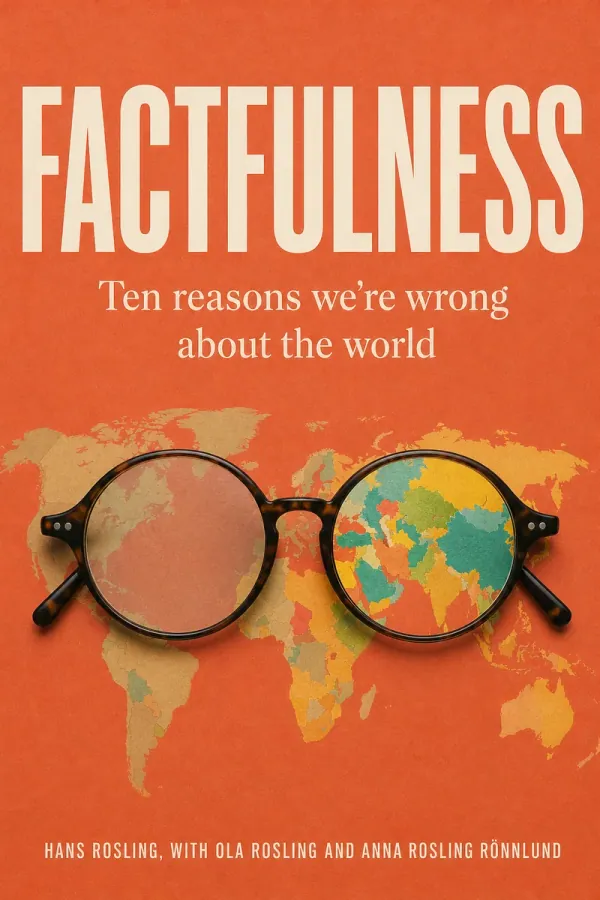
Factfulness is a book by the Swedish physician and statistician Hans Rosling, written with his son Ola Rosling and his daughter-in-law Anna Rosling Rönnlund. Its full title promises "ten reasons we're wrong about the world, and why things are better than you think." It was published on April 3, 2018, in the United States by Flatiron Books.
🕯️ A posthumous book
Hans Rosling learned in 2016 that he had pancreatic cancer. He died on February 7, 2017, and the book was published posthumously a year later. Factfulness is thus both a method for thinking about the world and the intellectual last testament of a man who spent his life fighting what he called ignorance of the facts about the planet.
🧠 A coined word
The word "factfulness" was invented by the authors, built on the word fact. The authors give it a deliberately calming definition.
"The stress-reducing habit of only carrying opinions for which you have strong supporting facts."
Hans Rosling, Ola Rosling, and Anna Rosling Rönnlund, Factfulness (2018)
The book does not claim that everything is fine. It argues that we are systematically wrong, and always in the same direction: we see the world as poorer, less healthy, and more dangerous than it is. According to the authors, this mistake does not come from a lack of intelligence, but from mental shortcuts and from news coverage dominated by the dramatic.
🚀 A worldwide success
The book quickly became an international best-seller, and the Gapminder foundation announced translations into dozens of languages. In France, it was published by Flammarion on February 13, 2019, translated by Pierre Vesperini, with the subtitle Penser clairement ça s'apprend!
Its most famous champion is Bill Gates, who has described it as one of the most important books he has ever read. In June 2018, he offered to give a free copy to every new graduate of American universities. Barack Obama also listed it among his summer reading.
🐒 The chimpanzee test
Factfulness, the book by Hans Rosling and his co-authors, opens with a questionnaire. Before reading further, readers are invited to answer thirteen simple questions about the state of the world, each with three possible answers.
❓ A few questions from the test
Here are examples drawn from the test run by the Gapminder foundation, with the correct answer:
| Question | Correct answer |
|---|---|
| In the last 20 years, the share of the world population living in extreme poverty has… | almost halved |
| How many one-year-old children in the world are vaccinated against some disease? | 80% |
| What is the life expectancy of the world population? | 70 years |
| In low-income countries, how many girls finish primary school? | 60% |
| Where does most of the world population live? | in middle-income countries |
| How many children aged 0 to 15 will there be in 2100, according to the UN? | 2 billion, same as today |
Other questions cover access to electricity (80% of humanity has it), girls' schooling (9 years on average by age 30, versus 10 for men), or deaths from natural disasters, which have fallen by more than half in a century.
🎯 Worse than chance
In 2017, Gapminder put these questions to about 12,000 people in 14 rich countries. Leaving aside the question on climate, which almost everyone gets right, the average score was 2.2 correct answers out of 12. Only one person scored 11, and no one got a perfect score.
Hence the image that made the book famous: a chimpanzee picking answers at random would get about a third of them right on average, or 4 out of 12. It would therefore do better than most of the humans tested. According to the authors, supposedly well-informed audiences do no better: teachers, journalists, Nobel laureates, and investment bankers make the same mistakes.
A Gapminder term for the picture of the world that makes people fail the test: a world perceived as more conflict-ridden, more negative, and more overcrowded than it really is, fed by excessive consumption of dramatic news.
🧪 Where did the test come from?
Hans Rosling started by quizzing his students at the Karolinska Institute, in Stockholm, before his public health course. He was struck by their mistakes on basic global facts. He then asked the same questions to his lecture audiences and found that false beliefs were everywhere. Starting in 2013, Gapminder began systematically recording the answers, then worked with polling institutes.
For Rosling, if people score worse than random chance, it is not simply because they are ignorant: they carry in their heads a false but consistent picture of the world. The book's goal is to correct that picture, without shame or guilt, but with curiosity and humility.
The rest of the course
This page publishes the first 2 parts. The full course has 8: here is what the next ones cover.
- 🪜 Four levels instead of two worlds
Rosling proposes replacing the "developed / developing" divide with four levels of income per person per day.
- 📉 The instincts that darken the picture
The negativity, straight line, fear, and size instincts, which make us see the world as worse than it is, and the rules for correcting them.
- 🧭 Generalizing, blaming, rushing
The other six instincts in Factfulness: generalization, destiny, single perspective, blame, and urgency, with the episode in Memba, Mozambique.
- 🌱 Neither optimist nor pessimist: possibilist
Rosling refused the label of optimist: he called himself a "possibilist" and named five big global risks that truly worried him.
- ✍️ Hans Rosling, the statistics doctor
The life of Hans Rosling (1948-2017): doctor in Mozambique, researcher on konzo, professor of international health, co-founder of Gapminder, and TED star.
- ⚖️ Reception, criticism, and limits
Factfulness was praised as an antidote to catastrophism, but criticized for cherry-picking good news and downplaying the environment and inequality.
Study “Factfulness” with flashcards and quizzes
In Oria, you read the full course, then practice on it: flashcards, multiple-choice quizzes, open questions or the Feynman method. Cards and questions then come back in your daily review, paced by spaced repetition.
Study this topic in OriaSources
These notes draw on the sources below. If a point seems doubtful, refer back to them.