Business & money
Coco Chanel: Biography and Study Notes
The designer who freed women's bodies and built a luxury empire
Study this topic in OriaThe essentials
Gabrielle Chanel was born poor in Saumur, grew up without a mother and invented a legend for herself. A milliner in Paris in 1910, within a few years she imposed a simple, comfortable fashion, jersey, the little black dress and No. 5 perfume, and became one of the richest businesswomen of her time. You'll follow her life step by step, including the Occupation years and what historians say about them, then her triumphant comeback in 1954, and understand why her style still crosses the decades.
Key dates and facts
- 1910
- Chanel Modes, 21 rue Cambon
- 1913
- Boutique in Deauville
- 1915
- Couture house in Biarritz
- 1918
- Buys 31 rue Cambon
- 1919
- Death of Boy Capel
- 1921
- Launch of No. 5 perfume
- 1924
- Parfums Chanel founded
- 1926
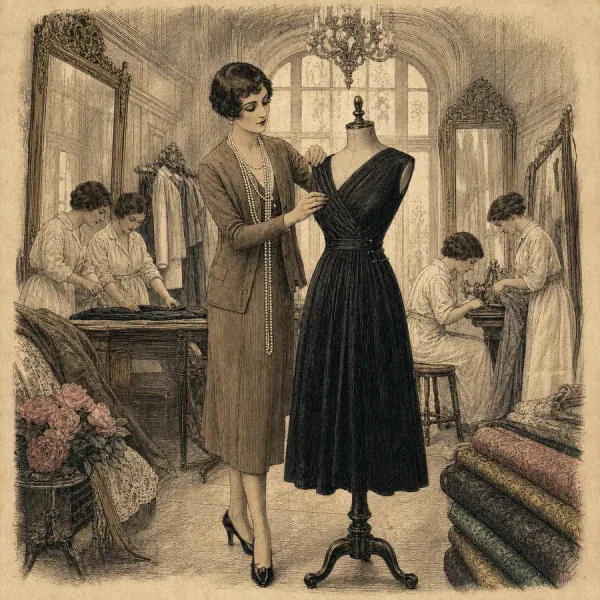
- The little black dress in Vogue
- 1939
- Couture house closes
- May 5, 1941
- Letter seeking to take over Parfums Chanel
🕯️ Gabrielle, a poor and reinvented childhood
Gabrielle Chanel was born on August 19, 1883 in the poorhouse of Saumur, run by the Sisters of Providence, a charitable institution for the poor. In the civil register, her name was misspelled “Chasnel.” She kept it officially all her life, because correcting it would have revealed that she was born in a poorhouse.
🧺 A family of traveling peddlers
Her father, Albert Chanel, was a street peddler who sold work clothes and underwear at markets, always on the road. Her mother, Jeanne Devolle, was a young seamstress and laundress. Gabrielle was born out of wedlock; her parents did not marry until November 1884. The couple had six children, one of whom died as a baby, and the family lived cramped in miserable lodgings, notably in Brive-la-Gaillarde.
On February 6, 1895, her mother died, worn out by pregnancies, illness and work at the markets in the cold. Gabrielle was eleven. Her father, often absent but adored by her, then sent his sons to work as farmhands and entrusted his daughters to nuns.
⛪ The Aubazine orphanage… or not?
According to the long-accepted version, taken up by most biographers, Gabrielle and her sisters were placed in the orphanage of the Cistercian abbey of Aubazine, in the Corrèze region, where she spent six years of austere, disciplined life and learned to sew. This setting has often been seen as the origin of her style: the black and white of the nuns' habits, the geometric sobriety of the abbey, and even, it is said, the interlocking Cs of its stained-glass windows.
But this stay is backed by no material evidence. In 2016, the researcher Henri Ponchon showed, using census records, that in the spring of 1896 Gabrielle was living in Thiers, in the Puy-de-Dôme, with a cousin of her mother's, where she worked as a nanny and servant. According to him, the Aubazine legend came from a biography by Edmonde Charles-Roux, L'Irrégulière, and it is her aunt Adrienne Chanel who appears in the Aubazine census records. The debate is not settled.
🎭 The making of a legend
One thing is certain: Chanel spent her life rewriting her childhood. She claimed that her father, an adventurous merchant, had gone off to make his fortune in America, that she had been raised by two aunts, that her mother had died when she was much younger, and she knocked about ten years off her age. According to some biographers, these inventions grew out of abandonment and the teasing of her schoolmates. She would later turn them into an art: controlling her own image.
🎶 Moulins, the cafés-concerts and the nickname “Coco”
At around eighteen, Gabrielle Chanel arrived in Moulins, in the Allier region, where her father's family lived. According to most biographers, she was taken in at a religious boarding house for young women, as a charity pupil, since she could not pay; there she found her young aunt Adrienne, almost the same age, who would become her best friend. In 1903, the two young women were placed as seamstresses in a local workshop specializing in trousseaus and baby clothes. This stay at the boarding house is also disputed by Henri Ponchon.
🎤 “Qui qu'a vu Coco?”
Gabrielle refused the anonymous fate of a little seamstress. In the evenings, she went to the cafés of Moulins frequented by the officers of the cavalry regiment stationed in town. She dared to go on stage at a café-concert, La Rotonde, as a second-billed singer, paid with whatever the plate passed around the room brought in. She often sang a popular song, “Qui qu'a vu Coco dans l'Trocadéro?” (“Who's seen Coco at the Trocadéro?”), and the officers nicknamed her “Coco.” Other explanations circulate, such as an allusion to the word cocotte, which then meant a kept woman; she herself claimed it was a nickname given to her by her father.
In 1906, she tried her luck in Vichy, a spa town full of theaters. Her youth and charm were appealing, but her voice was too weak, and she had to make do with serving glasses of mineral water to the spa guests. She realized she would not have a stage career.
🐎 Country-house life at Royallieu
In Moulins, she met Étienne Balsan, a wealthy heir and former cavalry officer who devoted himself to breeding racehorses. At about twenty-three, she became his mistress and moved into his château at Royallieu, near Compiègne, surrounded by forests and hunts. There she discovered the idle, luxurious life of high society, its codes and its famous courtesans.
But Gabrielle did not want to be merely a kept woman. She already stood out for the way she dressed: instead of riding sidesaddle in a long skirt, like the women of the day, she wore jodhpurs, riding breeches borrowed from British officers, with a tie and a simple band in her hair. She also made herself small, very plain hats, worn low on the forehead, which won over Balsan's lady friends. It was in this setting that she began turning her personal taste into a trade.
The rest of the course
This page publishes the first 2 parts. The full course has 9: here is what the next ones cover.
- 👒 From hats to the first boutiques
Meeting Boy Capel, her start as a milliner in 1909, the Chanel Modes shop at 21 rue Cambon in 1910, boutiques in Deauville (1913) and Biarritz (1915), jersey and the sailor shirt, paying Capel back (1908–1918).
- ✨ The Roaring Twenties: No. 5 and the little black dress
Boy Capel's death (1919), artistic friendships (Misia Sert, Stravinsky, Cocteau, the Ballets Russes), the creation of No. 5 perfume in 1921, the 1924 contract with the Wertheimers, the Duke of Westminster, the little black dress of 1926 and costume jewelry.
- 🏛️ The Chanel empire in the 1930s
A Hollywood contract (1931), a fine jewelry collection (1932), political involvement with Paul Iribe, rivalry with Elsa Schiaparelli, the 1936 strikes and a house of 4,000 workers in 1939.
- ⚖️ The Occupation: what historians say
The closing of the house in 1939, life at the Ritz with Baron von Dincklage, the 1941 attempt to take Parfums Chanel away from the Wertheimers, Hal Vaughan's research on her links to German intelligence, Operation Modellhut, and historians' debates.
- 🧥 Swiss exile and the great comeback of 1954
Questioning and release in 1944, exile in Switzerland, the 1947 agreement with the Wertheimers, opposition to Dior's New Look, the reopening of the house in 1954 at over 70, the tweed suit, the 2.55 bag and American acclaim.
- 🌙 The last years at the Ritz
Chanel in the 1960s: rejecting the miniskirt, watching shows from the mirrored staircase, loneliness and tyranny, a Broadway musical, her death at the Ritz on January 10, 1971 and her funeral.
- 👜 A style that never goes out of fashion: her legacy
What fashion owes Chanel (jersey, the little black dress, the suit, costume jewelry, No. 5, the bag), the fate of the house owned by the Wertheimer family, her presence in film and the mixed memory of the woman.
Study “Coco Chanel” with flashcards and quizzes
In Oria, you read the full course, then practice on it: flashcards, multiple-choice quizzes, open questions or the Feynman method. Cards and questions then come back in your daily review, paced by spaced repetition.
Study this topic in OriaSources
These notes draw on the sources below. If a point seems doubtful, refer back to them.