Business & money
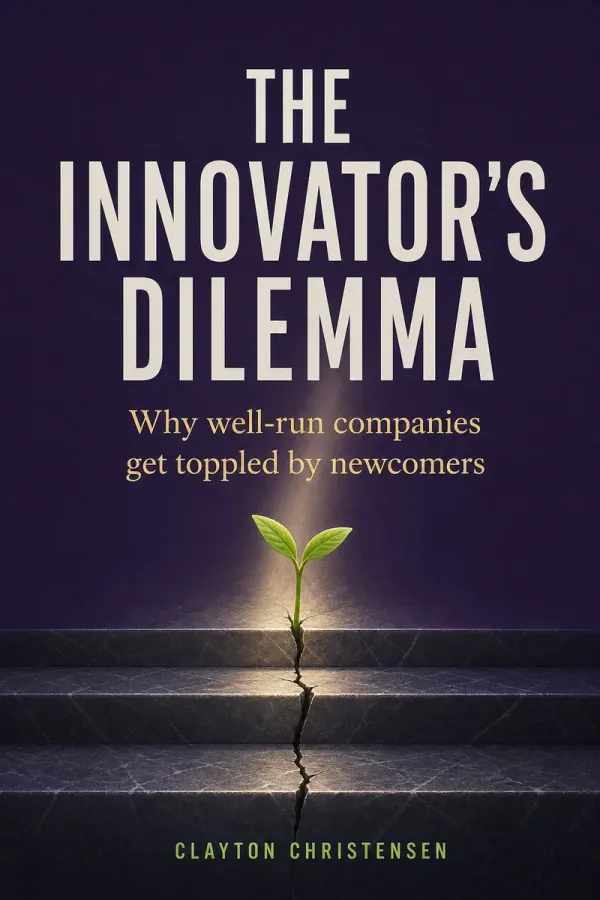
The Innovator's Dilemma by Clayton Christensen: Summary and Study Notes
Why well-run companies get toppled by newcomers
Study this topic in OriaThe essentials
Published in 1997, The Innovator's Dilemma by Harvard professor Clayton Christensen explains a paradox: excellent companies, attentive to their customers, lose their footing to competitors who arrive with products that are at first worse. You'll discover the difference between sustaining and disruptive innovation, the story of hard disks, excavators, and discount stores, the reasons leaders fail to react, the author's advice, and the criticism later aimed at a theory that became a buzzword.
Key dates and facts
- 1992
- Christensen's dissertation on hard disk drives
- 1995
- "Disruptive Technologies" article with Joseph Bower
- 1997
- Publication of The Innovator's Dilemma
- 2003
- Sequel: The Innovator's Solution
- 1955
- First hard disk drive at IBM
- 1980
- Seagate launches the 5.25-inch disk
- 1988
- Seagate finally ships 3.5-inch disks
- 116
- New technologies studied, 5 of them disruptive
- 1952
- Born in Salt Lake City
- 1992
- Doctorate and joins the Harvard faculty
📘 When doing the right thing leads to failure
The Innovator's Dilemma is a book by Clayton Christensen, a professor at the Harvard Business School, published in 1997 by Harvard Business School Press. Its subtitle spells out the stakes: when new technologies cause great firms to fail. It is its author's best-known work, and one of the most influential business books of the late twentieth century.
❓ A question turned on its head
Many management books ask why companies succeed. Christensen asks the opposite question: why do excellent companies, well run, attentive to their customers, and backed by strong research departments, lose their position as leaders, sometimes to the point of disappearing?
The usual answer was that they had grown complacent, fallen behind technologically, or made poor choices. Christensen defends a far more unsettling thesis: they often fail because they make good decisions, the very ones that had built their success. Listening to your best customers, investing where margins are highest, constantly improving your products: all of this is reasonable, and all of it can lead to downfall.
"The reason is that good management itself was the root cause."
Clayton Christensen, The Innovator's Dilemma (1997)
📄 From a dissertation to a best-seller
The book is the result of several years of research. Christensen devotes his doctoral dissertation, defended in 1992, to the hard disk drive industry. In 1995, he publishes an article with his colleague Joseph Bower in the Harvard Business Review, "Disruptive Technologies: Catching the Wave," where he coins the term disruptive technology. The article opens with a list of famous failures: Goodyear and Firestone arriving late to the radial-tire market, Xerox letting Canon create the market for small photocopiers, Bucyrus-Erie overtaken by Caterpillar and Deere in excavators, Sears supplanted by Walmart.
The book wins the Global Business Book Award for best business book of 1997. The Economist ranks it among the six most important business books ever written. Above all, its vocabulary spreads everywhere: in the years that follow, the word disruption becomes one of the most used terms in business, from Silicon Valley start-ups to the reform of schools and hospitals.
🔀 Sustaining innovation versus disruptive innovation
The whole theory of The Innovator's Dilemma, Clayton Christensen's book, rests on a distinction between two families of innovation. It doesn't depend on how technically difficult the invention is, but on its effect on the market.
An improvement to an existing product in the direction current customers expect: faster, more powerful, more reliable. It can be incremental or dramatic, but it serves the same customers on the same terms. Established companies excel at it.
A product or service that at first performs worse by the usual standards, but is simpler, cheaper, or more convenient, and appeals to customers who were overlooked or absent from the market. As it improves, it eventually satisfies mainstream customers and displaces the leaders.
🧩 Simple, not necessarily revolutionary
Christensen makes a surprising point: disruptive innovations are rarely technical feats. They are often made of components already on the shelf, assembled in a simpler way. Their strength comes from offering a different set of qualities, ones that hold no interest at first for mainstream-market customers.
"They offered less of what customers in established markets wanted and so could rarely be initially employed there."
Clayton Christensen, The Innovator's Dilemma (1997)
The example of the automobile helps make this clear. The first cars of the late nineteenth century were a revolutionary invention, but they were not a disruption in Christensen's sense: they were luxury items, too expensive to replace the horse-drawn carriage. The Model T, mass-produced and sold cheaply starting in 1908, did upend the transportation market.
📈 The moment of crossover
The mechanism rests on two different speeds. Established companies improve their products faster than most customers' needs grow: at some point, they offer more than is needed. Meanwhile, the disruptive product, at first insufficient, is improving too. The day it becomes "good enough" for the mass of customers, while staying cheaper or more convenient, it takes over the mainstream market. By then it is too late to react.
🔍 Two forms of disruption
In its sequel, The Innovator's Solution (2003), written with Michael Raynor, Christensen replaces the term "disruptive technology" with disruptive innovation: it is not the technology itself that is disruptive, but the business model that comes with it. He also distinguishes two forms:
- low-end disruption, which targets the least demanding customers, those unwilling to pay for performance they don't need;
- new-market disruption, which reaches people who were not customers at all, for lack of money or skills.
The book also uses the concept of a value network: the context in which a company identifies its customers' needs, chooses its suppliers, watches its competitors, and seeks its profit. A disruptive innovation almost always emerges in a different value network from that of the leaders, which explains why they fail to see it coming.
The rest of the course
This page publishes the first 2 parts. The full course has 8: here is what the next ones cover.
- 💾 The hard disk laboratory
The central case in The Innovator's Dilemma: the hard disk industry, where every new size (8, 5.25, 3.5 inches) was launched by newcomers while leaders kept serving their usual customers.
- 🏗️ Excavators, steel, and discount stores
The other examples in The Innovator's Dilemma: hydraulic excavators versus cable excavators, mini steel mills against integrated steel mills, and discount stores against department stores.
- 🧲 Why leaders fail to react
The mechanisms behind The Innovator's Dilemma: dependence on customers, small markets that don't interest large companies, the impossibility of analyzing a market that doesn't yet exist, organizational values, and cannibalization.
- 🛠️ What Christensen recommends
The Innovator's Dilemma's recommendations to established companies: hand disruption to a small autonomous unit, look for the right customers, accept failing early, and don't impose the parent company's processes.
- ✍️ Clayton Christensen, the author
The life of Clayton Christensen (1952 – 2020), author of The Innovator's Dilemma: his youth in Salt Lake City, studies at BYU, Oxford, and Harvard, his career as a consultant and entrepreneur, his Harvard professorship, his books, and his final years.
- ⚖️ A magic word and its critics
The legacy of The Innovator's Dilemma: the vogue for "disruption," the debate over Uber, Jill Lepore's 2014 critique and Christensen's response, the failed predictions, and what research confirms or qualifies.
Study “The Innovator's Dilemma” with flashcards and quizzes
In Oria, you read the full course, then practice on it: flashcards, multiple-choice quizzes, open questions or the Feynman method. Cards and questions then come back in your daily review, paced by spaced repetition.
Study this topic in OriaSources
These notes draw on the sources below. If a point seems doubtful, refer back to them.