Business & money
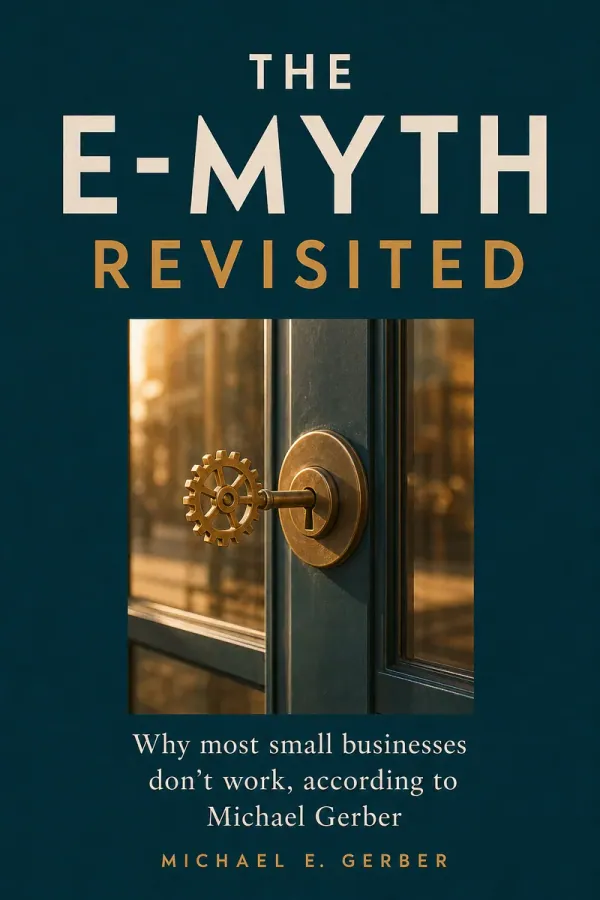
The E-Myth Revisited by Michael E. Gerber: Summary and Study Notes
Why most small businesses don't work, according to Michael Gerber
Study this topic in OriaThe essentials
Published in 1995, Michael Gerber's The E-Myth Revisited has become a classic for small business founders around the world. Its thesis: most businesses are not founded by visionaries, but by skilled technicians who confuse their craft with running a business. You'll discover the “Entrepreneurial Myth,” the three characters who coexist in every business owner, the stages of a company's growth, the idea of the franchise prototype and the seven-step program, then what critics and statistics say about its limits.
Key dates and facts
- 1977
- Gerber founds his consulting firm
- 1986
- First version, The E-Myth
- 1995
- Revised version, The E-Myth Revisited
- 2017
- French translation from Alisio
- 1936
- Born in Elizabeth (New Jersey)
- 1977
- Founds his consulting firm
- 1995
- The E-Myth Revisited
- 2008
- Awakening the Entrepreneur Within
📘 A cult book for small business owners
The E-Myth Revisited, by the American Michael E. Gerber, is one of the management books most widely read by founders of small businesses: tradespeople, restaurant owners, consultants, independent professionals. Its subtitle announces the program: Why Most Small Businesses Don't Work and What to Do About It.
🕰️ Two versions of the same book
The story begins in 1977, when Gerber founded his first consulting firm for small businesses. A few years later, he drew on that experience for a first book, The E-Myth, published in the mid-1980s (1985 or 1986, depending on the source). The book spread mostly from hand to hand, through word of mouth among business owners, and sold more than a million copies.
In 1995, Gerber published a thoroughly reworked version with HarperBusiness: The E-Myth Revisited. In it he incorporated what he had learned in the meantime by working with thousands of businesses. This is the version people read today.
🌍 A worldwide success
According to its publisher, the book was voted the best business book by the founders on the Inc. 500 list, which ranks the fastest-growing American companies. Reported sales figures vary by source, from more than two million to more than five million copies worldwide. It has been translated into many languages; in French, it was published in 2017 by Alisio as E-Myth, le mythe de l'entrepreneur revisité, translated by Christophe Billon with a foreword by the entrepreneur Augustin Paluel-Marmont.
🥧 A book written as a conversation
The book is not a dry manual. Gerber builds it as a dialogue with Sarah, an exhausted baker who runs a pie shop. She loves her craft, but her shop is crushing her. Chapter after chapter, the author alternates between general explanations and conversations with her, to show how a passion can turn into a prison, and how to get out.
🧑🔧 The Entrepreneurial Myth
The title of Michael Gerber's book plays on a word: the “E-Myth” is the Entrepreneurial Myth. We like to imagine that businesses are born of visionaries ready to risk their capital on a big idea. For Gerber, that is an illusion.
🔧 Technicians, not visionaries
In reality, he explains, most businesses are started by technicians: people who have mastered a skill and practiced it while working for someone else. The plumber opens a plumbing business, the cook a restaurant, the hairdresser a salon. Their first motivation is not to build an organization, but to gain their independence: no more boss, choosing their own hours, keeping the fruits of their labor for themselves.
⚡ The “entrepreneurial seizure”
Gerber describes the moment of leaving as a kind of impulse, which he calls the entrepreneurial seizure. One day, after a missed promotion, an unfair boss or one week too many, the technician decides they would be freer and better paid working for themselves. And they take the plunge, often very quickly.
💥 The fatal assumption
Behind this leap, according to Gerber, lies an error of reasoning, which he calls the fatal assumption.
“If I understand how to do the technical work of my business, I understand a business that does that technical work.”
The fatal assumption, as phrased by E-Myth, the company founded by Michael E. Gerber
But these are two different things. Knowing how to make excellent pies says nothing about how to set prices, hire staff, keep the books, find customers or plan for the future. Once in business for themselves, technicians discover that their skill is now only a small part of their new job.
🥧 Sarah, a prisoner of her shop
That is exactly what happens to Sarah, the baker in the book. She thought it was enough to make the best pies in town. She finds herself working nonstop, doing everything herself, without ever getting ahead. The work she loved has become a chore. For Gerber, her problem is neither laziness nor lack of talent: it is that she works in her business, instead of working on her business.
The rest of the course
This page publishes the first 2 parts. The full course has 8: here is what the next ones cover.
- 🎭 The Entrepreneur, the Manager and the Technician
The three personalities Gerber sees in every business founder, their conflicts and the typical imbalance of the small business owner.
- 🌱 Infancy, adolescence, maturity
The three stages of a business according to Gerber, the trap of the comfort zone and the idea that a great company is designed to be “mature” from the start.
- 🍟 The franchise prototype
The “Turn-Key Revolution”: designing your business as if you were going to franchise it, on the model of McDonald's, and working on the business rather than in it.
- 🛠️ The seven steps of business development
Gerber's practical method: the cycle of innovation, quantification and orchestration, then the seven-step program, from your life aim to your systems.
- ✍️ Michael Gerber, the author
The life and career of Michael E. Gerber, born in 1936: salesman, consultant, founder of E-Myth and author of a long series of books.
- ⚖️ Reception, criticism and limits
The lasting influence of The E-Myth Revisited, then its limits: exaggerated failure statistics, a sometimes mystical and self-promoting tone, and a model that doesn't match the ambitions of every small business owner.
Study “The E-Myth Revisited” with flashcards and quizzes
In Oria, you read the full course, then practice on it: flashcards, multiple-choice quizzes, open questions or the Feynman method. Cards and questions then come back in your daily review, paced by spaced repetition.
Study this topic in OriaSources
These notes draw on the sources below. If a point seems doubtful, refer back to them.