Business & money
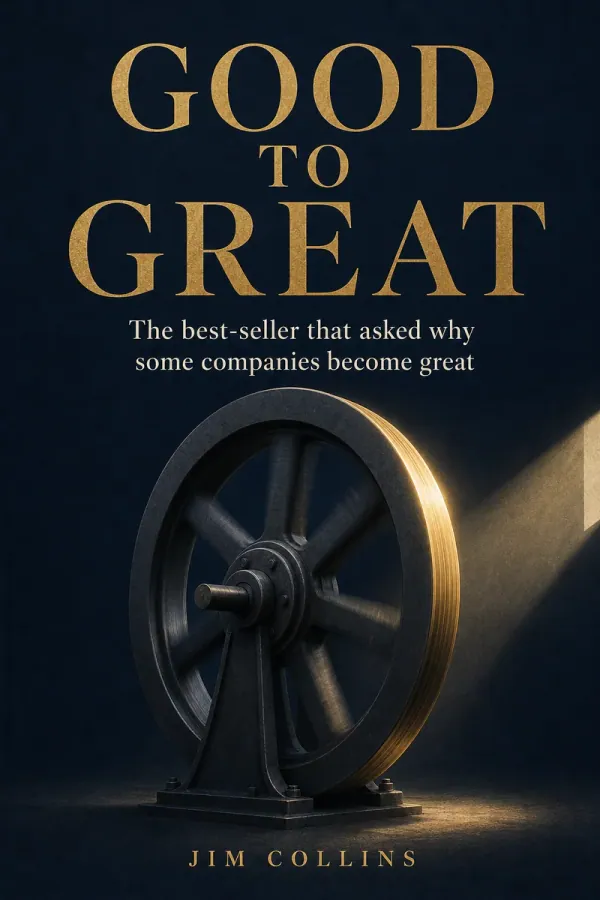
Good to Great by Jim Collins: Summary and Study Notes
The best-seller that asked why some companies become great
Study this topic in OriaThe essentials
Published in 2001, Jim Collins's Good to Great is a massive management best-seller, with several million copies sold. After five years investigating 1,435 large American companies, Collins singled out eleven that made the leap from "good" to "great" and set out to find what set them apart. You'll discover the Level 5 leader, the bus and its passengers, the Stockdale Paradox, the Hedgehog Concept and the flywheel, then what became of these model companies and why researchers have challenged the method.
Key dates and facts
- 1994
- Built to Last , Collins's first major success
- 2001
- Publication of Good to Great
- 2008
- The book is still selling more than 300,000 copies a year
- 2009
- About 4 million copies sold, according to the New York Times
- 3
- Circles: passion, best in the world, economic engine
- 4 years
- Average time to find your Hedgehog Concept
- 1
- Simple idea that guides every decision
- 1958
- Born in Aurora, Colorado
- 1994
- Built to Last , with Jerry Porras
- 2001
- Good to Great
📘 A five-year study of 1,435 companies
Good to Great is a management book by the American Jim Collins, published on October 16, 2001 by HarperBusiness, an imprint of HarperCollins. Its subtitle sums up the ambition: to understand why some companies make the leap and others don't. A line from Collins captures the spirit of the book: Good is the enemy of great. The idea: settling for correct keeps you from becoming remarkable.
🔎 A simple question, a heavy-duty method
Collins starts from a question: can a merely "good" company become "great," and if so, how? To find out, he and his team spend five years on the project, working out of his research lab in Boulder, Colorado, with 21 research associates. The starting point is a list of 1,435 companies that had appeared on the Fortune 500.
The criteria are strict. A qualifying company had to have gone through a long stretch of average results, then hit a turning point after which its stock returned at least three times the market over the next fifteen years. That leap had to be specific to the company, not to its whole industry. It had to have existed for at least 25 years before the turning point, been publicly traded for at least ten years, and its turning point had to predate 1985, to leave enough time to confirm it held.
🏢 Eleven winners and their "twins"
After the sorting, only eleven companies remain. According to Collins, they outperformed the market by 6.9 times on average over the fifteen years following their turning point. Each is matched with a company in the same industry that had the same odds at the same moment but never made the leap. That's the heart of the method: not just looking at what the winners have in common, but at what sets them apart from comparable competitors.
| "Great" company | Comparison company |
|---|---|
| Abbott Laboratories | Upjohn |
| Circuit City | Silo |
| Fannie Mae | Great Western Bank |
| Gillette | Warner-Lambert |
| Kimberly-Clark | Scott Paper |
| Kroger | A&P |
| Nucor | Bethlehem Steel |
| Philip Morris | R. J. Reynolds |
| Pitney Bowes | Addressograph |
| Walgreens | Eckerd |
| Wells Fargo | Bank of America |
The team pored over books, articles, and annual reports, analyzed nearly 980 cumulative years of financial data, and conducted 84 interviews with executives and board members. Collins repeats the point: his findings are correlations, not proof of cause and effect, since you can't run a controlled experiment on companies.
The success is immense and reaches far beyond the usual business-book audience. In 2011, Time magazine ranked it among the 25 most influential business management books, and several members of the Wall Street Journal's CEO council named it the best management book they had ever read.
🦸 The Level 5 leader
The first finding of Good to Great, Jim Collins's study of eleven companies that became great, surprised even its author. He hadn't set out to write about leaders. But every company that made the leap had, at the moment of its turning point, a very particular kind of boss, whom he names the Level 5 leader.
For Collins, this sits at the top of a five-level hierarchy of executive capability: a leader who blends deep personal humility with unwavering professional will. Their ambition is aimed first at the company and its mission, not at themselves.
🤫 Bosses almost no one had heard of
The eleven turning-point executives delivered spectacular results, and yet almost no one talked about them. Collins describes them as ordinary-looking people, often reserved, quiet, sometimes even shy, who sought neither magazine covers nor hero status. In a 2001 interview, he states that there's a direct link between a boss's lack of celebrity and the company's success in going from good to great. When a leader becomes a star, he says, the company turns into "a genius with a thousand helpers."
At every major decision where one choice would favor the leader's ego and another would favor the company, the Level 5 leader chooses the company. Conversely, the absence of a Level 5 leader is a constant among the comparison companies. And according to Collins, at those same moments of choice, celebrity bosses are more inclined to favor their own ego.
"Level 5 leadership is not just about humility and modesty. It is equally about ferocious resolve."
Jim Collins, Good to Great (2001)
🧻 The example of Darwin Smith
The most often told case is that of Darwin Smith, the head of Kimberly-Clark, a paper manufacturer. His team realizes that the company's future doesn't lie in its legacy paper mills, which had been making magazine and notepad paper for a century, but in consumer products like Kleenex tissues. Smith then makes a decision one board member called the boldest he had ever seen: he sells the mills, including the one in Kimberly, Wisconsin, the town that gave the company its name. He throws all the money into the fight against Procter & Gamble and Scott Paper.
The press and analysts call the idea foolish. Twenty-five years later, according to Collins, Kimberly-Clark had become the world's number one in paper-based consumer products, had beaten Procter & Gamble in six out of eight categories, and had bought its old rival Scott Paper.
🌱 Can you become Level 5?
Collins admits he doesn't know exactly how such a leader is made. His hypothesis: some people lack the seed for it, but many carry it inside them, buried, and can grow it through a mentor, a teacher, a hard life experience, or a good boss. He stresses one point: this finding is empirical, drawn from the data, not an ideology about what a good boss should be. That's also what makes it fragile, as later criticism of his method would show.
The rest of the course
This page publishes the first 2 parts. The full course has 8: here is what the next ones cover.
- 🚌 First who, then what
The bus image in Good to Great: before choosing a direction, the leaders of great companies get the right people on board, like David Maxwell at Fannie Mae, and pay turns out not to play the expected role.
- 🧭 Confronting the brutal facts: the Stockdale Paradox
In Good to Great, the discipline of facing reality head-on without losing faith in eventual victory, illustrated by Admiral Jim Stockdale, a prisoner in Vietnam, and by Churchill's statistics office.
- 🦔 The Hedgehog Concept
The strategic core of Good to Great: finding the intersection of three circles (passion, what you can be best in the world at, economic engine), with the example of Wells Fargo and the curse of competence.
- ⚙️ Discipline and the flywheel
The end of the Good to Great model: a culture of discipline, the stop-doing list, technology as an accelerator, and the flywheel effect, as opposed to the "doom loop" of companies that keep changing course.
- ✍️ Jim Collins, the author
The life and career of Jim Collins, author of Good to Great: Stanford, McKinsey and Hewlett-Packard, teaching, Built to Last, the Boulder lab, and the books that followed.
- ⚖️ What became of the "great" companies?
What happened to the eleven Good to Great companies (Circuit City's bankruptcy, Fannie Mae's bailout, the Wells Fargo scandal), and the criticism from Steven Levitt and Phil Rosenzweig about the halo effect and the limits of Jim Collins's method.
Study “Good to Great” with flashcards and quizzes
In Oria, you read the full course, then practice on it: flashcards, multiple-choice quizzes, open questions or the Feynman method. Cards and questions then come back in your daily review, paced by spaced repetition.
Study this topic in OriaSources
These notes draw on the sources below. If a point seems doubtful, refer back to them.