Business & money
Hooked by Nir Eyal: Summary and Study Notes
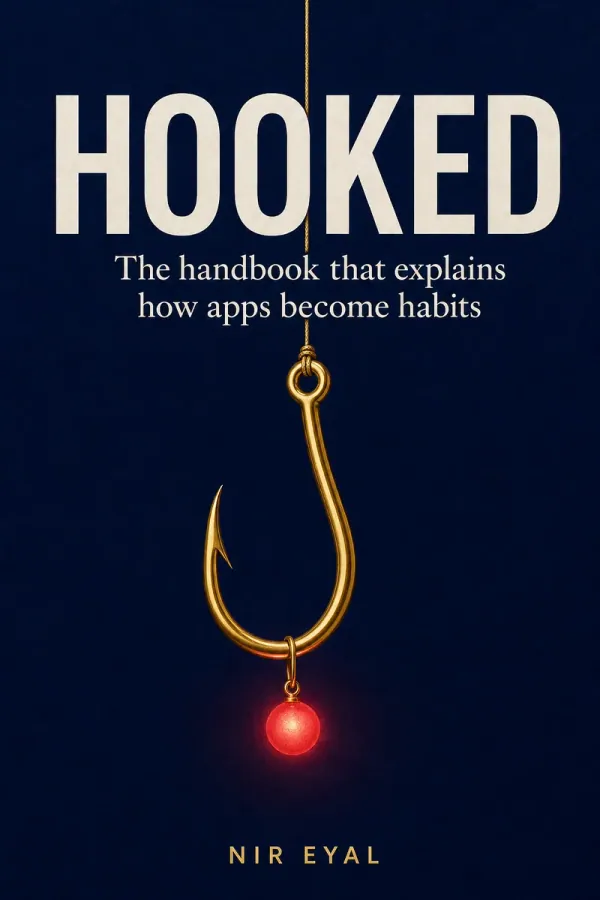
The handbook that explains how apps become habits
Study this topic in OriaThe essentials
Published in 2014, Nir Eyal's Hooked: How to Build Habit-Forming Products has become a reference book for app designers. It describes the “Hook Model,” a four-phase cycle the author finds in social networks and online services: trigger, action, variable reward, investment. You'll discover each phase, the ethical matrix the author proposes and his career, then the harsh criticism of the book, accused of serving as an instruction manual for the attention economy and challenged by behavioral scientists.
Key dates and facts
- 2012
- Eyal teaches at Stanford
- 2014
- Portfolio edition of Hooked
- 2018
- French translation from Eyrolles
- 2019
- Indistractable , his next book
- 1980
- Born in Hadera, Israel
- 2008
- Stanford MBA
- 2014
- Hooked
- 2019
- Indistractable
📘 A handbook born in the smartphone era
In the early 2010s, the smartphone found its way into every pocket, and with it came apps people check dozens of times a day: Facebook, Twitter, Instagram, Pinterest. One question then obsessed digital companies: how do you get people to come back on their own, without paying for ads to remind them? Hooked, by Nir Eyal, offers an answer.
✍️ From blog to book
Nir Eyal, a former online advertising entrepreneur turned consultant and Stanford lecturer, first developed his ideas on his blog, Nir and Far. That is where he first presented his Hook Model. He turned it into a book, first self-published around the turn of 2014. According to MIT Technology Review, within ten days the book had gathered more than a hundred reader reviews and climbed to the top of Amazon's sales in the product design category.
A revised version came out on November 4, 2014 from Portfolio, an imprint of Penguin Random House, with editorial collaboration from Ryan Hoover. It became a Wall Street Journal best-seller. According to the author's website, the book has sold more than a million copies and been translated into more than thirty languages. In French, it was published in 2018 by Eyrolles, translated by Pascale-Marie Deschamps.
🎯 A book for product makers
Hooked is not aimed first at users, but at the people who build products: startup founders, product managers, designers, marketers. The book presents itself as a practical guide, with examples drawn from the big platforms and exercises for applying the method to your own project. Its starting point is stated openly: many digital products succeed only if they become habits.
“The technologies we use have turned into compulsions, if not full-fledged addictions.”
Nir Eyal, Hooked (2014)
🧠 Why products want to become habits
Before presenting his model, Nir Eyal, the author of Hooked, explains why companies have so much to gain from creating habits in their users.
In Hooked, a habit is a behavior done with little or no conscious thought. You no longer decide: you act almost automatically, as when you unlock your phone without knowing why.
💰 Why habits are worth gold
A user who has formed the habit of using a service comes back on their own. The company no longer needs to spend money on advertising to bring them back. They also become more loyal: switching services would cost them effort. For Eyal, products that become habits can thus gain a lasting edge over their competitors.
📍 The Habit Zone
Not every product can become a habit. Eyal describes a Habit Zone that depends on two factors:
- frequency: how often does the behavior occur? In the workbook that accompanies the book, Eyal estimates that it is very difficult to create a habit around an action that happens less than once a week;
- perceived utility: how useful or pleasurable does the user find the behavior compared with the alternatives?
A very frequent action can become a habit even if it delivers little. A rare action, on the other hand, has to deliver a lot to take root.
💊 Vitamins or painkillers?
The startup world often distinguishes two types of products: “vitamins,” pleasant but optional, and “painkillers,” which relieve a real problem and become impossible to do without. Eyal adds a nuance: many habit-forming products start out as vitamins, then, once the habit is in place, become genuine painkillers for their users. You feel the lack when you don't use them.
🔁 The hook in four steps
To create these habits, Eyal proposes his model: a four-phase cycle, trigger, action, variable reward, investment. Each pass through the cycle reinforces the next, until the user no longer needs to be reminded.
The rest of the course
This page publishes the first 2 parts. The full course has 9: here is what the next ones cover.
- 🔔 Phase 1: the trigger
The first phase of the Hooked model: external triggers (notifications, icons, emails) and internal triggers (emotions such as boredom or loneliness).
- 👆 Phase 2: the action
The second phase of the Hooked model: the simplest possible action, explained by BJ Fogg's behavior model (motivation, ability, trigger).
- 🎰 Phase 3: the variable reward
The central phase of the Hooked model: the unpredictability of rewards, inherited from Skinner's experiments, and the three types of rewards (tribe, hunt, self).
- 💾 Phase 4: the investment
The last phase of the Hooked model: the user puts in a small effort that stores value in the product and loads the next trigger, followed by the habit test.
- 🧭 The Manipulation Matrix
The ethics chapter of Hooked: the “Manipulation Matrix,” which sorts designers into facilitators, peddlers, entertainers and dealers, and its limits.
- ✍️ Nir Eyal, the author
The life of Nir Eyal, born in Israel in 1980 and raised in Florida: his studies, consulting, teaching at Stanford, then his turn toward fighting distraction with Indistractable.
- ⚖️ Reception, criticism and limits
Hooked's influence in Silicon Valley, then the criticism: an instruction manual for the attention economy according to The Guardian, the question of responsibility, and Jason Hreha's scientific objections.
Study “Hooked” with flashcards and quizzes
In Oria, you read the full course, then practice on it: flashcards, multiple-choice quizzes, open questions or the Feynman method. Cards and questions then come back in your daily review, paced by spaced repetition.
Study this topic in OriaSources
These notes draw on the sources below. If a point seems doubtful, refer back to them.