Business & money
Influence by Robert Cialdini: Summary and Study Notes
The hidden triggers that make us say yes
Study this topic in OriaThe essentials
In 1984, American psychologist Robert Cialdini publishes Influence: The Psychology of Persuasion. After three years investigating undercover among salespeople and fundraisers, he describes six principles that push us to agree to a request almost without thinking, then adds a seventh in 2016. You'll discover each principle through its famous experiments, the author's advice for not getting caught out, and the limits of this marketing best-seller.
Key dates and facts
- 1984
- Publication of Influence: The Psychology of Persuasion
- 2012
- Cialdini advises Barack Obama's campaign
- 2016
- Pre-Suasion adds a seventh principle
- 2019
- Elected to the U.S. National Academy of Sciences
🕵️ A psychologist undercover among salespeople
Influence (published in French as Influence et manipulation) is the French title of Influence: The Psychology of Persuasion, published in 1984 by American social psychologist Robert Cialdini. The book has a rare feature: its author, an academic, spent years observing from the inside the people who make a living getting us to say yes.
🎓 A social psychology researcher
Born on April 27, 1945, Cialdini earned his bachelor's degree from the University of Wisconsin–Milwaukee in 1967, then his PhD in social psychology from the University of North Carolina in 1970, before further training at Columbia University. He spent most of his career at Arizona State University, where he became professor emeritus of psychology and marketing.
His starting point was personal. In the book's introduction, he describes himself as someone who has always let himself be talked into things too easily.
“All my life I’ve been a patsy.”
Robert Cialdini, Influence: The Psychology of Persuasion (1984)
🚗 Three years undercover
To understand these techniques, Cialdini didn't stop at the laboratory. For three years, he got himself hired and trained, without revealing his identity, by used-car salesmen, fundraising organizations, telemarketing firms, and door-to-door sellers. He calls these practitioners "compliance professionals": people whose job is to get us to agree.
He then cross-checked his observations against many experiments in social psychology, marketing, and economics. The result reads like an investigation, full of anecdotes and studies.
⚡ The central idea: our shortcuts
The book's thesis is simple. In a world saturated with information, we can't analyze every decision in detail. So we use mental shortcuts, general rules that, most of the time, make us act correctly with little time or effort. The danger is that these automatic responses can be deliberately triggered by those who know them, and turned against us.
The tendency to judge something by comparing it with what we just saw. A car salesman who first shows a very expensive model makes the next ones look cheap.
Cialdini also brings up this contrast as early as the introduction, along with our habit of assuming that a higher price must signal better quality. He then devotes a chapter to each of the six main principles he identified: reciprocity, commitment and consistency, social proof, liking, authority, and scarcity. A seventh, unity, would follow in 2016.
🎁 Reciprocity: we give back what we receive
The first principle Robert Cialdini describes in Influence is reciprocity: we feel obligated to return what others have given us. This rule exists in every human culture, and it is what allows society to function. But it has a flaw: it works even when the gift wasn't wanted.
🥤 A soda and raffle tickets
In 1971, psychologist Dennis Regan led participants to believe they were taking part in a study on art, alongside a partner named Joe, who was actually a confederate. During the experiment, Joe sometimes bought his neighbor a soda. At the end, he asked him to buy raffle tickets. When Joe had given nothing, the more he was liked, the more tickets were bought. But when he had given a soda, liking no longer predicted purchases: the debt created by the small gift took over.
This is why free samples work so well: a person who accepts a sample feels slightly obligated to buy something in return.
🍬 A mint with the check
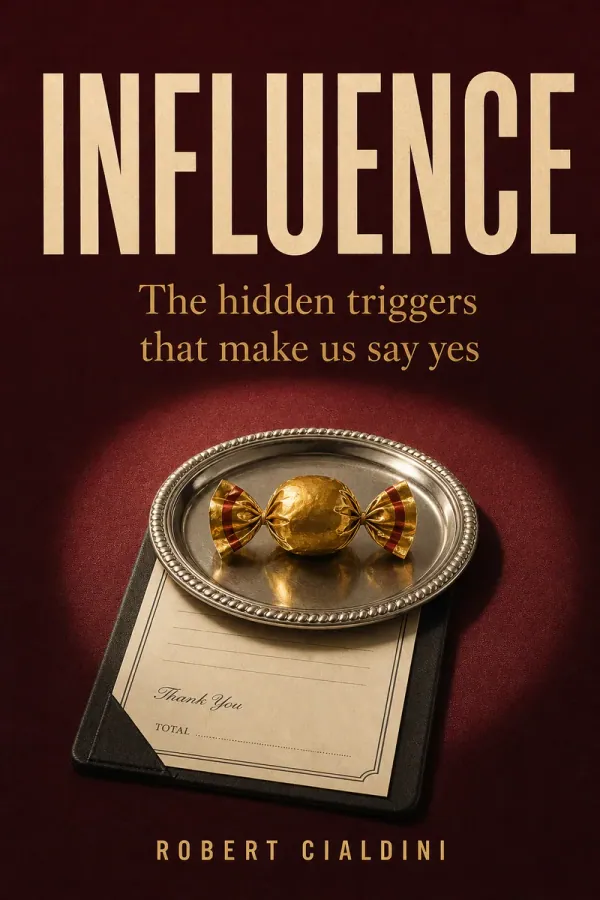
On his website, Cialdini cites studies conducted in restaurants. Giving a mint with the check increases tips by about 3%; two mints, by 14%. But if the server walks away, turns back, and offers a second mint "for you, because you're so nice," tips rise by 23%. What matters isn't just what you give, but how you give it: being the first to give, in a personal and unexpected way.
🚪 Door-in-the-face
Reciprocity also applies to concessions. If someone drops a large request in favor of a smaller one, we feel obligated to meet them halfway. Cialdini recounts that a young boy once offered him circus tickets for five dollars; he refused, and the boy then offered him chocolate bars for one dollar. Cialdini felt compelled to return the favor and bought some.
A technique that starts with an excessive request, almost certain to be refused, followed by a more reasonable one, which then looks like a concession.
In 1975, Cialdini and his colleagues put it to the test. They first asked volunteers to mentor young delinquents two hours a week for two years. After they refused, they simply asked them to accompany the teens to the zoo for a day. Result: 50% agreed, compared with 17% when the small request was made directly, and 25% when the large request was described but never actually made. A 2020 study replicated this result.
The rest of the course
This page publishes the first 2 parts. The full course has 9: here is what the next ones cover.
- ✍️ Commitment and consistency: staying true to your word
The second principle: the desire to stay consistent with our past choices, exploited through the foot-in-the-door technique and low-balling.
- 👥 Social proof: doing what others do
The third principle: when in doubt, we copy what others do, especially if they're like us, from laugh tracks to hotel towels.
- 🤝 Liking and authority: the people we say yes to
The fourth and fifth principles: we give in more easily to people we like and to those who carry the signs of authority, as Milgram showed.
- ⏳ Scarcity: what's missing attracts
The sixth principle: we want more of what is rare, limited, or forbidden, especially when it has just become so and others want it too.
- 🫂 The seventh principle: unity
The principle Cialdini added in 2016 in Pre-Suasion: we are more influenced by those with whom we share an identity, a sense of 'we.'
- 🛡️ How not to get played
Cialdini's advice, at the end of each chapter, for recognizing and defusing each influence technique without giving up useful shortcuts.
- 📈 A marketing classic, and its limits
The worldwide success of Influence, its impact on marketing and politics, and the limits raised by research and criticism: mixed results, contested experiments, manipulative uses.
Study “Influence” with flashcards and quizzes
In Oria, you read the full course, then practice on it: flashcards, multiple-choice quizzes, open questions or the Feynman method. Cards and questions then come back in your daily review, paced by spaced repetition.
Study this topic in OriaSources
These notes draw on the sources below. If a point seems doubtful, refer back to them.