Business & money
The Intelligent Investor by Benjamin Graham: Summary and Study Notes
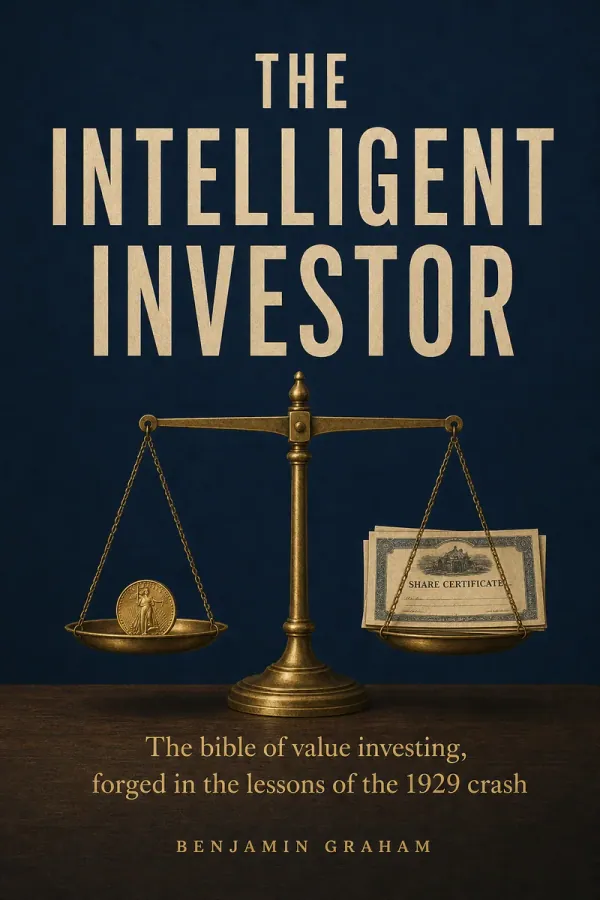
The bible of value investing, forged in the lessons of the 1929 crash
Study this topic in OriaThe essentials
Published in 1949 by Benjamin Graham, a professor and fund manager permanently marked by the 1929 crash, The Intelligent Investor teaches ordinary savers how to put money into stocks without ruining themselves. You'll learn the difference between investing and speculating, the allegory of Mr. Market, the central idea of the margin of safety, and the book's two investor profiles, defensive and enterprising. You'll also see how this book shaped Warren Buffett, what has aged since 1949, and what still holds up surprisingly well.
Key dates and facts
- 1894
- Born in London
- 1914
- Graduates from Columbia, joins Wall Street
- 1929
- The crash wipes out most of his fortune
- 1934
- Security Analysis , with David Dodd
- 1949
- The Intelligent Investor is published
- 1949
- The book is published; Buffett reads it at 20
- 1954 – 1956
- Buffett works at Graham-Newman
- 1976
- Graham dies in Aix-en-Provence
- 1984
- The "Superinvestors of Graham-and-Doddsville" speech
📉 Benjamin Graham, a child of crisis
The Intelligent Investor, published in 1949, is the work of Benjamin Graham, often called the "father of value investing." To understand the caution running through the book, you have to know the life of its author, shaped twice over by stock market crises.
👦 A hard-up childhood
Benjamin Graham was born on May 9, 1894, in London, under the name Benjamin Grossbaum. His family moved to New York when he was a year old and later took the name Graham. After his father, who ran a china and porcelain business, died, and then the panic of 1907 hit, the family fell into poverty: according to the German Wikipedia, his mother had put what remained of the family fortune into stocks, which the crash wiped out. That experience helped set the course of his whole life toward hunting for the real "value" behind an investment.
A brilliant student, he graduated second in his class at Columbia University in 1914, at age 20. Even before finishing his studies, three departments — mathematics, English, and philosophy — offered him a teaching post. But he had a widowed mother to support, so he chose Wall Street instead.
🏦 A formidable analyst
Graham quickly made a name for himself. In the case of Northern Pipe Line, an oil-pipeline company tied to the Rockefeller family, he discovered the firm was sitting on large, unused cash and bond holdings. He bought enough shares to force management to pay that money out to shareholders — one of the earliest examples of shareholder activism. From 1928 on, he also taught investing at Columbia Business School.
💥 The crash of 1929
The crash of 1929 wiped out much of his personal fortune. According to the German Wikipedia, drawing on the edition annotated by Jason Zweig, the value of the portfolios he managed fell by about 70%. His firm survived, partly thanks to help from friends and the sale of personal belongings. Graham drew hard lessons from the ordeal and sharpened an approach built on a distinction that would shape his entire body of work: never confuse the price of a stock with the value of the business standing behind it.
In 1934, in the depths of the Great Depression, he published Security Analysis with his colleague David Dodd, a dense manual of financial analysis. Then, in 1949, he wrote for a much wider audience: The Intelligent Investor.
📘 A book for the ordinary saver
Where Security Analysis spoke to professionals, Benjamin Graham's The Intelligent Investor targets the individual investor. The book came out in 1949 from the New York publisher Harper & Brothers. For financial journalist Jason Zweig, it was the first book to explain to a general audience both the intellectual framework and the emotional discipline needed to invest successfully.
🔄 A book revised again and again
Graham reworked his text several times — in 1954, 1959, and 1965 — then one last time in 1971–1972. That fourth revised edition, published in 1973, carries a preface and appendix by his former student Warren Buffett. Graham died in 1976 in Aix-en-Provence, France. In 2003, journalist Jason Zweig published a version enriched with commentary and new notes for every chapter; a further revised edition appeared in 2024. The book has sold more than a million copies and has been translated into many languages, including French.
🧭 A twenty-chapter structure
Chapter by chapter, the book covers the difference between investment and speculation, the investor and inflation, a century of stock-market history, the strategy of the defensive investor and then of the enterprising investor, how to handle market fluctuations, investment funds, the role of financial advisors, analyzing earnings per share, comparisons of real companies, and finally the margin of safety. For Jason Zweig, reading just chapters 1, 8, and 20 is enough to avoid the mistakes that trip up so many savers.
🧠 The real subject: temperament
The idea running through the whole book is that success in the stock market depends less on intelligence or knowledge than on character. Graham explains that economic conditions, companies, and rules change, but human nature stays the same. The investor's main enemy, then, is neither the market nor other people, but himself.
"The investor's chief problem—and even his worst enemy—is likely to be himself."
Benjamin Graham, The Intelligent Investor
Zweig also points out that Graham doesn't describe how people should act, but how they actually behave: through this attention to psychology, Graham was, in Zweig's view, anticipating findings in behavioral economics that would only be recognized with a Nobel Prize decades later.
The rest of the course
This page publishes the first 2 parts. The full course has 8: here is what the next ones cover.
- ⚖️ Investing or speculating
Graham's founding distinction between investment and speculation, the idea that a share is a piece of a company, and the lessons of the stock-market madness of 1927–1933.
- 🎭 Mr. Market, the moody partner
The book's most famous allegory: Mr. Market, a partner with changing moods who offers a different price every day, and what it teaches about stock-market swings.
- 🛡️ The margin of safety
The book's central idea (chapter 20): only buy with a comfortable gap between a company's estimated value and its price, to guard against your own mistakes.
- 🐢 Defensive or enterprising investor?
Graham's two profiles: the defensive investor, who wants to limit effort and worry, and the enterprising investor, who spends time hunting for bargains.
- 🎓 From Graham to Warren Buffett
The influence of the book and its author on Warren Buffett and on generations of value investors, from the 1984 speech to the limits Buffett and Munger themselves acknowledged.
- ⏳ What has aged, what remains
The book's limits today (outdated analytical methods, underrated growth, the traps of cheap stocks, the 1972 tax context) and the lessons that still hold up.
Study “The Intelligent Investor” with flashcards and quizzes
In Oria, you read the full course, then practice on it: flashcards, multiple-choice quizzes, open questions or the Feynman method. Cards and questions then come back in your daily review, paced by spaced repetition.
Study this topic in OriaSources
These notes draw on the sources below. If a point seems doubtful, refer back to them.