Business & money
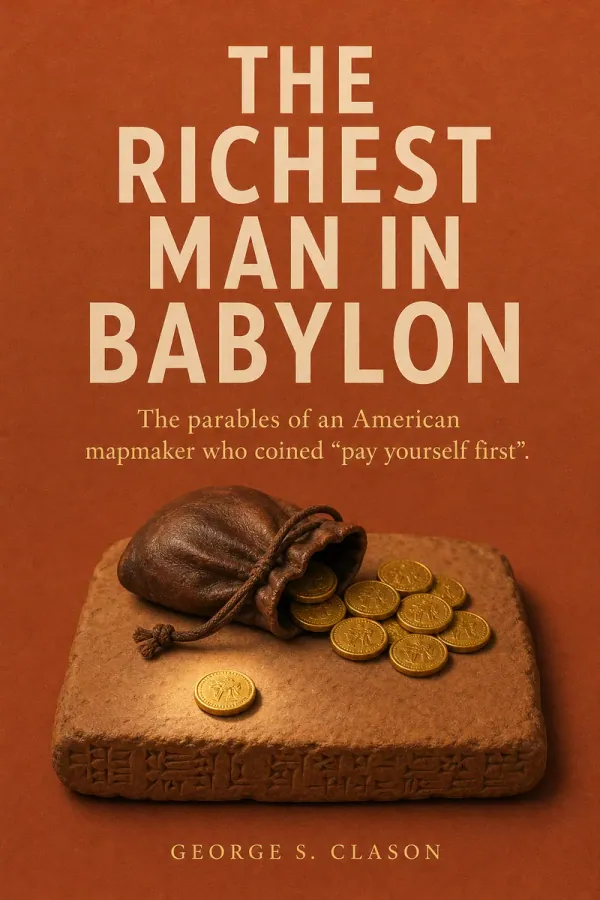
The Richest Man in Babylon by George S. Clason: Summary and Study Notes
The parables of an American mapmaker who coined “pay yourself first”
Study this topic in OriaThe essentials
Written in the 1920s to be handed out by banks and insurers, George S. Clason's parables follow Arkad, a former scribe who becomes the richest man in Babylon. You'll discover his “seven cures for a lean purse,” the “five laws of gold,” and the book's other stories, from the camel trader Dabasir to the slave Sharru Nada. You'll also see what the real Babylon of archaeologists has to do with this backdrop, and what this centuries-old advice from another era is still worth today.
Key dates and facts
- 1926
- First Babylonian pamphlet, according to most sources
- 1930
- Illustrated edition published by Clason in Denver
- 1952
- Clason sums up his lesson in the Denver Post
- 1957
- Clason dies in Napa, California
- 18th c. BC
- Hammurabi turns Babylon into a capital
- 6th c. BC
- Peak under Nebuchadnezzar II
- 539 BC
- Babylon captured by Cyrus II
- 1926
- Clason imagines his Babylon of parables
🏺 Bank pamphlets that became a classic
The Richest Man in Babylon wasn't originally written as a book. Its author, the American George S. Clason, spent the 1920s publishing a series of pamphlets on saving and financial success, written as parables set in ancient Babylon. Sources disagree on the exact date: the English Wikipedia article on the book mentions pamphlets distributed between 1920 and 1924, while the author's biographical entry and the magazine Quartz date the first one to 1926, the year usually given for the work.
🏦 Distributed by banks and insurers
These small pamphlets became hugely popular because banks, investment firms and insurance companies distributed them by the thousands, handing them to their customers and employees. In his foreword, Clason even thanks the business leaders who passed his stories along “in such generous quantities” to their friends, relatives, employees and associates. The best parables were later gathered into a single volume; in 1930, Clason himself published an illustrated edition in Denver, The Richest Man in Babylon and Other Stories.
📚 A century on bookshelves
Nearly a hundred years later, the book is still being reprinted. According to Quartz in 2016, it had sold more than 2 million copies in 26 languages. It regularly turns up on recommended-reading lists about money, from The Wall Street Journal to CNBC, and is often described as a classic of personal finance.
💡 The man behind “pay yourself first”
Clason is credited with a phrase that has become one of the most widespread pieces of financial advice in the world: “pay yourself first.” The idea is simple: before paying for anything else, set aside a share of what you earn. For Quartz, this is the nugget of wisdom hiding behind modern savings accounts and retirement plans. The book delivers it through the mouth of an old Babylonian moneylender, in deliberately archaic language, full of solemn “thee”s and biblical turns of phrase.
🗺️ George S. Clason, Denver mapmaker
George Samuel Clason was born on November 7, 1874, in Louisiana, a small town in Missouri. He studied at the University of Nebraska and served in the U.S. Army during the Spanish-American War of 1898. In 1900, he settled in Denver, Colorado.
🚗 The first road atlas
In Denver, Clason founded two companies: the Clason Publishing Company and, more importantly, the Clason Map Company. It was the first to publish a road atlas of the United States and Canada. The success of this business is what allowed him to launch his savings pamphlets.
📉 Ruined by the crash
Ironically, the Clason Map Company did not survive the Great Depression of the 1930s. According to Quartz, Clason realized, even before the crash hit, that his financial advice was needed more than ever, and gathered his parables into a book to publish himself. Looking back in 1952, he summed up his whole lesson in one line for the Denver Post: the secret of personal financial success, he said, lay in believing in and living by a simple rule — that part of everything you earn belongs to you. The man who taught others to protect their treasure could not save his own business, swept away by a crisis that ruined millions of Americans.
👨👩👧 A family of writers
Clason married twice. Both of his children, Clyde B. Clason and Robin Clason McKown, also became writers. In 1949, he moved to Napa, California, where he died on April 7, 1957, at age 82.
This background sheds light on the book. Clason was neither a banker nor an economist, but an early-20th-century publisher and businessman who knew how to tell simple stories to a wide audience. His parables reflect the values of 1920s America: saving, hard work, homeownership and caution toward promises of quick riches.
The rest of the course
This page publishes the first 2 parts. The full course has 8: here is what the next ones cover.
- 💰 Bansir, Kobbi, and Arkad's secret
The first two parables in The Richest Man in Babylon: the chariot-builder Bansir and the musician Kobbi, and the story of Arkad, a scribe who grew rich thanks to the advice of the moneylender Algamish.
- 🪙 The seven cures for a lean purse
The heart of The Richest Man in Babylon: the seven cures Arkad teaches a hundred students at the king's request, from saving a tenth to improving one's own earning power.
- 📜 The goddess of fortune and the five laws of gold
Two parables from The Richest Man in Babylon: the debate on luck, which favors men of action, and the five laws of gold passed down from Arkad to his son Nomasir.
- 🐪 Moneylender, walls, camel trader: the other parables
The final parables in The Richest Man in Babylon: Rodan and the moneylender Mathon, the old soldier Banzar on the city walls, the camel trader Dabasir and his tablets, and the slave Sharru Nada who became a merchant.
- 🏛️ The real Babylon behind the backdrop
What history and archaeology say about the Babylon George S. Clason describes: chronology, currency, walls, Semiramis and the hanging gardens, between fact and legend.
- 📈 The legacy and limits of a century-old book
What still holds up in The Richest Man in Babylon (automatic saving, budgeting, caution) and its limits: very general advice, dated investments, homeownership and insurance, its view of slavery and of women.
Study “The Richest Man in Babylon” with flashcards and quizzes
In Oria, you read the full course, then practice on it: flashcards, multiple-choice quizzes, open questions or the Feynman method. Cards and questions then come back in your daily review, paced by spaced repetition.
Study this topic in OriaSources
These notes draw on the sources below. If a point seems doubtful, refer back to them.