Business & money
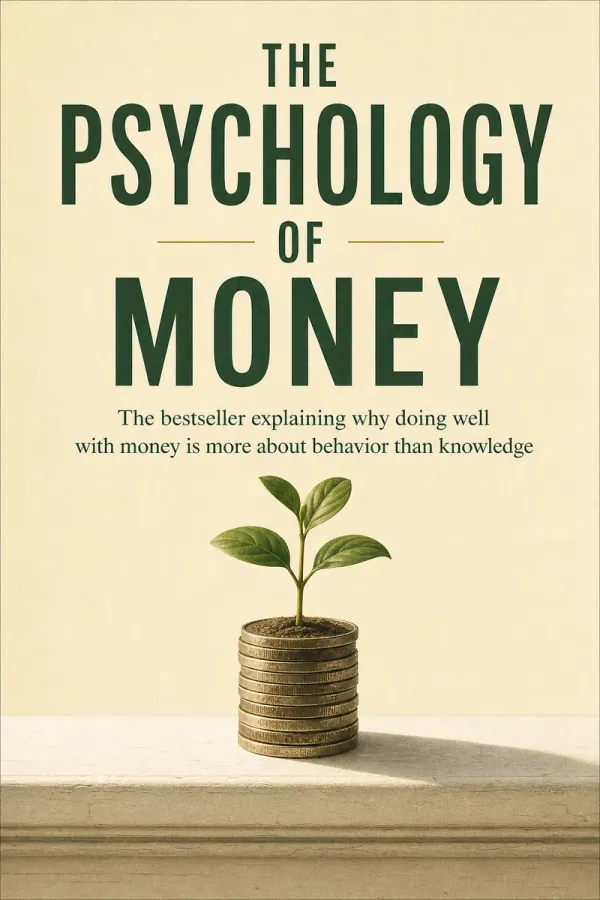
The Psychology of Money by Morgan Housel: Summary and Study Notes
The bestseller explaining why doing well with money is more about behavior than knowledge
Study this topic in OriaThe essentials
Published in 2020, Morgan Housel's The Psychology of Money became one of the best-selling personal finance books of the decade. Its thesis: doing well with money depends less on what you know than on how you behave. You'll discover its big ideas, from the role of luck to the power of compounding, from invisible wealth to the margin of safety, then the author's own story and what critics say the book gets wrong.
Key dates and facts
- 2018
- “The Psychology of Money” essay on the Collaborative Fund blog
- 2020
- Book published by Harriman House
- 2022
- French edition by Valor
- 2023
- Second book, Same as Ever
📗 From a viral essay to a worldwide bestseller
The Psychology of Money is a book by American author Morgan Housel, published on September 8, 2020 by Harriman House, a British publisher. Its subtitle promises “timeless lessons on wealth, greed, and happiness.” In France, it was published by Valor éditions on March 17, 2022.
✍️ A blog essay before the book
It all started on June 1, 2018. Housel published a long essay titled “The Psychology of Money” on the blog of Collaborative Fund, the investment firm where he is a partner. In it, he listed twenty flaws, biases, and behaviors he had often observed in people's relationship with money. That essay became the blueprint for the book.
When the book came out, Housel explained his starting point: he had been writing about investing for thirteen years, largely about the 2008 financial crisis. In trying to understand why people had acted as they did, he found the answers less in finance textbooks than in psychology, sociology, and history.
🚪 Turned down by every American publisher
Success was far from guaranteed. According to a 2025 interview with the Next Big Idea Club, every American publisher turned down the manuscript, and it was ultimately the British publisher Harriman House that released it. Even so, the book found its audience, largely through word of mouth.
📈 Millions of readers
Sales figures vary depending on when the source was published: more than 7 million copies according to the Next Big Idea Club in 2025, and more than 10 million worldwide according to publisher Harriman House. As early as October 2020, production company Cavalry Media acquired the book's rights with a view to an adaptation. The format is distinctive: nineteen short chapters, followed by a more personal closing chapter, each built around a story and an idea.
Housel summed it up himself at the time of release: this isn't a book about what to do with your money, but about what goes on in your head when you try to do something with it.
🧠 Nobody's crazy: behavior before knowledge
Morgan Housel's book starts from an observation: there is no other field where someone with no degree, no experience, and no connections can do far better than an expert trained at the best universities. Nobody imagines an amateur operating on a heart better than a surgeon. In finance, it happens.
⛽ The janitor and the banker
The book's most famous example contrasts two men. Ronald Read worked as a gas station attendant and mechanic for about twenty-five years in Vermont, then as a part-time janitor at a department store. When he died in 2014, at age 92, it emerged that he had quietly built up nearly $8 million by patiently buying dividend-paying stocks, living very simply, and holding his shares for decades. He left $1.2 million to his town library and $4.8 million to the hospital.
On the other side, Richard Fuscone, a former Merrill Lynch executive educated at top universities, retired in his forties. But debt and hard-to-sell investments led him into personal bankruptcy during the financial crisis. For Housel, the lesson isn't that one should copy one man and avoid the other: it's that managing money depends above all on behavior, which is far harder to teach than formulas.
“Good investing is not necessarily about making good decisions. It's about consistently not screwing up.”
Morgan Housel, The Psychology of Money (2020)
🌍 Everyone has their own money story
The opening chapter, “No One's Crazy,” develops a related idea. Our financial decisions rest on our own experiences, which represent a tiny fraction of everything that has happened in the world, but a huge share of how we think the world works. Someone who turned twenty during a soaring stock market will not see investing the same way as someone who grew up during a crisis.
In his 2018 essay, Housel pointed to the Great Depression, which marked an entire generation, and a study by economists showing that investors' beliefs depend on what they have lived through. Research backs him up: economists Ulrike Malmendier and Stefan Nagel showed in 2011 that people who experienced poor stock returns during their lifetime take on less financial risk. Housel's conclusion: what looks crazy in other people's choices is often perfectly logical in light of their own history.
The rest of the course
This page publishes the first 2 parts. The full course has 8: here is what the next ones cover.
- 🎲 Luck, risk, and knowing what's “enough”
Two ideas from Morgan Housel's The Psychology of Money: luck and risk are two sides of the same coin, and knowing what counts as “enough” guards against greed.
- 📈 Compounding, survival, and tail events
The chapters of Morgan Housel's The Psychology of Money on time: the counterintuitive power of compounding, the difference between getting rich and staying rich, and the weight of extreme events.
- 🕰️ Freedom, fancy cars, and invisible wealth
The chapters of Morgan Housel's The Psychology of Money on what money is for: the freedom to control your own time, the paradox of the man in the car, wealth you cannot see, and saving without a specific goal.
- 🛟 Reasonable rather than rational, and margin of safety
Morgan Housel's advice in The Psychology of Money for living with uncertainty: being reasonable rather than perfectly rational, keeping a margin of safety, accepting that you'll change, paying the price of volatility, and being wary of pessimism.
- ✍️ Morgan Housel, from journalism to investing
The career of Morgan Housel, author of The Psychology of Money: a columnist at the Motley Fool and the Wall Street Journal, a partner at Collaborative Fund, his later books, and his personal philosophy about money.
- ⚖️ Reception and criticism
How the press and readers received Morgan Housel's The Psychology of Money, and the limitations critics have pointed out: an anecdotal method, a lack of empirical validation, its American focus, and the risk of stating the obvious.
Study “The Psychology of Money” with flashcards and quizzes
In Oria, you read the full course, then practice on it: flashcards, multiple-choice quizzes, open questions or the Feynman method. Cards and questions then come back in your daily review, paced by spaced repetition.
Study this topic in OriaSources
These notes draw on the sources below. If a point seems doubtful, refer back to them.