Personal growth
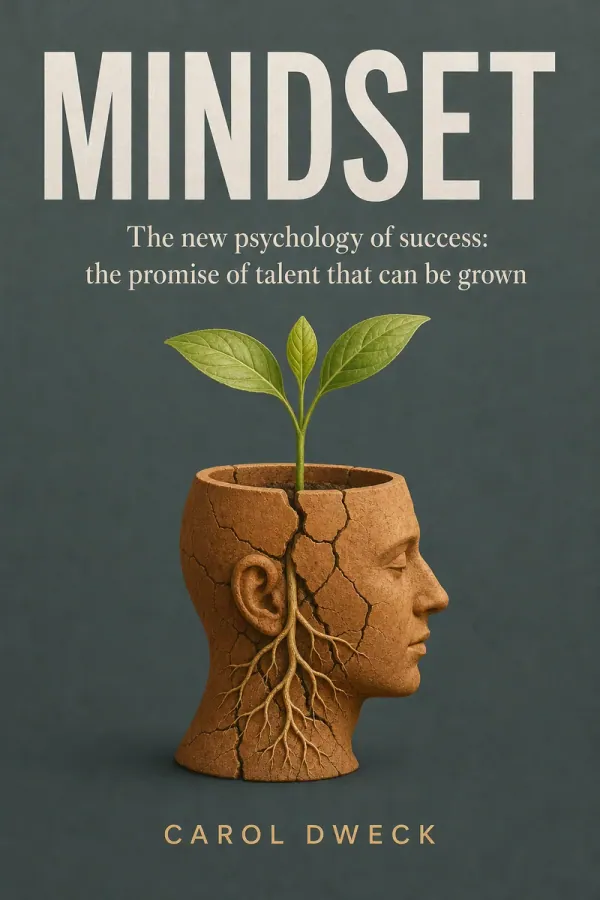
Mindset by Carol Dweck: Summary and Study Notes
The new psychology of success: the promise of talent that can be grown
Study this topic in OriaThe essentials
For the psychologist Carol Dweck, everything hinges on one quiet belief: do you think your abilities are fixed, or that they can develop? Her book Mindset, published in 2006, applies this idea to school, sport, work and love. You'll discover the two mindsets, the famous experiments on praise, Dweck's advice for changing… and what the big recent studies really say about how well these ideas actually work.
Key dates and facts
- 1972
- PhD at Yale on learned helplessness
- 1988
- Founding article on implicit theories
- 2006
- Publication of Mindset
- 2017
- Wins the first Yidan Prize
- 2018
- Two meta-analyses: weak effects
- 2019
- English trial across 101 schools: no effect
- 2019
- National study in Nature: effect among the weakest students
- 2023
- Two competing meta-analyses
🌱 Two ways of seeing talent
Mindset: The New Psychology of Success is a book by the American psychologist Carol Dweck, published in 2006. It starts from a simple question: why do some gifted people thrive, while others, just as capable, freeze at the first obstacle?
🔒 The fixed mindset
According to Dweck, everyone carries a belief, often unconscious, about where their abilities come from. With a fixed mindset, you believe that intelligence, talent or personality are handed to you once and for all: you have a certain amount of it, and that's it. The goal then becomes looking smart and never looking stupid. Every grade, every remark, is experienced as a verdict on your deepest worth. Failure becomes frightening, since it seems to reveal a limit you can never overcome, and effort itself looks suspicious: if you were truly gifted, you wouldn't need to work at it.
📈 The growth mindset
With a growth mindset, by contrast, you believe abilities can be developed through work, good methods, help from others and persistence. Dweck is careful to say this does not mean believing everyone is the same, or that anyone could become Einstein: simply, that everyone can improve. Challenges become opportunities to learn, criticism becomes useful information, and failure becomes a signal to change strategy or practise more.
In scientific papers, Dweck and her colleagues speak of "implicit theories": a person's underlying beliefs about whether their qualities can change. These are also called the "entity theory" (fixed) and the "incremental theory" (growth).
🧭 A belief read through reactions
For Dweck, people don't consciously choose their mindset, but it can be inferred from their behaviour, especially in the face of failure. The two attitudes form a continuum rather than two camps: according to a figure often cited, roughly 40% of people lean toward the fixed view, 40% toward the growth view, and 20% don't clearly fall into either. The book claims these beliefs shape every area of life, and that a growth mindset makes for a less stressful, more successful life. It is this very strong promise that research would later put to the test.
👩🔬 Carol Dweck, the researcher behind the book
Carol Dweck, the author of Mindset, is an American psychologist born on 17 October 1946 in New York. A specialist in motivation, she has taught at Stanford University since 2004. Her popular book sums up more than thirty years of research.
🏫 A classroom seated by IQ
Her interest in the subject dates back to childhood. In Brooklyn, in the 1950s, she earned a spot in a sixth-grade class reserved for high-achieving students. Her teacher seated the children in order of their IQ and gave small responsibilities, such as cleaning the blackboard or carrying the flag, to those with the highest scores. Dweck would later recall growing increasingly afraid of losing her reputation as one of the smartest kids, to the point of avoiding a spelling bee and a French competition.
🎓 From Yale to Stanford
A graduate of Barnard College in 1967, she earned a PhD in psychology from Yale University in 1972, focused on learned helplessness: the state in which people stop trying because they believe themselves incapable. She then taught at the University of Illinois, at Harvard from 1981, again in Illinois, then at Columbia in 1989, before joining Stanford.
One of her earliest experiments, conducted around 1975, involved schoolchildren whom their teachers considered "helpless" in mathematics: after a few failed problems, they could no longer solve even the ones they knew how to do. Dweck taught half of them to attribute their mistakes to a lack of effort rather than a lack of ability. These children learned to persevere and succeed.
💡 From "implicit theories" to a bestseller
In 1985, her collaborator Ellen Leggett put forward the idea that children hold different theories about intelligence. In 1988, Dweck and Leggett published a landmark paper on these implicit theories. In 2006, Mindset translated them into everyday language and turned them into a bestseller. Dweck has received numerous honours, including election to the US National Academy of Sciences in 2012 and, in 2017, the Yidan Prize for Education Research, worth about $3.9 million, of which she was one of the first two laureates. True to her own ideas, she took up the piano as an adult and learned Italian after turning 50.
The rest of the course
This page publishes the first 2 parts. The full course has 8: here is what the next ones cover.
- 🏆 "You're so smart" or "You worked hard"?
The Mueller and Dweck experiment (1998) on praise: praising a child's intelligence rather than their effort makes them more fragile in the face of failure.
- 🎒 At school: "not yet"
Mindset's applications in the classroom: Blackwell's study of middle-schoolers, the brain presented as a muscle, the Brainology program, and the phrase 'not yet'.
- ⚽ On the field and in the office
Mindset's chapters on sport (the myth of 'natural talent') and on business (Enron, leaders, negotiators).
- 💞 In love and friendship
Mindset's chapter on relationships: how mindset shapes the way people handle conflict, partners, shyness and bullying, and what research on implicit theories says about it.
- 🔄 Changing your mindset… for real
How Dweck proposes shifting to a growth mindset, and her 2015 clarification on the 'false growth mindset' and the triggers of the fixed mindset.
- 🔍 What the research says today
The scientific limits of Mindset: difficult replications, large trials with weak or no effects, 2018 and 2023 meta-analyses, debate over conflicts of interest, and criticism of individual-responsibility framing.
Study “Mindset” with flashcards and quizzes
In Oria, you read the full course, then practice on it: flashcards, multiple-choice quizzes, open questions or the Feynman method. Cards and questions then come back in your daily review, paced by spaced repetition.
Study this topic in OriaSources
These notes draw on the sources below. If a point seems doubtful, refer back to them.