Essays & strategy
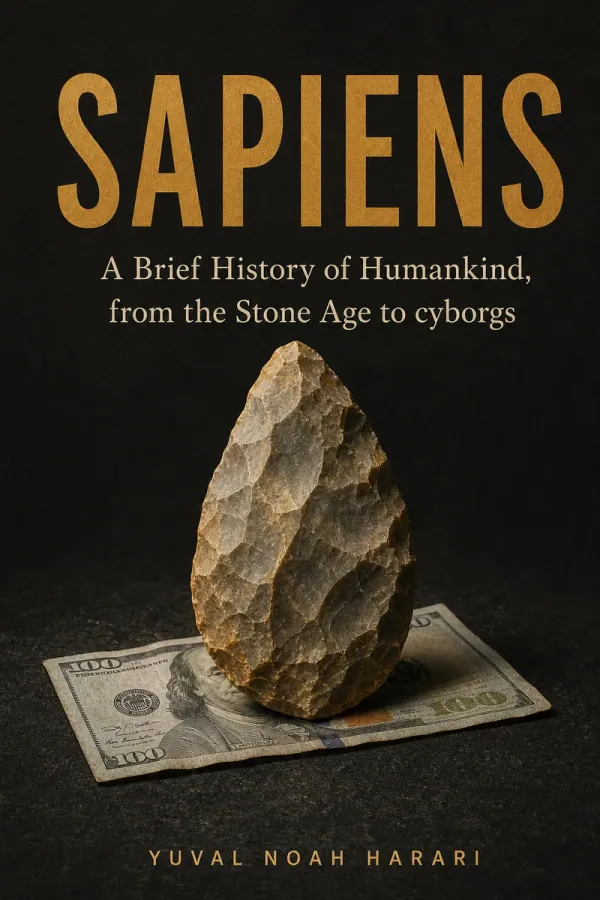
Sapiens by Yuval Noah Harari: Summary and Study Notes
A Brief History of Humankind, from the Stone Age to cyborgs
Study this topic in OriaThe essentials
In Sapiens, Israeli historian Yuval Noah Harari tells the entire history of our species through four revolutions: cognitive, agricultural, unifying, and scientific. His central claim: Homo sapiens dominates the world because it can cooperate in huge numbers around shared fictions, such as gods, nations, or money. You'll discover the book's most striking ideas, why it became a worldwide phenomenon, and why so many historians and scientists call it brilliant but overconfident.
Key dates and facts
- 2011
- Published in Hebrew in Israel
- 2014
- English edition, Sapiens: A Brief History of Humankind
- 2015
- French translation published by Albin Michel
- 2020
- First volume of the graphic-novel adaptation
- 2014
- English release, followed by a free online course taken by more than 100,000 people
- 2015
- Wenjin Prize from the National Library of China
- 2016
- Bill Gates names it one of his ten favorite books
- 2022
- 182 weeks on the New York Times bestseller list
🎓 Harari and the birth of a bestseller
Sapiens: A Brief History of Humankind is the work of Yuval Noah Harari, an Israeli historian born in 1976. Nothing marked him out to write a worldwide bestseller: he started out as a specialist in medieval and military history, the author of scholarly articles on the Crusades, special operations in the age of chivalry, and soldiers' memoirs.
📚 A medievalist with a big picture in mind
Harari studied at the Hebrew University of Jerusalem, then earned a doctorate in 2002 at Oxford University's Jesus College. It was at Oxford that he discovered the work of Jared Diamond, author of Guns, Germs, and Steel. He has said this book was a revelation: it showed him that one could ask very big questions about human history and try to answer them with the tools of science. In the acknowledgments of Sapiens, he thanks Diamond for teaching him to see the big picture.
Back in Israel, he taught world history at the Hebrew University. He inherited this introductory course because no colleague wanted to take it on. His twenty lectures became the material for a book.
📖 From lecture course to book
The book first appeared in Hebrew in 2011, after being turned down by most major Israeli publishers. A first, self-published English translation appeared in 2012 under the title From Animals Into Gods, ahead of the 2014 edition from Harvill Secker in London. The French version, translated by Pierre-Emmanuel Dauzat, was released in September 2015.
🗺️ Four revolutions to tell the story of humankind
The project is dizzying in scope: to tell, in roughly 500 pages, the entire history of our species, from the Stone Age to the twenty-first century, blending biology, anthropology, economics, and philosophy. To do it, Harari divides time into four great revolutions:
- the Cognitive Revolution, about 70,000 years ago, when imagination and language transform Sapiens;
- the Agricultural Revolution, about 10,000 to 12,000 years ago;
- the unification of humankind, a long march toward a single world through money, empires, and religions;
- the Scientific Revolution, which began about 500 years ago and may bring an end to Sapiens itself.
The book's guiding idea can be summed up in one sentence: the natural sciences set the limits of what humans can do, and within those limits it is culture that writes history. Harari does not simply narrate; he judges, provokes, and questions. Has all this progress made us any happier? It is this ambition, and this tone, that would make the book both a success and an easy target.
🗣️ The Cognitive Revolution: the power of fiction
In Sapiens, Yuval Noah Harari opens with a reality check: for most of prehistory, several human species lived on Earth at the same time. Homo erectus, Neanderthals, and other cousins shared the planet with our ancestors. For a very long time, Homo sapiens was just another animal, with no special importance, stuck somewhere in the middle of the food chain.
💡 A shift in the mind
Then, roughly 70,000 years ago, something changed. Harari calls this turning point the Cognitive Revolution: Sapiens began thinking and communicating in an unprecedented way. For the author, this was probably a mutation that rewired the brain, though no one knows exactly why. This new language was not just for pointing out a lion or a water source. It served above all to talk about other people: Harari stresses the role of gossip, which lets you know whom to trust within a group.
But gossip has a limit: you cannot know more than a few dozen people intimately. How, then, did thousands and later millions of strangers manage to cooperate?
🧩 Believing together in things that don't exist
This is the heart of the book. According to Harari, Sapiens is the only animal able to believe in things that exist purely in the collective imagination: gods, nations, money, human rights, corporations, or laws. These imagined realities are not lies: as long as a crowd believes in them, they really do organize everyone's life.
In Harari's terms, any reality that exists only because many people believe in it at the same time: a religion, a nation, a currency, a corporation. It lets strangers cooperate without knowing one another.
Two Catholics who have never met can set off together on a crusade; two lawyers unknown to each other can defend the same client, because they believe in the same laws. For Harari, it is this flexible, large-scale cooperation that explains our species' dominance. He draws a radical conclusion from it: every great system of human cooperation, from religions to trade networks, ultimately rests on shared fictions.
🦣 The ecological serial killer
This new power came at a cost for the rest of the living world. Harari argues that Sapiens played a key role in the disappearance of other human species. He even suggests that the encounter with the Neanderthals may have been history's first great campaign of ethnic cleansing, while cautioning that we don't actually know what happened.
He also describes the arrival of humans in Australia, about 45,000 years ago, as a pivotal event, followed by the extinction of the continent's megafauna. According to him, at the time of the Cognitive Revolution, the planet had around 200 genera of large land mammals weighing over 50 kilograms; by the dawn of agriculture, only about a hundred remained. His conclusion is deliberately uncomfortable: long before industry, our hunter-gatherer ancestors did not live in harmony with nature, and Sapiens holds the grim record of the deadliest species in the history of biology.
The rest of the course
This page publishes the first 2 parts. The full course has 8: here is what the next ones cover.
- 🌾 The Agricultural Revolution, "history's biggest fraud"
Sapiens' most provocative claim: agriculture multiplied human numbers but made most individuals' lives worse, human and animal alike.
- 🪙 Money, empires, religions: the unification of humankind
How, according to Harari, three universal "imagined orders", money, empires, and religions, gradually brought humankind together into a single world.
- 🔭 The Scientific Revolution, or the discovery of ignorance
According to Sapiens, modern science is born when Europeans admit their ignorance, then ally with empires and capitalism to transform the world.
- 😊 Happier than in the Stone Age? And after Sapiens?
The closing chapters of Sapiens: whether progress has made us happier, the suffering of farm animals, and a future in which technology might replace Homo sapiens.
- 🌍 A global publishing phenomenon
The numbers and milestones behind Sapiens' success: sales, translations, awards, celebrity endorsements, and adaptations.
- ⚖️ What historians and scientists hold against it
The main criticisms leveled at Sapiens by philosophers, anthropologists, archaeologists, and neuroscientists: oversimplification, sensationalism, scarce sourcing, and an overly linear narrative.
Study “Sapiens” with flashcards and quizzes
In Oria, you read the full course, then practice on it: flashcards, multiple-choice quizzes, open questions or the Feynman method. Cards and questions then come back in your daily review, paced by spaced repetition.
Study this topic in OriaSources
These notes draw on the sources below. If a point seems doubtful, refer back to them.