Essays & strategy
Walden; or, Life in the Woods by Henry David Thoreau: Summary and Study Notes
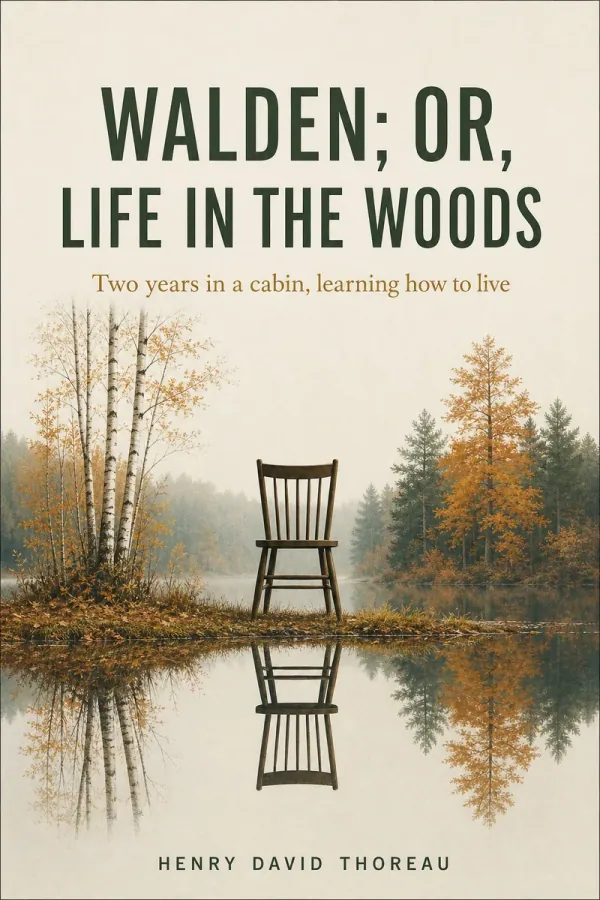
Two years in a cabin, learning how to live
Study this topic in OriaThe essentials
In 1845, Henry David Thoreau moved into a cabin he had built on the shore of Walden Pond, near Concord, Massachusetts. He stayed there two years, two months, and two days, and turned the experience into Walden (1854) — part memoir, part essay, part pamphlet. You'll discover who Thoreau was, how he actually lived by the pond, his critique of the race for money, the night in jail that would later inspire Gandhi and Martin Luther King Jr., the writing of a book that defies easy categories, and its legacy, from environmentalists to readers today.
Key dates and facts
- March 1845
- Construction of the cabin begins
- July 4, 1845
- First night by the pond
- July 1846
- One night in jail for refusing to pay taxes
- Sept. 6, 1847
- Final departure from Walden
- 1849
- A Week on the Concord and Merrimack Rivers , a commercial failure
- August 9, 1854
- Walden published in Boston
- 1856
- George Eliot's praise in the Westminster Review
- May 6, 1862
- Thoreau dies in Concord
🌲 Thoreau before Walden
Henry David Thoreau, the author of Walden; or, Life in the Woods, was born on July 12, 1817, in Concord, a small town in Massachusetts near Boston. He was first named David Henry and would not reverse his names until after his studies. His father made pencils, and the family was of modest means.
🎓 A graduate who turned down the beaten path
From 1833 to 1837, Thoreau studied at Harvard University: rhetoric, ancient languages, philosophy, mathematics, and the sciences. The usual careers open to graduates — law, the church, business, or medicine — held no appeal for him. Hired as a schoolteacher in Concord, he resigned after a few weeks rather than administer corporal punishment. In 1838, he opened a small school with his older brother John, built on new methods, with nature walks and visits to workshops.
✨ Meeting Emerson
Back in Concord, he grew close to the philosopher and poet Ralph Waldo Emerson, fourteen years his senior, who became his friend and mentor. On Emerson's advice, Thoreau began, on October 22, 1837, a journal he would keep for the rest of his life and which would feed his books. Emerson introduced him to a circle of writers and thinkers, had his first pieces published in the magazine The Dial, and took him in from 1841 to 1844, where Thoreau worked as a tutor, handyman, and gardener.
An American philosophical and literary movement of the 1830s and 1840s, led by Emerson. It held that a spiritual truth lies beyond the material world and is reached through personal intuition rather than religious doctrine. Nature was seen there as the visible sign of spirit.
🕯️ Grief and missteps
In 1842, the death of his brother John, carried off by tetanus after cutting himself while shaving, devastated him: John died in his arms. Thoreau worked at the family pencil factory, where he improved the quality of the graphite, but he was still searching for his path. In March 1844, he and a friend accidentally set fire to part of the nearby woods, which earned him a bad reputation in town. According to scholar Michel Granger, the wish to get away from Concord for a while may have played a part in his departure.
Above all, Thoreau wanted time and quiet to write. In 1845, his friend the poet William Ellery Channing gave him a piece of advice that has become famous, telling him to build himself a hut and there begin “the grand process of devouring yourself alive.” At the end of 1844, Emerson had just bought a wooded lot on the shore of Walden Pond. He agreed to let his young friend settle there.
🪓 A cabin by the pond
In the spring of 1845, Henry David Thoreau began building his pine cabin on the shore of Walden Pond, about a mile and a half from his family's home. It measured roughly 10 by 15 feet. He slept there for the first time on the night of July 4, 1845, the anniversary of American independence: a symbolic date for a man proclaiming his own.
“I went to the woods because I wished to live deliberately, to front only the essential facts of life, and see if I could not learn what it had to teach, and not, when I came to die, discover that I had not lived.”
Henry David Thoreau, Walden; or, Life in the Woods (1854)
🧾 A house for $28
To show that one can be housed at little expense, Thoreau includes in the book the exact tally of his materials, remarking how few people seem to know what their own house costs them.
| Material | Cost in dollars |
|---|---|
| Boards (mostly shanty boards) | 8.03½ |
| Refuse shingles for roof and sides | 4.00 |
| Laths | 1.25 |
| Two second-hand windows with glass | 2.43 |
| One thousand old brick | 4.00 |
| Two casks of lime (“That was high.”) | 2.40 |
| Hair (“More than I needed.”) | 0.31 |
| Mantle-tree iron | 0.15 |
| Nails | 3.90 |
| Hinges and screws | 0.14 |
| Latch | 0.10 |
| Chalk | 0.01 |
| Transportation (“I carried a good part on my back.”) | 1.40 |
| Total | 28.12½ |
The furniture was just as spare: a bed, a table, a desk, three chairs, a small mirror, a few utensils, and a lamp. The three chairs each had their purpose, he explains: “one for solitude, two for friendship, three for society.”
🌱 The bean field
To earn a little money, Thoreau farmed about two and a half acres of beans, which he hoed through his summer mornings, along with potatoes, peas, and corn. His crop left him a profit of $8.71½, worked out to the last half-cent. He topped this up with surveying, carpentry, and day labor in the village — “for I have as many trades as fingers,” he joked. The rest of the time, he read, wrote, watched nature, and walked.
🏘️ A hermit who wasn't so isolated
Thoreau gives the impression of a wild, solitary life, but the reality was more nuanced. His cabin stood barely a mile from the village; he walked there almost every day to see friends and catch up on the news. His mother and sisters often brought him cooked meals, and his mother took his dirty laundry home to wash. Friends and curious visitors dropped by. This was, then, neither a runaway's escape nor a hermit's life, but a deliberate experiment in simple living.
Thoreau left the cabin on September 6, 1847, after two years, two months, and two days. He would later explain simply that he left the woods “for as good a reason” as he went there: it seemed to him that he had several more lives to live.
The rest of the course
This page publishes the first 2 parts. The full course has 9: here is what the next ones cover.
- 💰 “Economy”: living as simply as possible
The first and longest chapter of Walden, "Economy": Thoreau's critique of the race for money and comfort, the four essential needs, his praise of simplicity, and the example of John Field.
- 🦉 Sounds, solitude, and the neighbors of the woods
The chapters of Walden devoted to life close to nature: forest sounds, Thoreau's praise of solitude, his visitors, his animal neighbors, the battle of the ants, and the "higher laws."
- 🌊 Sounding the pond through the seasons
Walden Pond at the heart of Thoreau's book: its purity, the measuring of its depth in winter, the map the author drew, the ice harvesters, and the rebirth of spring.
- ⛓️ One night in jail: civil disobedience
Thoreau's arrest in July 1846 for refusing to pay his taxes, his opposition to slavery and the Mexican War, the essay Civil Disobedience, and its influence on Gandhi and Martin Luther King Jr.
- ✍️ A book that defies categories, written and rewritten
The making and style of Walden: seven or eight drafts between 1846 and 1854, a hybrid genre between memoir, essay, and pamphlet, the narrator's many masks, the humor, the allusions, and the birth of nature writing.
- 📖 A mixed reception in Thoreau's lifetime
The publication of Walden in 1854, the first reviews, favorable and mocking, its modest sales, posthumous attacks, and Thoreau's death in 1862.
- 🌍 From obscurity to a world classic
Walden's legacy: its rediscovery in the twentieth century, its translations around the world, its influence on environmentalists, writers, and film, modern critics, and the protection of Walden Pond today.
Study “Walden; or, Life in the Woods” with flashcards and quizzes
In Oria, you read the full course, then practice on it: flashcards, multiple-choice quizzes, open questions or the Feynman method. Cards and questions then come back in your daily review, paced by spaced repetition.
Study this topic in OriaSources
These notes draw on the sources below. If a point seems doubtful, refer back to them.