Essays & strategy
The Art of War by Sun Tzu: Summary and Study Notes
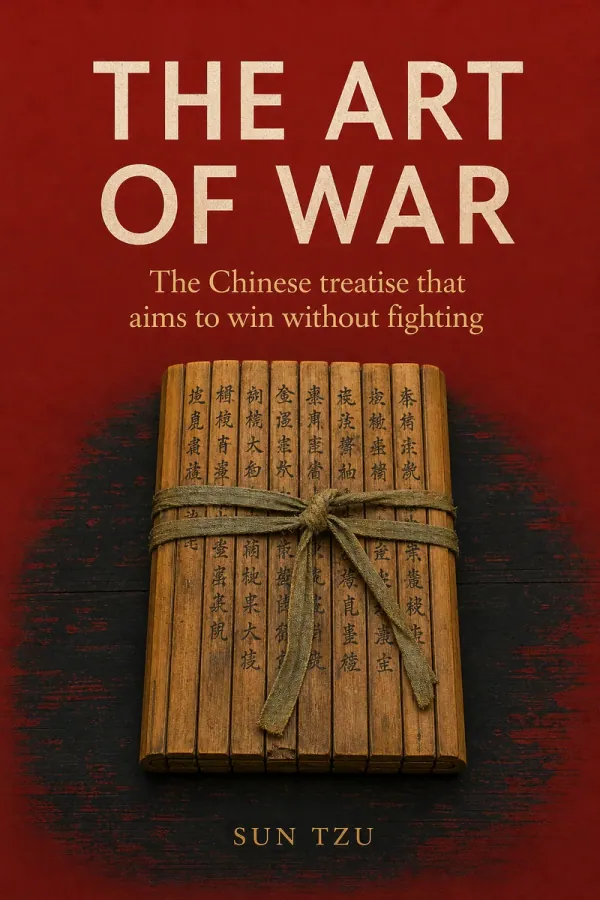
The Chinese treatise that aims to win without fighting
Study this topic in OriaThe essentials
Attributed to Sun Tzu, a strategist whose very existence is still debated, The Art of War was born in a fractured China where states fought one another without pause. In thirteen short chapters, it teaches how to calculate, to outwit, to read the terrain, and to gather intelligence in order to win at the lowest possible cost. You'll see where this text comes from, what it really says, how it traveled to Europe thanks to the Jesuit Amiot in 1772, and why generals, business leaders, and coaches still read it today.
Key dates and facts
- 514 – 495 BC
- Reign of King Helü of Wu
- 506 BC
- Battle of Boju, according to Sima Qian
- 180
- Palace women in the anecdote
- 12th century
- First doubts raised by scholars
- 3rd century
- First commentary, by Cao Cao
- 1772
- Amiot's translation published in Paris
- 1910
- English translation by Lionel Giles
- 1972
- Yinqueshan bamboo slips found
- 1521 – 1573
- Takeda Shingen, a reader of Sun Tzu
- 1949
- Mao's victory in China
🏯 A China torn apart by war
The Art of War, a treatise on strategy attributed to Sun Tzu, was not born in a unified empire. It belongs to a China splintered into rival kingdoms, where war had become the everyday business of princes. To understand why this short book dwells so much on calculation, economy, and cunning, we first need to look at the world that produced it.
👑 From weakened Zhou kings to rival states
During the Spring and Autumn period (771 – 476 BC), the Zhou dynasty still reigned in theory, but its authority had become purely symbolic. The lords who ruled the various states acted as independent sovereigns, forming alliances, betraying one another, and fighting. According to tradition, it was toward the end of this period that Sun Tzu is said to have served the king of Wu, a state in the southeast.
Next came the Warring States period, which stretched from the 5th century BC to 221 BC, the year the state of Qin finished unifying China. Seven great powers dominated this era: Chu, Han, Qi, Qin, Wei, Yan, and Zhao. Their rulers eventually took the title of king themselves, a sign that no one any longer recognized the old overlordship of the Zhou.
⚔️ A war that changed in nature
Over these centuries, warfare was transformed from the ground up. According to the Wikipedia article devoted to the treatise, conflicts multiplied between states and war lost its ritual, codified character. Armies grew from a few thousand men to hundreds of thousands of combatants, equipped with iron weapons and crossbows, and led by professional generals.
In such a world, a poorly prepared campaign could ruin a state: soldiers had to be fed, officers paid, equipment transported, and mobilized peasants no longer worked their fields. Hence the treatise's obsession with the cost of war and with swift victory. The text opens, in fact, with a line that states the stakes without any detour.
"The art of war is of vital importance to the State. It is a matter of life and death, a road either to safety or to ruin."
Sun Tzu, The Art of War, chapter I, translated by Lionel Giles (1910)
📚 The age of the Hundred Schools
This age of violence was also an intellectual golden age. It is known as the time of the Hundred Schools of Thought: Confucianism, Taoism, Legalism, and many other currents all offered their own recipes for good government. Military treatises were part of this ferment. The Art of War brought an original answer to it: the best war is the one you win by thinking more than by striking.
🧙 Sun Tzu, man or legend?
Sun Tzu (or Sun Zi) is not a proper name in the strict sense: it means "Master Sun." Tradition identifies him with a certain Sun Wu, a strategist from the late Spring and Autumn period, to whom The Art of War is attributed. The dates usually given for him, around 544 – 496 BC, belong to tradition rather than certainty.
📖 Sima Qian's account
Almost everything told about Sun Tzu comes from the historian Sima Qian, author of the Records of the Grand Historian (Shiji), written under the Han dynasty, several centuries after the supposed events. According to him, Sun Wu, a native of the state of Qi, presented his treatise to King Helü of Wu, who reigned from 514 to 495 BC. Sima Qian also has him take part in the Battle of Boju, in 506 BC.
The most famous episode is a test. The king asks Sun Tzu to demonstrate his method using 180 palace women, divided into two companies commanded by two of the king's favorite concubines. When the orders are met with laughter instead of obedience, Sun Tzu has the two favorites put to death, despite the king's protests. The other women then obey instantly. Convinced, Helü makes him his general. Modern historians consider this story essentially legendary, but it sums up a central idea of the treatise: an army exists only through discipline.
❓ Historians' doubts
As early as the 12th century, Chinese scholars began to question the story. The Zuo Commentary (Zuo zhuan), which mentions most of the major figures of the period, does not say a single word about Sun Tzu. The name "Sun Wu" appears in no text earlier than Sima Qian, and some scholars see it as a nickname meaning "fugitive warrior." The treatise also contains anachronisms, such as the crossbow, which point instead to the Warring States period.
Several hypotheses coexist: an invented figure, a confusion with Sun Bin, a 4th-century-BC strategist presented as his descendant, or a real Sun Wu whose work was later completed by his successors. The practice of pseudepigraphy, attaching a text to the prestigious name of an ancient figure, was common in ancient China.
🗓️ When was the text written?
The dating remains debated. According to the French Wikipedia article, the style of the text suggests it was composed in the late 5th or early 4th century BC. The English article states that scholars generally place the completion of its oldest parts between 500 and 430 BC. In any case, the book likely postdates the traditional Sun Tzu by at least several decades.
The rest of the course
This page publishes the first 2 parts. The full course has 9: here is what the next ones cover.
- 🗂️ Thirteen chapters, one method
The structure of The Art of War in thirteen chapters, with their English titles, and the logic linking them.
- 🧮 Calculating before fighting (chapters I to IV)
The first four chapters: the five factors of assessment, the cost of war, the ideal of winning without fighting, and the rule of making yourself invincible first.
- 🌊 Cunning, momentum, and movement (chapters V to IX)
Chapters V to IX: energy and surprise, weak points and strong, direct and indirect confrontation, adapting to circumstances, and watching the enemy on the march.
- 🗺️ Terrain, fire, and spies (chapters X to XIII)
The final four chapters: the classification of terrain, the nine situations of a campaign, the five ways of attacking by fire, and the decisive role of spies.
- 📜 From bamboo to Amiot: transmission and translations
How the text survived the centuries: bamboo slips, Cao Cao's commentary, the Seven Military Classics, the 1972 Yinqueshan discovery, then the translations by Amiot (1772), Giles (1910), and others.
- 🌍 From Mao to the stadium: a worldwide influence
The influence of The Art of War in Asia (Japan, Mao's China, Vietnam), in Western armies, and then in management, sport, and popular culture.
- ⚖️ Limits and critical readings
The limits of The Art of War and the debates it raises: an uncertain author, a composite text, the contrast with Clausewitz, the harshness of its logic, and the risks of reading it out of context.
Study “The Art of War” with flashcards and quizzes
In Oria, you read the full course, then practice on it: flashcards, multiple-choice quizzes, open questions or the Feynman method. Cards and questions then come back in your daily review, paced by spaced repetition.
Study this topic in OriaSources
These notes draw on the sources below. If a point seems doubtful, refer back to them.