Personal growth
The 5 Love Languages by Gary Chapman: Summary and Study Notes
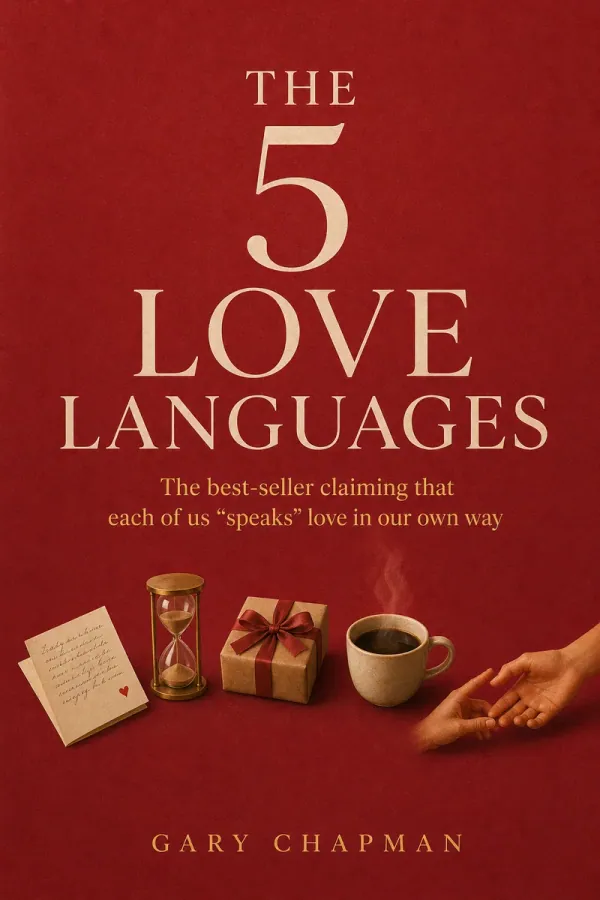
The best-seller claiming that each of us “speaks” love in our own way
Study this topic in OriaThe essentials
Published in 1992 by the American pastor Gary Chapman, The 5 Love Languages has sold more than 20 million copies. Its idea: each of us expresses and receives love mainly through one of five “languages,” and a couple does better when each partner learns the other's. You'll discover the “love tank,” the five languages, how to spot your own, the author, and what psychological research really says about the theory.
Key dates and facts
- 1992
- Published in the United States
- 1997
- First French edition (Farel)
- 2013
- 297 weeks on the New York Times bestseller list
- 2015
- Revised edition: The Secret to Love That Lasts
- 1997
- Version for children
- 2004
- Version for singles
- 2006
- The Five Languages of Apology
- 2011
- Version for the workplace
- 1938
- Born in China Grove (North Carolina)
- 1971
- Joins Calvary Baptist Church
📕 A pastor's book that became a phenomenon
The Five Love Languages is a book by the American Gary Chapman, a Baptist pastor and marriage counselor. It was published in 1992 by Northfield Publishing, an imprint linked to the Christian publisher Moody, with an explicit subtitle: How to Express Heartfelt Commitment to Your Mate. Recent editions carry a catchier subtitle: The Secret to Love That Lasts.
🗣️ An idea born in a counseling office
Chapman started neither from laboratory experiments nor from statistical surveys. He drew on his experience as a pastor who counseled struggling couples. By his own account in interviews, he noticed over the years that people who said they didn't feel loved by their spouse kept voicing the same complaints and requests. He grouped them into five broad categories, which he called “love languages.” The book is therefore first of all a collection of observations from the field, illustrated with many stories of couples he counseled.
📈 A success that grew over the years
The start was modest but encouraging: 8,500 copies in the first year, four times what the publisher had hoped for, then 17,000 the following year and 137,000 two years later. By 2013, the book had spent 297 weeks on the New York Times bestseller list.
Figures vary by source: 11 million copies sold in English by 2018 according to one estimate, more than 20 million according to the publisher, Moody. The book has been translated into about fifty languages. In France, it came out in 1997 from the publisher Farel as Les Langages de l'amour, later retitled Les 5 langages de l'amour, and reportedly sold about 250,000 copies there. The phrase “love language” has since entered popular culture, far beyond the book's readers.
⛽ The “love tank” and the end of being in love
Before presenting his five languages, Gary Chapman, the author of The 5 Love Languages, offers a diagnosis of married life. Why do so many people who are deeply in love at the start end up feeling lonely together? His answer rests on two ideas: being in love is temporary, but the need to be loved remains.
💘 Being in love doesn't last
Chapman distinguishes being in love from loving. The first, the passion of the early days, is in his view almost a matter of instinct: you don't decide it, it happens. During this period, you feel admired, chosen, unique. But the euphoria is short-lived: usually two years or less, according to Chapman. He draws on the work of the American psychologist Dorothy Tennov, who studied romantic infatuation and concluded that romantic obsession lasts about two years on average.
When that wave subsides, the couple comes back down to earth. For Chapman, this is where everything is decided: love must then become a choice, not just an emotion.
🫙 Filling the other's tank
To explain what happens next, Chapman uses an image that has become famous: each of us has an emotional love tank. When our spouse shows us love in a way that touches us, the tank fills up and we feel secure. When they don't, or do so in a way that doesn't speak to us, the tank slowly drains, and we end up no longer feeling loved, even if the other person sincerely loves us.
Gary Chapman's metaphor for the emotional need to be loved. A “full” tank brings a feeling of security; an “empty” tank makes conflicts harsher and the relationship more fragile.
The problem, in his view, therefore doesn't always come from a lack of love, but from a misunderstanding: each partner loves the other in their own “language,” without realizing the other speaks a different one. Like two people who each speak a language foreign to the other, partners give a great deal without managing to understand each other.
“Love is a choice.”
Gary Chapman, The 5 Love Languages (2015 edition)
The rest of the course
This page publishes the first 2 parts. The full course has 8: here is what the next ones cover.
- 🖐️ The five languages
The five ways of expressing love described by Gary Chapman in The 5 Love Languages: words of affirmation, quality time, receiving gifts, acts of service and physical touch, with his examples.
- 🔍 Finding your language and learning your partner's
How, according to Gary Chapman in The 5 Love Languages, to spot your own primary language and your partner's, and why you sometimes have to speak a language that doesn't come naturally to you.
- 🌐 From children to the office: a concept adapted everywhere
The many spin-offs of Gary Chapman's The 5 Love Languages (children, singles, the workplace, apologies) and the place of the phrase “love language” in global popular culture.
- ✍️ Gary Chapman, pastor and marriage counselor
The life of Gary Chapman, author of The 5 Love Languages: born in 1938 in North Carolina, Baptist pastor in Winston-Salem for fifty years, radio host and speaker.
- 🔬 What research says
Scientific studies of Gary Chapman's five love languages: a few favorable results, but a recent review concludes that its three main assumptions are not supported.
- ⚖️ Reception, criticism and limits
Why Gary Chapman's The 5 Love Languages remains so popular despite scientific criticism, what you can take from it and its main limitations.
Study “The 5 Love Languages” with flashcards and quizzes
In Oria, you read the full course, then practice on it: flashcards, multiple-choice quizzes, open questions or the Feynman method. Cards and questions then come back in your daily review, paced by spaced repetition.
Study this topic in OriaSources
These notes draw on the sources below. If a point seems doubtful, refer back to them.