Classic novels
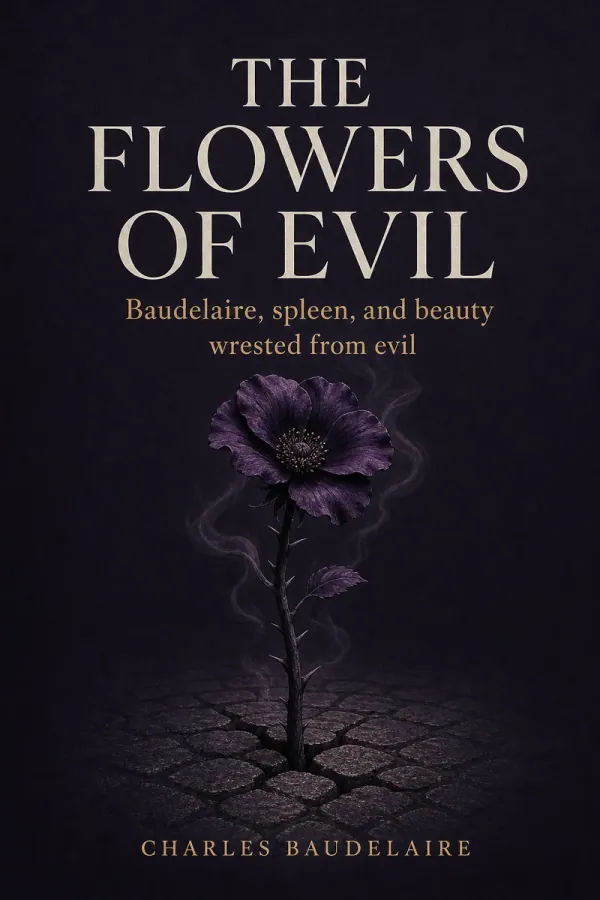
The Flowers of Evil by Charles Baudelaire: Summary and Study Notes
Baudelaire, spleen, and beauty wrested from evil
Study this topic in OriaThe essentials
Published in 1857, The Flowers of Evil earned Charles Baudelaire a trial for offending public morals and the censorship of six poems. Yet the collection has become one of the peaks of French poetry: a book built like a journey, from spleen to death, that seeks beauty even in ugliness and brings the great city into poetry for the first time. You'll discover Baudelaire and his era, the architecture of the collection, the trial and its reversal in 1949, a close reading of “The Albatross,” “Correspondences,” “Spleen,” and “To a Passer-By,” the collection's major themes, and its symbolist legacy.
Key dates and facts
- 1821
- Born in Paris
- 1841
- Forced voyage to the Indian Ocean
- 1844
- Placed under legal guardianship
- 1848
- On the barricades in February
- Jul. 5, 1857
- Hostile article in Le Figaro
- Aug. 1857
- Conviction and six poems removed
- 1866
- The Wrecks published in Belgium
- May 31, 1949
- Conviction overturned by the Court of Cassation
- 1857
- First edition and trial
- 1867
- Baudelaire dies in Paris
🎩 Baudelaire and his era
Charles Baudelaire, the author of The Flowers of Evil, was born in Paris on April 9, 1821. His father, Joseph-François Baudelaire, was a cultivated man, a lover of painting and a painter himself, already in his sixties when his son was born. He died in 1827, when Charles was only five. A year later, his mother, Caroline, remarried an army officer, Jacques Aupick, a future general. The teenager would grow to hate this stepfather, who took away part of the affection of his mother, the only person who ever truly mattered to him.
🎓 A brilliant, rebellious student
A boarder in Lyon and then at the Louis-le-Grand school in Paris, Charles won prizes for Latin verse in the national competition, but was expelled from school in April 1839. He barely passed his baccalaureate and led a bohemian life that worried his family. In June 1841, hoping to settle him down, his stepfather had him put on a ship from Bordeaux to Calcutta. After a storm, the ship stopped at Mauritius and then at Bourbon Island (Réunion); Baudelaire refused to go any further and returned to France in February 1842. Though he hated the journey, it left him with a store of exotic images, colors, and scents that would nourish his entire body of work.
🕴️ The dandy under guardianship
Once of age, he inherited his father's money and squandered half of it in eighteen months on luxury spending. His family had a legal guardian appointed: starting September 21, 1844, the notary Narcisse Ancelle managed his money and paid him a monthly allowance of 200 francs. Baudelaire experienced this guardianship as a lasting humiliation; for the rest of his life he remained in debt and constantly changed addresses to escape his creditors. Back in Paris, he had fallen for Jeanne Duval, a young actress with whom he would have a stormy relationship for nearly twenty years.
🖌️ Art critic, revolutionary, translator
Before becoming known as a poet, Baudelaire made a name for himself as an art critic with his Salons of 1845 and 1846, in which he championed the Romantic painter Eugène Delacroix. In 1848, he took part in the barricades of the February revolution and founded a small republican newspaper, Le Salut public, which lasted only two issues. That same year, he published a translation of Edgar Allan Poe, the American writer he would go on to translate throughout his career. Louis-Napoléon Bonaparte's coup of December 2, 1851, put an end to his political illusions: “December 2 physically depoliticized me,” he wrote in 1852 (translated).
👑 The Second Empire
The Flowers of Evil was published under the Second Empire of Napoleon III, an authoritarian regime that had made the Catholic Church a political ally. It was also the era when Prefect Haussmann tore through old Paris to cut through it with grand boulevards. That same year, 1857, the same prosecutor, Ernest Pinard, pursued both Flaubert over Madame Bovary and Baudelaire over his poems: literature that depicted evil without openly condemning it unsettled those in power.
🌺 A collection built like a journey
The Flowers of Evil gathers nearly all of Charles Baudelaire's verse poetry, written from 1840 until his death in 1867. Most of the pieces date from the 1840s and 1850s. The project changed names several times: in 1845, a collection titled The Lesbians was announced, then, from 1848, Limbo, a title abandoned because another poet had already used it. On June 1, 1855, eighteen poems appeared in the Revue des Deux Mondes under the title “Flowers of Evil,” suggested by the writer Hippolyte Babou. The final title had been found.
🔤 A title in the shape of an oxymoron
The title joins two words that seem to exclude each other: the flower, a symbol of beauty, and evil. It is an oxymoron, and the whole project lies there: drawing beauty out of what is ugly, sad, or guilty. The capital letter often given to “Evil” recalls its religious weight, that of original sin. The collection opens with a preface-poem, To the Reader, and is dedicated to the poet Théophile Gautier, hailed as “the perfect magician of French letters” (translated).
📚 Four editions in eleven years
On February 4, 1857, Baudelaire handed his Alençon publisher, Auguste Poulet-Malassis, a manuscript of one hundred poems, a number he saw as a kind of perfection. The book went on sale in June 1857, printed in 1,300 copies. After the trial, the 1861 edition removed the six condemned pieces but added some thirty new poems and an entirely new section, Parisian Scenes. In 1866, the banned poems appeared in Belgium in The Wrecks. Finally, the posthumous 1868 edition, prepared by the poet's friends Théodore de Banville and Charles Asselineau, contains 151 poems.
🧭 Six stages of a journey
Baudelaire refused to let his book be read as a simple collection of pieces: in an 1861 letter to Alfred de Vigny, he asked that it be recognized “that it is not a mere album, and that it has a beginning and an end” (translated). The six sections do indeed trace a journey.
| Section | What the poet is seeking | Famous poems |
|---|---|---|
| Spleen and Ideal | Diagnosis: the real world causes suffering, the ideal beckons | The Albatross, Correspondences, Hymn to Beauty, Spleen |
| Parisian Scenes (1861) | Escaping boredom by losing oneself in the crowds of Paris | The Swan, The Little Old Women, To a Passer-By |
| Wine | Escaping through intoxication, “artificial paradises” | The Soul of Wine, The Ragpickers' Wine |
| Flowers of Evil | Seeking oblivion in carnal pleasures | Destruction, A Voyage to Cythera |
| Revolt | Rising up against God, invoking Satan | Abel and Cain, The Litanies of Satan |
| Death | Setting off into the unknown, the final journey | The Death of Lovers, The Voyage |
The logic is one of a string of failures. Spleen and Ideal, the longest section (85 poems), sets a pull toward an ideal world against the crushing weight of spleen. The next three sections are attempted escapes: the city, wine, sensual love. All of them disappoint. Then comes Revolt, the shortest section (three poems), followed by Death, which closes with The Voyage, the collection's longest poem, where death becomes a departure “Into the depths of the Unknown, to find something new!” (translated)
The rest of the course
This page publishes the first 2 parts. The full course has 8: here is what the next ones cover.
- ⚖️ The 1857 trial and the banned poems
Baudelaire's conviction for offending public morals, the six banned poems, and his legal rehabilitation by the Court of Cassation in 1949.
- 🕊️ “The Albatross” and “Correspondences”
A close reading of two key poems from Spleen and Ideal: the poet misunderstood like an albatross, and the theory of correspondences between the senses and the beyond.
- 🌧️ “Spleen”: crushing boredom
What Baudelaire means by spleen, the Boredom denounced in To the Reader, and a close reading of the poem “When the low, heavy sky weighs like a lid.”
- 🏙️ “To a Passer-By” and the Parisian Scenes
The modern city enters poetry: a close reading of “To a Passer-By” and an overview of the Parisian Scenes section, added in 1861.
- 🖤 Spleen and Ideal, the beauty of evil, modernity
The collection's major themes: the tension between spleen and the ideal, beauty drawn from evil, death, women, and Baudelaire's own definition of modernity.
- ✨ A new form and an immense legacy
Baudelaire's formal innovations, his contemporaries' reception, and the collection's influence on Verlaine, Rimbaud, Mallarmé, and symbolism.
Study “The Flowers of Evil” with flashcards and quizzes
In Oria, you read the full course, then practice on it: flashcards, multiple-choice quizzes, open questions or the Feynman method. Cards and questions then come back in your daily review, paced by spaced repetition.
Study this topic in OriaSources
These notes draw on the sources below. If a point seems doubtful, refer back to them.