Personal growth
The Monk Who Sold His Ferrari by Robin Sharma: Summary and Study Notes
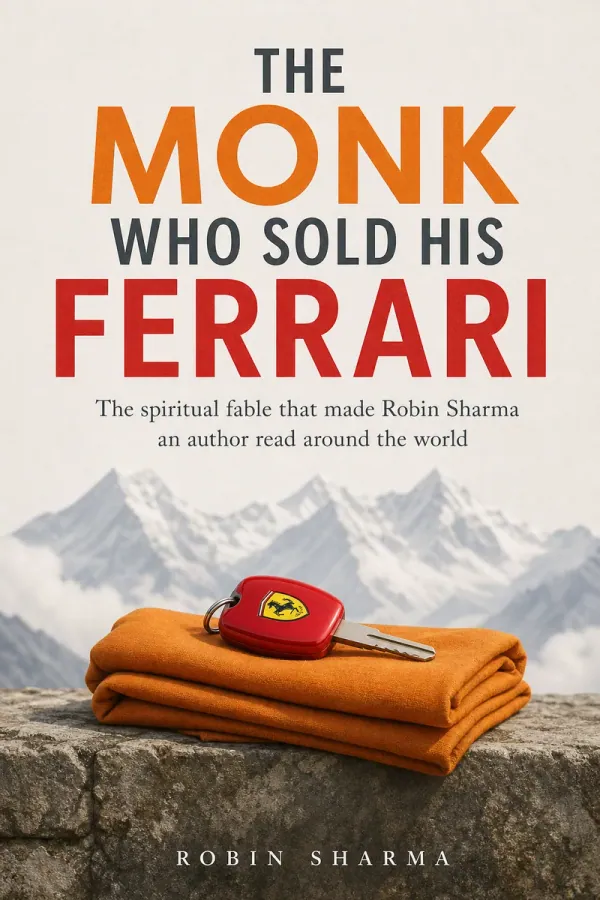
The spiritual fable that made Robin Sharma an author read around the world
Study this topic in OriaThe essentials
Self-published in the mid-1990s by a Canadian lawyer, Robin Sharma's The Monk Who Sold His Ferrari became one of the most widely read self-help books in the world, from North America to India. Told as a fable, it recounts the transformation of Julian Mantle, a star lawyer struck down by a heart attack. You'll discover the story, the fable of the garden and its seven virtues, the author's career, and what critics and researchers say about the limits of this kind of wisdom.
Key dates and facts
- 1994
- First self-published book, MegaLiving!
- 1996
- First edition of The Monk in Toronto
- 1997
- HarperCollins edition in Canada
- 1999
- French translation in Quebec
- 2022
- 25th-anniversary edition in India
- 1994
- MegaLiving! , his first book
- 1999
- Who Will Cry When You Die?
- 2010
- The Leader Who Had No Title
- 2018
- The 5 AM Club
- 2024
- The Wealth Money Can't Buy
📘 A self-published book that became a global best-seller
The Monk Who Sold His Ferrari is a self-help book by the Canadian Robin Sharma. It is neither an essay nor a manual: it is a fable, an invented story meant to pass on life lessons. Its subtitle promises a fable “about fulfilling your dreams and reaching your destiny.”
🖨️ Self-published beginnings
The story of its publication is part of its legend. In 1994, Robin Sharma, then a lawyer, had already self-published a first book, MegaLiving!, about stress and spirituality. He did it again with The Monk: library catalogs list a first edition published in Toronto in 1996 by a small press. According to the account given by the author and the press, his mother edited the manuscript and his family helped sell the first copies, about two thousand, to friends and acquaintances.
The book was then spotted in a bookstore by Ed Carson, at the time president of HarperCollins Canada. According to The Globe and Mail, he bought the rights for $7,500. The HarperCollins edition came out in 1997; when the book reached 10,000 copies sold, the paper reports, Sharma left the law to devote himself to writing. An American edition followed in 1998 from HarperSanFrancisco.
🌍 A success on several continents
Sonia Schindler's French translation came out in 1999 from the publisher Un monde différent, in Quebec, then in paperback from J'ai lu. In India, where the book is published by Jaico in Mumbai, it became a classic; it has even been translated into Dogri, a language of Jammu. In 2022, Jaico published a 25th-anniversary edition.
Sales figures vary by source. According to Wikipedia, more than three million copies had been sold by 2013; the author's official website now speaks of more than 25 million readers and translations into more than 90 languages and dialects, figures supplied by the author himself.
🦉 A “business fable”
The book belongs to the genre of the business fable, which peaked in the early 2000s: Spencer Johnson's Who Moved My Cheese? came out in 1998. The idea is to tell a simple story that appeals to the reader's emotions, rather than lining up arguments as a treatise would.
⚖️ Julian Mantle, the lawyer who collapses in court
The story of The Monk Who Sold His Ferrari, Robin Sharma's fable, has only a few characters. The hero, Julian Mantle, is a trial lawyer at the height of his career, a courtroom star who owns a vacation home and a red Ferrari. Behind this material success, he is exhausted and deeply unhappy.
💥 A brutal wake-up call
One day, in the middle of a trial, Julian collapses on the courtroom floor, struck down by a heart attack. He survives, but the warning drives him to question his whole life. He gives up the law, sells his possessions, including his vacation home and his car, and vanishes. We learn that he has gone to India, then into the Himalayas, in search of another way to live.
🗣️ One long conversation
The narrator is John, a former colleague younger than Julian, who saw him as his mentor. One day, a mysterious visitor turns up at his door: it is Julian, unrecognizable, rejuvenated, radiating calm. The rest of the book takes the form of a dialogue between the two men. Julian describes his meeting with monks living in seclusion in the mountains, then, over a long conversation, passes on to John what he has learned.
The chapter titles of the original edition trace this journey: “The Wake-Up Call,” “The Mysterious Visitor,” “The Miraculous Transformation of Julian Mantle,” the meeting with the sages, then a series of chapters each devoted to one lesson.
🏎️ What the Ferrari stands for
The car in the title is a symbol: of material success and social status. Selling your Ferrari means refusing to measure your life by what you own. The title plays on a deliberately striking contrast: the most brilliant lawyer becomes a “monk.” But the book doesn't ask readers to give everything up. Its aim is to carry the wisdom Julian brings back into an ordinary life, with a job, a family and constraints.
This device, a master who returns to teach a friend, lets Sharma present his advice as answers to John's questions. That is what makes the book easy to read, and also what some critics hold against it: the story serves mainly as a pretext for the lessons.
The rest of the course
This page publishes the first 2 parts. The full course has 9: here is what the next ones cover.
- 🏔️ The Sages of Sivana and the fable of the garden
The heart of Robin Sharma's book: the Sages of Sivana, the master Yogi Raman, and the fable of the garden, a strange image in which each element symbolizes one of the seven virtues of a fulfilling life.
- 🌱 The garden of the mind: mastering your thoughts
The first virtue in The Monk Who Sold His Ferrari: the mind is a garden that must be cultivated, by choosing your thoughts, visualizing your goals and investing in yourself.
- 🗼 The lighthouse and the sumo wrestler: a purpose and kaizen
Two virtues in The Monk Who Sold His Ferrari: the lighthouse symbolizes the life purpose that guides our efforts, the sumo wrestler stands for kaizen, the continuous self-improvement borrowed from Japanese management.
- ⏱️ The pink cable and the stopwatch: discipline and time
Two virtues in The Monk Who Sold His Ferrari: the pink cable, made of thin wires, symbolizes discipline built through small acts, and the gold stopwatch reminds us that time is our most precious resource.
- 🌹 The roses and the path of diamonds: serving and living in the moment
The last two virtues in The Monk Who Sold His Ferrari: the roses symbolize selfless service to others, the path of diamonds the ability to live fully in the present.
- ✍️ Robin Sharma, from lawyer to global speaker
The biography of Robin Sharma, author of The Monk Who Sold His Ferrari: born in Uganda to a family of Indian origin, raised in Canada, a career as a lawyer, then books, speeches and a training company.
- ⚖️ Reception, criticism and limits
The success of The Monk Who Sold His Ferrari and its limits: criticism of the writing and clichés, the paradox between spirituality and material success, a composite vision of the East, and what psychology says about positive thinking.
Study “The Monk Who Sold His Ferrari” with flashcards and quizzes
In Oria, you read the full course, then practice on it: flashcards, multiple-choice quizzes, open questions or the Feynman method. Cards and questions then come back in your daily review, paced by spaced repetition.
Study this topic in OriaSources
These notes draw on the sources below. If a point seems doubtful, refer back to them.