Personal growth
The Power of Now by Eckhart Tolle: Summary and Study Notes
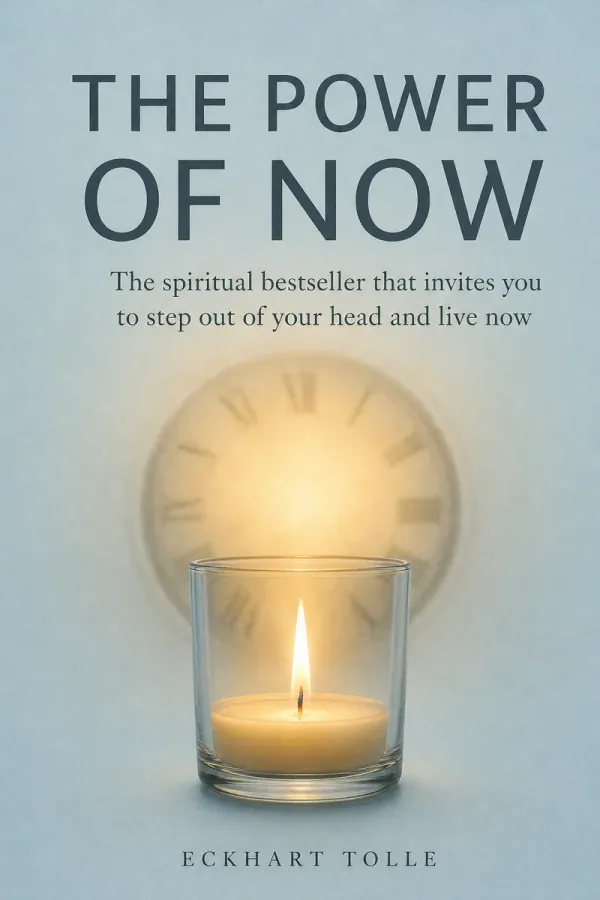
The spiritual bestseller that invites you to step out of your head and live now
Study this topic in OriaThe essentials
Published in 1997, Eckhart Tolle's The Power of Now became one of the most widely read spirituality books in the world, boosted by Oprah Winfrey. Its core idea: our suffering comes from identifying with the mind, and the way out is full attention to the present moment. You'll discover the “voice in the head,” the pain-body, psychological time, the author's startling life story, and what critics and attention research say about its limits.
Key dates and facts
- 1997
- Published by Namaste Publishing in Vancouver
- 1999
- Relaunched by New World Library
- 2000
- Endorsed by Oprah Winfrey; French edition
- 2008
- Translated into 33 languages
- 1948
- Born in Lünen, Germany
- 1977
- “Inner transformation” at age 29
- 1995
- Settles in Vancouver
- 2005
- Publication of A New Earth
📗 A self-published book that became a worldwide phenomenon
The Power of Now: A Guide to Spiritual Enlightenment is the first book by Eckhart Tolle, a German-born author who settled in Canada. Published in 1997, it presents itself as a guide to spiritual enlightenment for everyday life. Its message boils down to one idea: most of our suffering comes from identifying with the mind, and the way out is full attention to the present moment, rather than getting lost in regret over the past or worry about the future.
📦 A very modest start
The book was first published in Vancouver by a small press, Namaste Publishing, with a first print run of only 3,000 copies. Tolle has said he personally dropped off a few copies each week at small bookshops around town, while friends placed others in bookshops further afield. In 1999, the California-based publisher New World Library relaunched it on a much larger scale.
📺 Oprah Winfrey's boost
The turning point came in 2000: talk-show host Oprah Winfrey recommended the book in her magazine, O. In August 2000, it entered the New York Times bestseller list, which it topped two years later. By July 2011, it had spent 102 weeks on the paperback advice list. By 2008, it had already been translated into 33 languages.
Sales figures vary by source: about 3 million copies in North America by 2009 according to the American press, and roughly 16 million worldwide by 2025 according to the English Wikipedia article. Either way, it is one of the best-selling spirituality books of its generation.
📖 Ten chapters, one message
In French, the book appeared in 2000 from Éditions Ariane in Quebec, under the title Le Pouvoir du moment présent : Guide d'éveil spirituel. It has an introduction and ten chapters, ranging from “You Are Not Your Mind” to “The Meaning of Surrender.” The book draws on several spiritual traditions and offers simple exercises for putting its principles into practice. Some of its ideas, such as the ego's negative role in happiness, would be developed further in Tolle's next book, A New Earth (2005).
🧠 You Are Not Your Mind
The first chapter of The Power of Now, Eckhart Tolle's 1997 book, sets out the distinction the whole rest of the book rests on: on one side our thoughts, on the other what we truly are.
🗣️ The voice in the head
Tolle starts from an observation anyone can make: we hear an almost constant “voice in the head,” a stream of involuntary thoughts, commentary, and inner dialogue. In his view, this voice often interprets the present through the lens of the past, because it is the product of our entire history and the thinking habits inherited from our culture. It can even become our own worst enemy: many people, he writes, live with an inner tormentor who attacks them, punishes them, and drains their energy. Tolle sees this as a major source of unhappiness.
👁️ Becoming the observer
His proposal is to stop identifying with this voice. The very fact that we can hear it, he argues, shows that we are not it: there are the thoughts, and there is the presence that notices them. Tolle calls this position the observer (the watcher). He advises listening to one's thoughts with impartiality, without judging them. Observed this way, they lose their grip and settle down; a brief interval of calm opens up between two thoughts, which he calls “no-mind.” At first these intervals last only a few seconds. Tolle claims the same practice works for emotions.
In the book's vocabulary, “mind” refers to compulsive, involuntary thought activity that we identify with, not intelligence in general. Tolle does not reject thinking: he objects to being dominated by it.
🔧 A tool that took over
Tolle insists: this isn't about stopping thinking. He compares the mind to a remarkable instrument when used well, but a destructive one when it uses us instead. Believing we are our mind is, in his view, the fundamental illusion. Enlightenment, as he describes it, means rising above thought, not falling below it: we keep using our intelligence for practical tasks, more focused and effective than before, but without the constant inner chatter.
To practice this, Tolle offers another route besides watching one's thoughts: directing full attention to the moment, for instance by taking any routine daily activity and carrying it out with total awareness. He presents this intense attention to the present as the essence of meditation.
The rest of the course
This page publishes the first 2 parts. The full course has 8: here is what the next ones cover.
- 🌑 The Pain-Body
The second chapter of Tolle's book: the pain-body, an accumulation of past emotional pain, its manifestations, and how to observe it rather than feed it.
- ⏳ Now versus Psychological Time
Chapters 3 and 4 of Tolle's book: only the present is real, psychological time, the mind's strategies for avoiding the moment, and the “leave it, change it, or accept it” rule.
- 🌿 Presence, the Subtle Body, and Surrender
The final chapters of Tolle's book: the inner body (subtle body), practical advice, relationships, life's cycles, peace, and surrender.
- 🪷 A Blend of Spiritual Traditions
The sources behind Tolle's book (Zen, Sufism, Hinduism, Christian mysticism, Krishnamurti, Ramana Maharshi), its claim to be the essence of all religions, and theologians' reactions.
- ✍️ Eckhart Tolle, the Author
Eckhart Tolle's life: born in Germany in 1948, a youth spent in Spain and England, the 1977 “inner transformation,” years of drifting, settling in Vancouver, and the success of A New Earth.
- ⚖️ Reception, Criticism, and Limits
The reception of The Power of Now: famous admirers, press criticism (“spiritual mumbo jumbo,” pseudo-science), French objections, and what research on attention and mindfulness has to say.
Study “The Power of Now” with flashcards and quizzes
In Oria, you read the full course, then practice on it: flashcards, multiple-choice quizzes, open questions or the Feynman method. Cards and questions then come back in your daily review, paced by spaced repetition.
Study this topic in OriaSources
These notes draw on the sources below. If a point seems doubtful, refer back to them.