Personal growth
The Power of Habit by Charles Duhigg: Summary and Study Notes
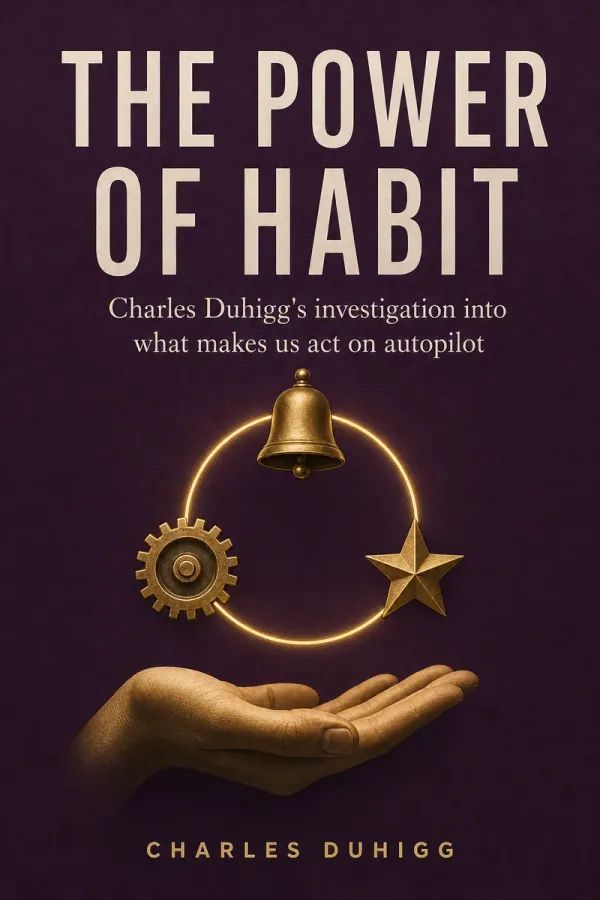
Charles Duhigg's investigation into what makes us act on autopilot
Study this topic in OriaThe essentials
Published in 2012 by Charles Duhigg, a reporter at the New York Times, The Power of Habit popularized the idea of the “habit loop” and has sold more than ten million copies. The book explains how our automatic behaviors form, how to replace them, and how companies and social movements use them. You'll discover the cue-routine-reward loop, the golden rule of habit change, keystone habits, the Target affair, and what psychologists find wrong with this single model.
Key dates and facts
- 2012
- Published by Random House
- 2012
- Longlisted for the Financial Times and McKinsey award
- 2013
- French edition from Éditions Saint-Simon
- 2020
- Launch of a training course based on the book
- 1974
- Born in New Mexico
- 2006
- Joins the New York Times
- 2012
- Publication of The Power of Habit
- 2013
- Pulitzer Prize with the New York Times team
📗 The book that made the habit loop famous
The Power of Habit: Why We Do What We Do in Life and Business is a book by the American journalist Charles Duhigg, then a reporter at the New York Times. Published in February 2012 by Random House, it explores the science of how habits form and change, in individuals, in companies, and in societies.
🧪 Between investigation and popular science
Duhigg is neither a psychologist nor a neurologist, but an investigative journalist. As psychologist Timothy D. Wilson notes in his review for the New York Times, he read hundreds of scientific papers and interviewed many of their authors, then tells their findings, drawn from social psychology, clinical psychology, and neuroscience, through vivid stories. The book follows a three-part structure: the habits of individuals, then of organizations, then of societies. According to the author, close to half of the book deals with collective habits.
A study published in 2002 by psychologist Wendy Wood and her colleagues gives a sense of the stakes: about 43% of our daily behaviors are thought to be carried out by habit.
📈 A slow-building best-seller
A few days before publication, the New York Times Magazine ran an excerpt titled “How Companies Learn Your Secrets,” about the retail chain Target, which caused a stir. The book entered the bestseller lists of the New York Times, Amazon, and USA Today, and stayed there for more than three years according to the author. In 2012, it made the longlist for the Financial Times and McKinsey Business Book of the Year Award. According to Duhigg's website, it has been translated into 40 languages and sold more than 10 million copies.
In France, the book was published in 2013 by Éditions Saint-Simon, translated by Johan-Frédérik Hel Guedj, under the subtitle Changer un rien pour tout changer (“Changing One Thing to Change Everything”). It belongs to a wave of books about habits, including James Clear's Atomic Habits (2018), which explicitly draws on its loop.
🔁 The habit loop
At the center of The Power of Habit, Charles Duhigg describes a pattern said to govern every habit: the habit loop. It has three parts.
- The cue, or trigger, tells the brain to switch into automatic mode and choose which habit to use.
- The routine is the behavior itself, physical, mental, or emotional. This is what people commonly call “the habit.”
- The reward helps the brain determine whether this loop is worth remembering for the future.
🧠 The brain on autopilot
Duhigg draws on neuroscience. When we learn a behavior, like a rat learning to run through a maze or a person learning to back a car out of a driveway, decisions are first made in the brain's thinking regions, the prefrontal cortex. As the behavior becomes automatic, brain activity decreases and an older structure, the basal ganglia, linked to emotions, memory, and pattern recognition, takes over. These observations align with the work of neuroscientist Ann Graybiel at MIT: as a habit forms, certain neurons fire at the start and end of the task and stay almost silent throughout it, as if the brain were chunking the whole sequence into a single block.
The advantage is considerable: freed up, the mind can think about something else. That is how we can drive while listening to the radio, or brush our teeth without remembering where we started. The studies Duhigg cites show that we repeat these gestures the same way as long as the surroundings stay the same, but that on vacation, when the cues change, we alter them without noticing. Hence a piece of advice: a change of scenery is a good time to change a habit, for instance to quit smoking.
🦷 The craving that drives the loop
For Duhigg, what makes a habit powerful is craving: over time, cue and reward become so intertwined that the mere appearance of the cue creates a desire for the reward. He illustrates this with the story of American advertising man Claude C. Hopkins and Pepsodent toothpaste, in the early decades of the twentieth century. Hopkins drew attention to the film that naturally forms on teeth, a cue anyone can feel, and promised a beautiful smile. But according to Duhigg, it is mainly the tingling, fresh sensation after brushing that cements the habit: when you forget to brush your teeth, that tingle is missing.
Another example is Procter & Gamble's fabric spray Febreze. Launched scent-free to eliminate bad odors, it was at first a flop: people who live with bad smells eventually stop noticing them, so the cue disappears. The product took off once the brand added a scent and marketed it as the finishing touch to cleaning, the small reward that closes out an existing routine. According to Duhigg, it now brings in more than a billion dollars a year.
The rest of the course
This page publishes the first 2 parts. The full course has 7: here is what the next ones cover.
- 🔄 The golden rule of habit change
How to change a habit according to Duhigg: keep the cue and the reward, replace the routine; the cookie experiment, Tony Dungy, Alcoholics Anonymous, and the role of belief.
- 🗝️ Keystone habits
The habits that drive others, according to Duhigg: Alcoa and safety under Paul O'Neill, transformed individuals, willpower as a habit at Starbucks.
- 🏢 Habits of companies and societies
The second half of Duhigg's book: organizational habits (hospitals, the King's Cross fire), Target and predicting pregnancies, social movements (Montgomery, Saddleback).
- ✍️ Charles Duhigg, the author
The life of Charles Duhigg: born in 1974 in New Mexico, Yale and Harvard, journalist at the Los Angeles Times then the New York Times, 2013 Pulitzer Prize, later books.
- ⚖️ Reception, criticism, and limits
The reception of The Power of Habit: praise from the press, Timothy D. Wilson's criticism of a single, overly broad model, the real time it takes to form a habit, and the challenge to “ego depletion.”
Study “The Power of Habit” with flashcards and quizzes
In Oria, you read the full course, then practice on it: flashcards, multiple-choice quizzes, open questions or the Feynman method. Cards and questions then come back in your daily review, paced by spaced repetition.
Study this topic in OriaSources
These notes draw on the sources below. If a point seems doubtful, refer back to them.