Business & money
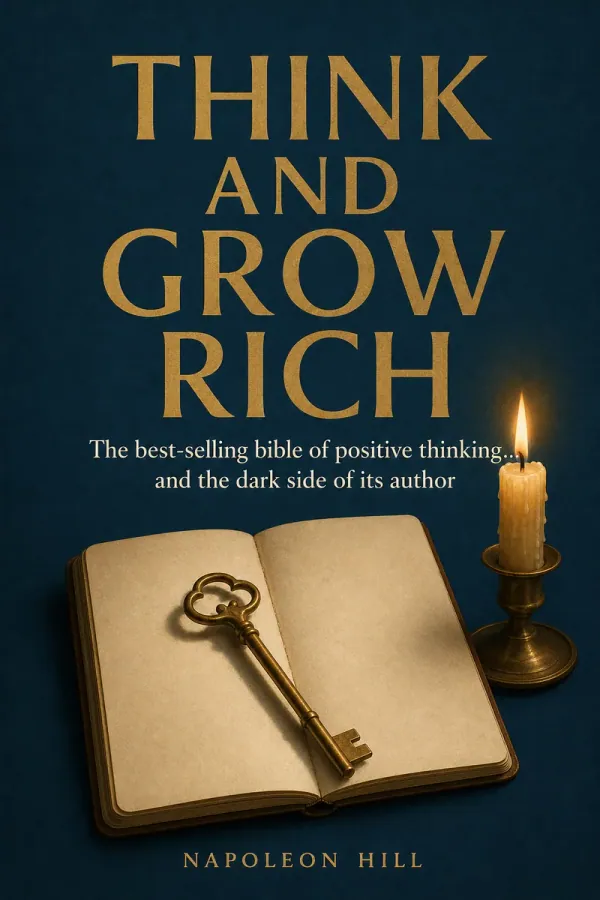
Think and Grow Rich by Napoleon Hill: Summary and Study Notes
The best-selling bible of positive thinking… and the dark side of its author
Study this topic in OriaThe essentials
Published in 1937, Napoleon Hill's Think and Grow Rich is one of the best-selling self-help books in history. It promises that burning desire, faith and autosuggestion turn thoughts into fortune. You will discover its thirteen “steps to riches,” its famous anecdotes and its strangest chapters, then why historians and journalists doubt almost everything Hill tells us: his interviews with Andrew Carnegie, his meetings with top businessmen, and even parts of his own life story.
Key dates and facts
- 1928
- The Law of Success is published in eight volumes
- 1929
- Stock market crash and start of the Great Depression
- 1937
- Think and Grow Rich is published
- 1940
- Hill divorces Rosa Lee Beeland, who keeps the rights
- 1883
- Born in Pound, Virginia
- 1908
- Flees Mobile after fraud accusations
- 1918
- Arrest warrants in Illinois
- 1970
- Dies in Greenville, South Carolina
- 1908
- Meeting with Carnegie, according to Hill
- 1919
- Carnegie dies; Hill only tells the story afterward
📘 A best-seller born of the Great Depression
Think and Grow Rich, by the American writer Napoleon Hill, was published in 1937 by the Ralston Society. It is today a classic of self-help, often listed among the best-selling books of the genre of all time.
🏚️ A book for a ruined country
Timing mattered a great deal. Since the 1929 crash, the United States had been living through the Great Depression: mass unemployment, bankruptcies, vanished savings. Hill addressed this discouraged public directly. In the book, he describes the crisis as a time when fear paralyzed the country, then claims that with President Roosevelt's arrival, that fear gradually turned into faith, like an electrician slowly switching the lights of a theater back on. For him, the Depression marked the death of one era and the birth of another, one that called for “practical dreamers.”
📚 The heir of The Law of Success
The book did not come out of nowhere. It reworks and condenses a huge eight-volume course Hill had published in 1928, The Law of Success, which laid out sixteen “laws.” Think and Grow Rich gathers them into thirteen principles, presented as the successive steps of a “philosophy of achievement.” In the foreword, the publisher claims the book distills the experience of more than 500 self-made millionaires, and that it took twenty-five years of work to write.
📈 Sales figures impossible to verify
The book's commercial success is real, but its scale is murky. Hill's biographers cite 20 million copies sold over fifty years; the Napoleon Hill Foundation claimed 100 million in 2015; the French Wikipedia page cites close to 60 million, and the site Gizmodo about 15 million. Critic Richard Lingeman, writing in The New York Times in 1995, already noted that the best-seller records of the era suggested “considerably” lower figures. One thing is certain: in 2007, seventy years after it first appeared, BusinessWeek magazine still ranked it sixth among the best-selling paperback business books.
So the safest estimate is a wide range, from 15 to 100 million copies depending on the source — which says a great deal about how the book's legend was built, much like that of its author.
🧔 Napoleon Hill, a troubled career
Oliver Napoleon Hill was born on October 26, 1883, in a one-room cabin near Pound, Virginia, deep in the Appalachian Mountains. His mother died when he was nine; his stepmother made sure he went to school. By thirteen, he was already writing as a “mountain reporter” for small local newspapers.
💼 A string of shady ventures
His adult life became a series of businesses that ended badly. In 1907, he co-founded a lumber company in Mobile, Alabama. By 1908, newspapers reported it was facing bankruptcy and suspected of fraud: it bought lumber on credit and resold it cheap without paying its suppliers. According to journalist Matt Novak's investigation (Gizmodo, 2016), Hill left Mobile in September 1908 as arrest warrants were being issued against him. He moved to Washington, dropped his first name and started calling himself Napoleon Hill.
Next came the “Automobile College of Washington” (1909-1912), where students assembled cars without pay for a manufacturer that went bankrupt, then the George Washington Institute in Chicago (1915-1918). In June 1918, Illinois issued two arrest warrants against him for selling shares in this school, valued at $100,000, while his own assets were worth about $1,200. In the 1920s, he launched magazines and a correspondence school for prison inmates, which local newspapers also denounced as a scam in 1923.
🎢 Fortune, ruin and fortune again
In 1928, The Law of Success finally brought him real wealth: he bought a Rolls-Royce and a large estate in the Catskills. The 1929 crash swept it all away, and the estate was seized before the year was out. The following years were filled with short-lived projects, including a film produced with investors who later accused him of fraud.
In 1936, at a conference in Knoxville, he met Rosa Lee Beeland, 29; he was 53. They got engaged within 48 hours. Penniless, the couple moved in with Blair, Hill's son, who lent them money to write the book. According to sources gathered by Wikipedia, Rosa Lee contributed significantly to writing and editing Think and Grow Rich, and the book's copyright was placed in her name. When they divorced around 1940, she kept most of the book's income.
🌅 The final years
Hill remarried in 1943, to Annie Lou Norman, resumed lecturing, briefly hosted a radio show in Los Angeles, then sold success courses with businessman W. Clement Stone, with whom he co-wrote Success Through a Positive Mental Attitude in 1960. He founded the Napoleon Hill Foundation in 1963 and died on November 8, 1970, in Greenville, South Carolina, at age 87.
The rest of the course
This page publishes the first 2 parts. The full course has 8: here is what the next ones cover.
- 🔥 It all starts with a burning desire
The starting thesis of Think and Grow Rich: thoughts are things, burning desire is the first step, illustrated by Edwin C. Barnes and Edison, the six steps to riches, and the story of “three feet from gold.”
- 🧠 Faith, autosuggestion and the subconscious
The “mental” steps of Think and Grow Rich: faith, autosuggestion, the subconscious mind, and the brain presented as a broadcasting and receiving station for thought.
- 🤝 Knowledge, planning, decision and the “Master Mind”
The practical steps of Think and Grow Rich: specialized knowledge, imagination, planning, decision versus procrastination, persistence, and the “Master Mind” principle.
- 🔮 Sex energy, the sixth sense and the ghosts of fear
The strangest chapters of Think and Grow Rich: the transmutation of sex energy, the sixth sense and the “invisible counselors,” then the six basic fears.
- 🕵️ Carnegie, Edison, Wilson: meetings that cannot be verified
The doubts surrounding Napoleon Hill's claims in Think and Grow Rich: the 1908 meeting with Andrew Carnegie, the interviews with top businessmen, and the claimed ties to presidents Wilson and Roosevelt.
- ⚖️ Legacy and criticism: from positive thinking to “The Secret”
The influence of Think and Grow Rich on self-help and the law of attraction, and what psychology research says about its methods: visualization, positive thinking, and attitudes toward risk.
Study “Think and Grow Rich” with flashcards and quizzes
In Oria, you read the full course, then practice on it: flashcards, multiple-choice quizzes, open questions or the Feynman method. Cards and questions then come back in your daily review, paced by spaced repetition.
Study this topic in OriaSources
These notes draw on the sources below. If a point seems doubtful, refer back to them.