Classic novels
The Old Man and the Sea by Ernest Hemingway: Summary and Study Notes
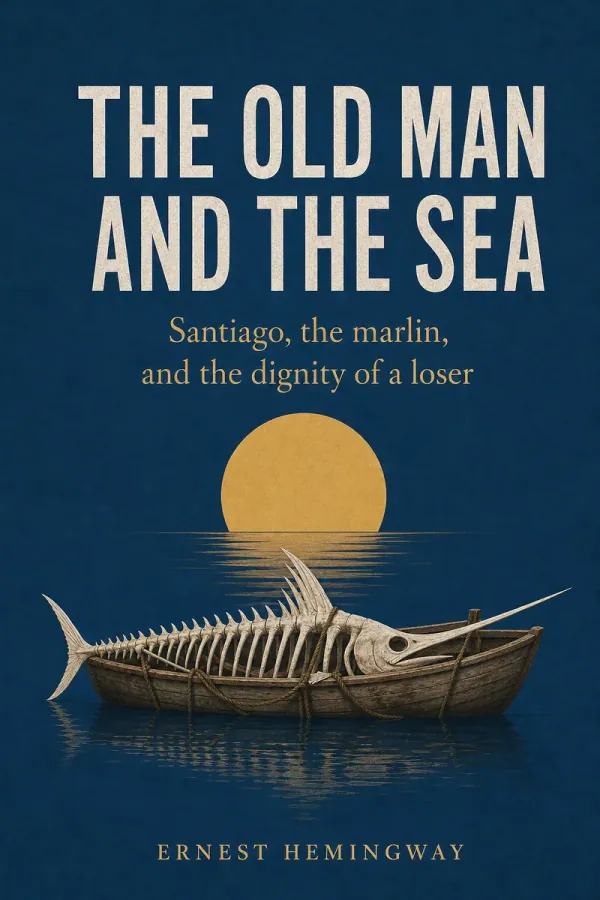
Santiago, the marlin, and the dignity of a loser
Study this topic in OriaThe essentials
Published in 1952, The Old Man and the Sea tells of the struggle of Santiago, a Cuban fisherman who has caught nothing for eighty-four days, against a gigantic marlin off the Cuban coast. This short story, written in a few weeks, earned Ernest Hemingway the Pulitzer Prize and weighed heavily in his Nobel Prize. You'll discover its genesis, the author's adventurous life, the story day by day, its symbols, the debate over the real-life model for the old man, and how critics have judged it.
Key dates and facts
- 1936
- First sketch in Esquire
- Dec. 1950
- Writing begins in Cuba
- Sept. 1, 1952
- Full publication in Life
- Sept. 8, 1952
- Hardcover edition from Scribner
- 1899
- Born in Oak Park
- 1918
- Wounded on the Italian front
- 1954
- Nobel Prize in Literature
- 1961
- Dies in Ketchum
- 1953
- Pulitzer Prize for fiction
- 1958
- Film with Spencer Tracy
🖋️ A story written in one burst in Cuba
The Old Man and the Sea is a short novel by the American writer Ernest Hemingway, telling of an old Cuban fisherman's struggle against a giant fish. It is the last major work of fiction published in his lifetime, and his most famous.
📉 A writer in trouble
By late 1950, Hemingway was going through a turbulent period. His previous novel, Across the River and into the Trees, had received very negative reviews. His marriage to his fourth wife, Mary Welsh, was strained, and he had fallen for a young Italian woman, Adriana Ivancich, who spent the winter of 1950-1951 with them at the Finca Vigía, his property near Havana. Suddenly able to write again, he finished a first book of a planned "sea trilogy," then began another story.
🎣 A story heard fifteen years earlier
The idea went back a long way. In the mid-1930s, a Cuban guide, Carlos Gutiérrez, had told him the story of an old man and a giant marlin. Hemingway had summarized it in a paragraph in an article for Esquire magazine published in April 1936, "On the Blue Water." According to researcher Mary Cruz, this story had already been circulating among Cuban fishermen for decades. Above all, Hemingway knew the Gulf Stream intimately, having spent thousands of hours there fishing for big game aboard his own boat, the Pilar.
⏱️ Six to eight weeks of writing
Between December 1950 and February 1951, he wrote up to a thousand words a day, twice his usual pace. The manuscript, about 26,500 words long, was essentially finished by mid-February, in six to eight weeks depending on the source. Mary read each day's pages every evening. Hemingway, struck by the quality of this seemingly so simple story, sent it to a few close contacts, including his editor Charles Scribner, who responded with enthusiasm.
📰 Five million copies in two days
He had first planned to make it one episode of his big book on the sea, then decided to publish it on its own. The book is dedicated to Charles Scribner and to his former editor Maxwell Perkins. Life magazine published the complete text in its issue of September 1, 1952: it sold a record 5.3 million copies in two days. The Scribner hardcover edition came out on September 8, stayed six months on The New York Times bestseller list, and was translated into nine languages by early 1953. Jean Dutourd's French translation was published by Gallimard that same year, 1952.
🥊 Hemingway, a life of adventure and short sentences
Ernest Hemingway was born on July 21, 1899, in Oak Park, an affluent suburb of Chicago, Illinois. His father, a doctor, taught him to hunt and fish during summers spent in the forests and lakes of northern Michigan: he kept a lifelong passion for nature and the outdoors. After high school, he spent six months as a reporter for the Kansas City Star, whose style guide called for short sentences and vigorous English. This would become the foundation of his prose.
🚑 War, then Paris
In 1918, having joined the Red Cross, he drove ambulances on the Italian front and was severely wounded by shrapnel. In 1921, he settled in Paris as a correspondent for the Toronto Star and mixed with the expatriate American writers and artists of the "Lost Generation." His first novel, The Sun Also Rises, was published in 1926; A Farewell to Arms, drawing on his wartime experience, in 1929. By then he was living in Key West, Florida.
🌍 Always where it's happening
In 1937, he covered the Spanish Civil War, which inspired For Whom the Bell Tolls (1940). Starting in 1939, he lived in Cuba, at the Finca Vigía. During the Second World War, he followed, as a journalist, the Normandy landings and the liberation of Paris. Married four times, a heavy drinker, a boxer, a big-game hunter, and a marlin fisherman, he built a public image as an adventurer that became almost as much a part of his legend as his books.
🧊 The iceberg theory
Hemingway's principle of writing, also called the "theory of omission": the writer shows only the visible part of events, in simple sentences, and leaves beneath the surface the emotions, structure, and symbols, which the reader senses without being told.
This stripped-down style, built of dialogue and silences, influenced generations of writers.
✈️ The Nobel and the end
In January 1954, during a safari in Africa, he survived two consecutive plane crashes that left him badly injured and diminished for the rest of his life. In October 1954, he received the Nobel Prize in Literature, but, still recovering, did not travel to Stockholm. He left Cuba for the last time in July 1960. Suffering from severe depression and hospitalized several times, he took his own life on July 2, 1961, at his home in Ketchum, Idaho.
The rest of the course
This page publishes the first 2 parts. The full course has 9: here is what the next ones cover.
- 🎣 Eighty-four days without a fish
The story's opening: Santiago, an old Cuban fisherman deemed unlucky, his friendship with young Manolin, their conversations about baseball, and the decision to go far out to sea.
- 🐟 Three days holding the marlin
The heart of the story: on the eighty-fifth day, Santiago hooks a gigantic marlin that drags him out to sea; for nearly three days, he holds the line, exhausted and injured, until he kills the fish he has come to respect.
- 🦈 The return: the sharks
The journey back to port: drawn by the blood, sharks attack the marlin lashed to the skiff; Santiago fights them off to the point of exhaustion but reaches port with only a skeleton.
- 🦁 The boy and the lions
The ending: in the morning, the village discovers the giant skeleton, Manolin cries at the sight of the old man's hands and promises to fish with him again; Santiago falls back asleep and dreams of lions.
- ⚓ Dignity, nature, and Christian symbols
The book's major themes and readings: dignity in defeat, kinship with nature, the many Christian symbols around Santiago, and Hemingway's own position, which rejected forced symbolism.
- 🧭 Who was the real old man?
The debate over Santiago's model: Hemingway claimed he was invented, biographers have often pointed to his captain Gregorio Fuentes, and other leads point to the guide Carlos Gutiérrez and the fishermen of Cojímar.
- 🏆 Pulitzer, Nobel, and debates
Reception: a triumphant welcome in 1952, the Pulitzer Prize in 1953 and the Nobel in 1954, then a harsher critical return, film adaptations, and French translations.
Study “The Old Man and the Sea” with flashcards and quizzes
In Oria, you read the full course, then practice on it: flashcards, multiple-choice quizzes, open questions or the Feynman method. Cards and questions then come back in your daily review, paced by spaced repetition.
Study this topic in OriaSources
These notes draw on the sources below. If a point seems doubtful, refer back to them.